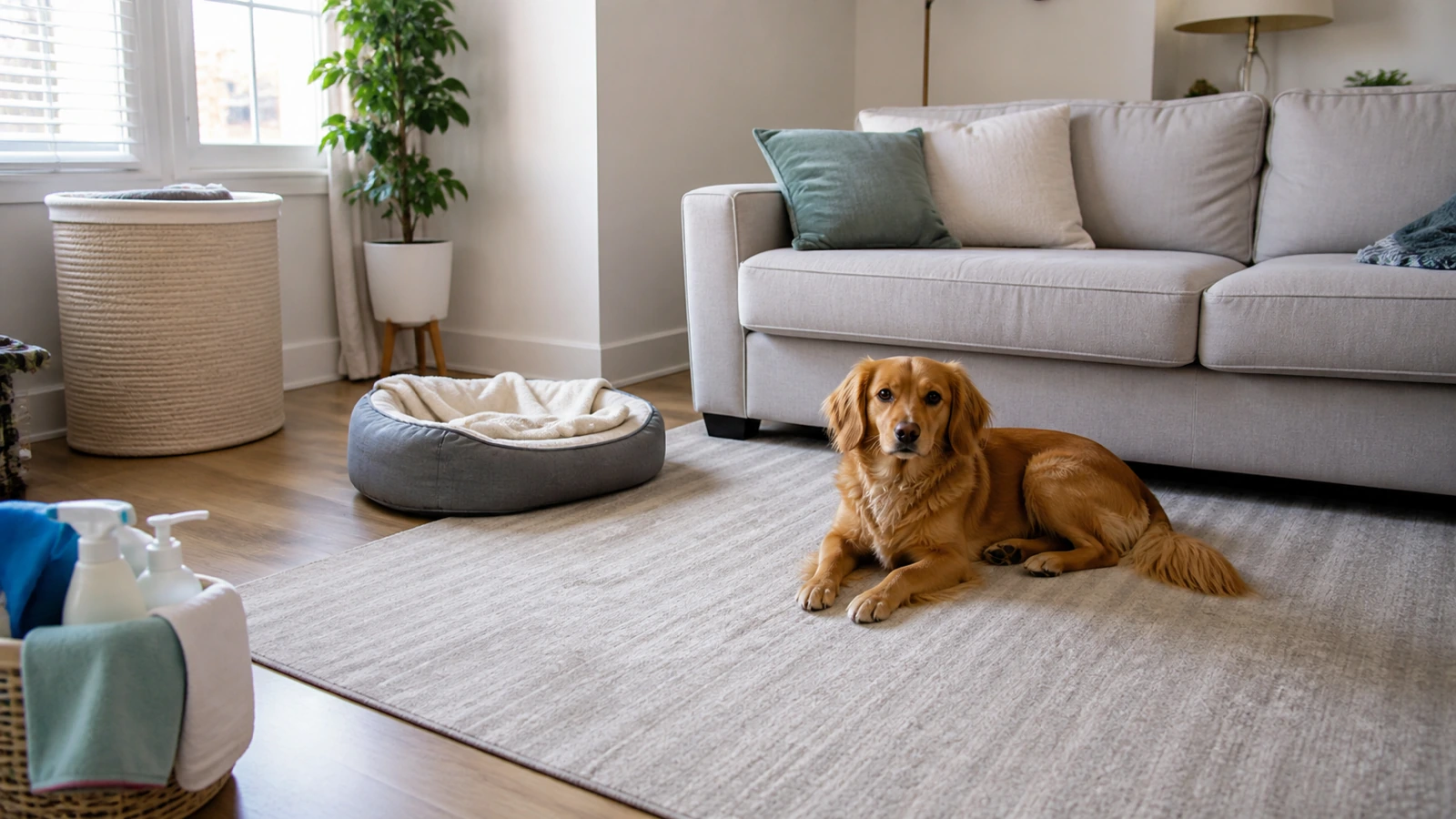
If you are wondering why pet odor keeps coming back after cleaning, do not assume the whole apartment needs another deep clean. The attempt may have reached the wrong source, improved only the surface, left material damp, or allowed a textile, tool, or pet zone to put odor back.
The useful question is, “What does the result of the cleaning attempt tell me?” A smell that never changed differs from one that returned when fragrance faded. One carpet edge also calls for a different next step from several rooms changing with building airflow.
Use this order:
SAFETY TRIAGE → FOLLOW CARE INSTRUCTIONS AND DRY FULLY → LOCAL OR ROOM-WIDE → NEVER LEFT OR RETURNED → SURFACE OR DEEP → TRANSFER, TOOL, OR RECURRENCE → AIRFLOW BOUNDARY → CORRECT HANDOFF
This is a diagnosis sequence, not permission to apply more product. Do not mix cleaners. Follow the cleaner label and material instructions for compatibility, contact time, rinsing, ventilation, drying, and pet re-entry.
Stop Before Treating an Odor as a Pet-Cleaning Problem
Leave ordinary odor troubleshooting when the smell or surrounding evidence suggests a more urgent hazard.
- If you suspect natural gas or fuel gas, leave immediately. Do not operate lights, appliances, phones, or anything that could spark nearby. Call 911 or the gas utility from a safe location and return only when authorities approve. See Con Edison’s gas-safety guidance.
- For smoke, sparking, melting, unusual heat, or a burning electrical odor, stop using the equipment, leave if fire may be developing, and contact emergency services or a qualified professional as appropriate.
- Sewage, unknown chemical odor, or irritation after mixed cleaners is not routine deodorizing. Leave the exposure and contact emergency services or Poison Control as appropriate. Keep product containers for responders.
- Visible mold-like growth, a continuing leak, or persistently wet material needs property or moisture investigation. Odor alone cannot identify mold.
- A new, strong odor coming from the pet—especially with pain, discharge, itching, wounds, vomiting, diarrhea, or major urination or stool changes—belongs with a veterinarian. Do not repeatedly bathe the pet or deodorize the room in place of medical assessment.
If none of those boundaries applies, continue with the cleaning-failure sequence.
Quick Answer
First, wait for the dry condition required by the care instructions. Damp material can smell different, and moisture can make old odor more noticeable. No universal sofa, carpet, or pet-bed drying time exists; construction, method, indoor conditions, and liquid recovery matter.
Next, decide whether odor is local or room-wide, then whether it never left or returned. The same dry seam, cushion, or carpet edge makes adjacent or deeper material more plausible. A room-wide return after laundry, vacuuming, HVAC, or pet use suggests transfer, tools, recurrence, or airflow.
Re-clean only when you can name the source, confirm compatibility, and explain what will change. Otherwise, more moisture or chemistry may obscure the diagnosis.
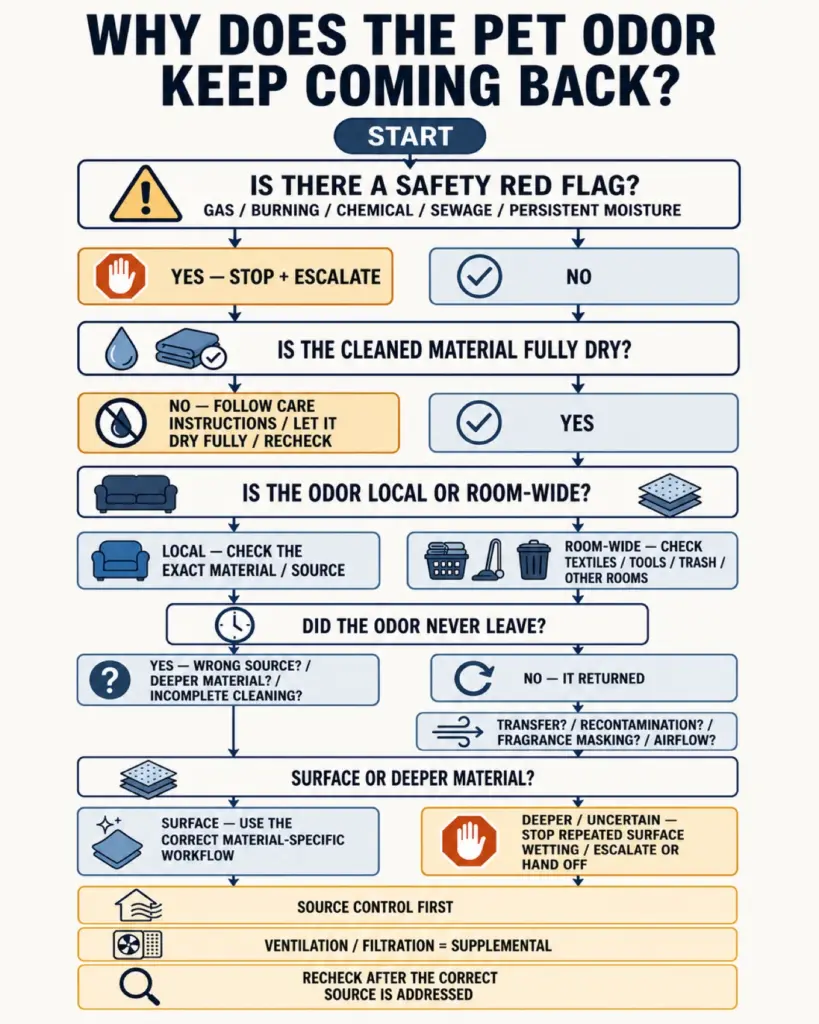
Table of Contents
| Smell Pattern or Symptom | Plausible Failure Mode | Next Check | Best Handoff |
|---|---|---|---|
| Odor did not change at all | Wrong object, wrong room, or method did not reach the source | Compare the cleaned zone with nearby textiles, edges, waste, and pet-use zones after everything is dry | Use the apartment pet-odor source guide if the source is still unclear |
| Odor improved while scented product was noticeable, then returned | Fragrance may have masked rather than removed the source | Recheck after added fragrance has cleared; do not add another scent | Return to source identification, not a stronger fragrance |
| One dry carpet spot or edge still smells | Residue may remain in fibers, backing, padding, seam, or a nearby surface | Compare the center, perimeter, transition, baseboard edge, and underside without adding more liquid | Use the cat urine carpet guide when the source is known cat urine |
| Odor improves after surface cleaning but returns at the same exact carpet zone | A deeper or inaccessible layer becomes more plausible | Review accident history, material construction, treatment reach, and whether the padding or subfloor may be involved | Use the carpet-padding decision guide |
| One couch cushion smells when compressed or moved | Odor may be in a cover, seam, batting, foam, deck, or nearby throw | Separate removable items and compare each only within its care limits | Use the couch odor workflow |
| Odor appears during or after vacuuming, mopping, or extraction | Tool, tank, hose, cloth, bag, bin, or moved waste may be a secondary source | Smell-check and inspect the waste path after powering equipment off safely | Follow the exact equipment-care instructions before reuse |
| Odor returns after the pet uses the zone | Moisture, hair, saliva, debris, waste, or a new accident may have re-entered | Check what changed after the cleaned area was reset | Control the recurring zone before repeating the same cleaning |
| Odor appears in several rooms or when doors, fans, or HVAC conditions change | Another room, hallway, adjacent unit, or building airflow may contribute | Compare conditions with doors, local exhaust, and equipment operating normally; document the pattern | Contact property management if the source is outside tenant control |
Why Pet Odor Keeps Coming Back After Cleaning
Cleaning can succeed at one task and fail at another. A carpet pass may remove visible soil but not reach a lower layer. Washing a sofa cover does not change its insert or throw. Mopping does not reset the mop head, feeding mat, or trash.
Read location, timing, material condition, and the event that makes odor noticeable again as clues—not proof of a contaminant, microorganism, or medical cause. Change one branch at a time: dry the material, remove waste, reset tools, compare zones, then observe pet use or airflow. Changing everything at once can improve the room without identifying what remained.
Let the Material Dry Before You Judge the Result
Do not make a final odor decision while carpet, upholstery, foam, bedding, grout, a mop head, or an extractor component is still damp. Wetting can temporarily change how odor moves from a material, and the cleaning solution may have its own smell. A surface that feels dry at the top can also have a wetter backing, pad, insert, seam, or underside.
The dry-state checkpoint comes from the exact material and method. Read its care instructions, cleaner label, and equipment manual. Consider applied and recovered liquid, whether cushions were separated, whether both sides of a mat were exposed, and whether air can reach the area. Do not use unapproved heat or cover a damp insert.
EPA guidance says that wet or damp building materials should be dried promptly and notes a 24–48-hour mold-prevention boundary in that building-moisture context. It also says carpet backing and padding must be dried along with the carpet. That guidance is important when there is a leak or persistent moisture, but it is not a promise that every household-cleaning job will be fully dry at a fixed hour. A dense cushion, saturated pad, folded textile, and lightly damp hard surface do not share one clock. See the EPA guidance on finding mold and moisture for the actual scope.
If a material is not progressing toward a normal dry condition, if dampness returns without new cleaning, or if a leak is involved, stop treating the situation as ordinary pet odor. Renters may need to document the wet area and notify property management. Repeatedly adding cleaner to a material that cannot dry is the wrong diagnostic move.
Is the Odor Local or Room-Wide?
A local odor stays strongest at one identifiable zone: a couch cushion, carpet edge, seam, pet bed, litter area, rug underside, feeding mat, or entry towel. After the material is dry, compare the center with its perimeter and adjacent objects. Do not press your face against an unknown contaminated surface; use normal observation and handle items according to their care and hygiene limits.
Local concentration helps define the next inspection. A carpet edge may direct attention to backing, padding, a transition strip, or the baseboard area. A single cushion may separate a cover problem from batting or foam. A pet bed may point to its removable cover, insert, liner, floor contact, or the blanket placed on top.
A room-wide or multi-zone odor appears across textiles, near laundry, around tools or trash, in another room, or under changing airflow. It does not mean every surface needs re-cleaning. Several small sources—or one hamper, wet tank, or airflow path—can affect a compact apartment.
If you genuinely cannot locate the source after the dry-state check, step back to the general pet-odor source guide. This article begins after a cleaning attempt; it should not encourage you to keep treating random surfaces when the original source remains unknown.
Did the Odor Never Leave, or Did It Return?
The Odor Never Really Left
If the odor remained at roughly the same location and intensity, consider whether the wrong source was cleaned. The visible mark may not have represented the full affected area, or the nearby pet bed, rug, baseboard edge, trash, litter zone, or furniture could have been the stronger source.
Incomplete reach is another possibility. A surface wipe cannot reach cushion foam, carpet padding, grout depth, or a subfloor. A process may also miss a label-required contact, rinse, extraction, or drying step. Compare the product’s intended job with the material and layer; do not simply use more.
Finally, the material may still be wet or may be too porous, damaged, or inaccessible for normal surface DIY treatment. If the dry-state result cannot be established, do not classify the cleaning as a success or failure yet.
The Odor Disappeared and Then Returned
Timing becomes especially useful here. If the change tracks the fade of a scented spray or detergent, fragrance masking is plausible. If the odor becomes noticeable with fresh moisture or humid conditions at the same carpet zone, remaining material involvement becomes more plausible. The Carpet and Rug Institute notes that some odor products may simply mask pet-urine odor and that odor may reappear during high humidity when urine has not been completely removed. That supports a careful recheck, not certainty about what layer is affected. See the CRI pet urine and carpet technical bulletin.
Odor following returned laundry, a sofa throw, or a stored tool points toward transfer. Odor following pet use suggests recurrence; odor following fans, exhaust, doors, or HVAC suggests checking airflow after local sources.
Surface Improvement vs Deeper Material
Many apartment materials are assemblies rather than single surfaces. Carpet includes face fibers and backing, often over a separate pad and subfloor. Upholstery may include a cover, seams, batting, foam, decking, and frame. Grout, plank seams, rug backing, and floor transitions create paths that a surface wipe cannot fully inspect.
Deeper involvement becomes more plausible when the material is fully dry, odor returns from the same precise zone, the surface improved, and the original liquid could have moved beyond the accessible face. This remains a hypothesis; construction, spill history, repeat accidents, and prior treatments matter.
| Surface or Source | Why Surface Cleaning May Fail | Useful Diagnostic Check | Stop or Escalation Condition |
|---|---|---|---|
| Carpet | Liquid can extend through face fibers into backing, seam, pad, or subfloor | Recheck only when dry; compare center, perimeter, edge, transition, and known accident history | Repeated dry-state return from one zone, damaged seam, persistent wetness, or likely pad/subfloor involvement |
| Area rug | Top fibers may improve while backing, pad, or floor below remains involved | Inspect all accessible layers within care limits and dry them separately | Delicate construction, dye transfer, damaged backing, trapped floor moisture, or no safe drying setup |
| Upholstered cushion | Cover may be cleaner while seam, batting, foam, deck, or frame retains the source | Compare removable and fixed components without saturating or opening construction | Unknown care code, nonremovable deep source, persistent dampness, distortion, bleeding, or odor from inaccessible foam |
| Grout or floor seam | Residue or moisture may remain in a porous joint or travel along an edge | Localize the dry odor and check for swelling, separation, or trapped moisture | Damaged finish, loose material, swollen plank, repeating wetness, or tenant-restricted repair area |
| Pet bed | Cover, liner, insert, fill, and floor contact can behave differently | Separate approved removable parts and compare after complete drying | Insert cannot be cleaned or dried as directed, damage holds residue, or odor immediately returns from the core |
| Curtains, clothes, or blankets | Odor may transfer between textiles or return from a hamper or storage area | Remove one group from the room, follow its label, and compare after dry reset | Contamination exceeds ordinary laundry, item is non-washable, or repeated washing damages it without resolving the source |
| Mop, extractor, or vacuum waste path | Collected debris and dirty liquid remain inside the cleaning system | Power off safely; inspect the approved-access bag, bin, head, hose, tank, brush, cloth, or waste container | Electrical odor, damaged cord or battery, leaks, abnormal heat, inaccessible contamination, or service-required parts |
Known cat urine in carpet belongs in the cat urine carpet cleanup workflow. When the surface improves but padding involvement is the real question, use the carpet-padding guide. For a source localized to upholstery, move to the care-code-first couch odor guide. Those pages own the material-specific execution; this page owns the decision to hand off.
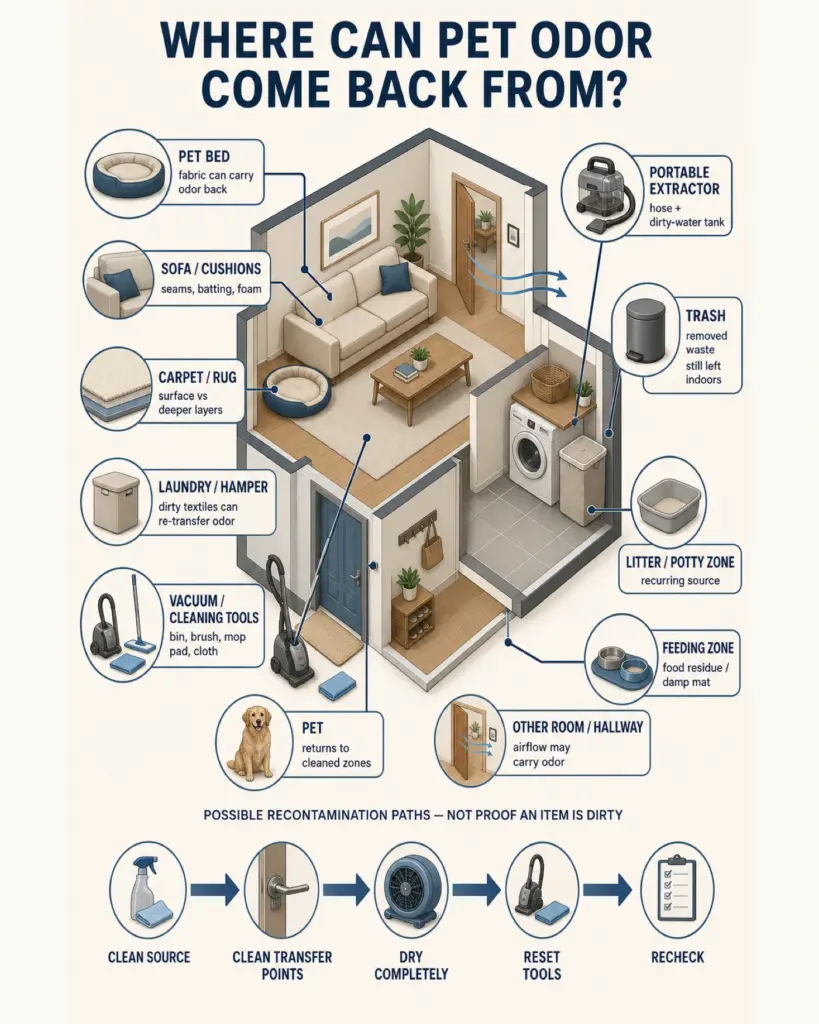
Check Textiles for Odor Re-Transfer
Cleaning one textile does not isolate it from the rest of the apartment. A freshly cleaned sofa cover can be reset over an unchanged cushion. A washed pet-bed cover can pick up odor from an insert. Clean clothing can return to a hamper that still holds damp pet towels. Curtains, throws, blankets, entry mats, harnesses, and reusable furniture covers can exchange hair, moisture, saliva, soil, and odor when they share a pile or storage space.
Compare one textile group instead of washing everything. Remove it, follow care labels, separate dirty from clean, dry fully, and reset it only onto a dry surface. A change while it is absent—and again when it returns—is a useful lead.
Do not infer sanitation from a weaker smell, and do not add scent boosters to make the comparison easier. Fragrance can make it harder to tell whether the transfer pathway has actually been interrupted.
Cleaning Tools and Waste Can Become Secondary Sources
The cleaning path does not end when soil leaves the floor or sofa. It ends when the collected material is removed, the approved tool components are reset, and the waste is no longer sitting in the apartment.
A vacuum bag or bin can retain debris; an upholstery tool or brush can retain hair and damp residue. A mop head or cloth can transfer material between zones. An extractor hose or dirty-water tank holds recovered liquid, while nearby trash and hampers keep removed sources in the apartment.
Use timing: does odor appear when the vacuum runs, after an extractor enters storage, when trash remains, or before a “clean” mop touches the floor? Inspect approved-access components; do not dismantle equipment or improvise chemistry.
Follow the exact manual. For one example, BISSELL directs owners of a specified carpet-cleaner family to empty and rinse the dirty-water tank, allow it to dry fully before reassembly, and rinse the hose and tool. That evidence supports tool reset as a real step, but the instructions for one model do not automatically apply to every vacuum, mop, or extractor. Use the manual for your exact equipment. See BISSELL’s after-cleaning maintenance guidance.
Stop using powered equipment for a burning or electrical odor, unusual heat, sparking, liquid where the manual prohibits it, damaged wiring, battery damage, or a leak near electrical components. Those signs are not ordinary pet odor.
Check Whether the Pet Source Returned
Some cleaning works, but the cycle restarts: new litter waste, food beneath a mat, a bed reset over a damp insert, wet entry gear, nearby trash, or hair, saliva, debris, moisture, or a new accident returning with the pet.
The clue is the sequence: the zone passes a dry check, then changes after a particular use. Observe the reset and the first period of normal use. Keep the pet away only as long as the product label, material instructions, and safe drying require; do not use access restriction as punishment.
If recurrence is the issue, a repeatable cadence may prevent the same source from rebuilding. Use the weekly apartment cleaning schedule for pet homes for that planning step. Do not turn a maintenance problem into repeated emergency deep cleaning.
Odor Removed vs Odor Masked
Removal changes the source or affected material through a compatible method. Masking adds a competing smell. Perfume replacing pet odor does not prove source removal.
Do not use essential oils, fragrance oils, room sprays, or homemade deodorizer mixtures as a diagnostic test. Do not combine vinegar, bleach, ammonia, peroxide, disinfectants, or other cleaners. CDC advises following label directions, providing ventilation as directed, storing products away from children and pets, and never mixing cleaning or disinfection products. See the CDC household cleaning and disinfection guidance.
Smell intensity also does not prove that a surface is clean, disinfected, contaminated, or unsafe. Cleaning, sanitizing, disinfecting, odor reduction, and source removal are different outcomes. Use the label and the actual task—not fragrance—to define completion.
Ozone generators are not an acceptable shortcut. EPA says ozone is generally ineffective at controlling indoor air pollution at concentrations within public-health standards, can harm health, and may mask some odors. Read the EPA ozone-generator guidance.
An Air Purifier Cannot Replace Source Control
An air purifier may supplement source control and ventilation. Depending on its filter design, airflow, operating conditions, and the pollutant, it may capture some airborne particles or adsorb some gases. It cannot wash bedding, empty litter or trash, remove urine from padding, dry foam, clean an extractor tank, or remove a contaminated material from the room.
EPA places source control first, followed by improved ventilation and air cleaning as the three main indoor-air strategies. That order matters here. If a purifier appears to improve the room only while running, ask what source continues to emit or re-enter the space. See EPA’s indoor-air improvement guidance.
After source control, the HEPA versus activated carbon guide explains particle filtration versus gas adsorption. A filter cannot solve an unidentified source.
Check Apartment Airflow Only After Local Sources
Apartments add pathways that a tenant may not control. Odor can move from another room when doors open, from a hallway around an entry door, from an adjacent unit through leakage paths, or through a shared or contaminated ventilation system. Bathroom and kitchen exhaust operation can change pressure and airflow. An open window can improve dilution in one condition and admit outdoor or neighboring odors in another.
Do not declare the HVAC system responsible because an odor is room-wide. First complete the safe local checks: dry materials, textiles, waste, tools, pet zones, and adjacent rooms. Then document the airflow pattern without blocking required vents or altering building systems.
Record time, location, weather, equipment operation, the strongest doorway, vent, chase, or shared-wall zone, and whether neighbors notice it. Do not open ducts, apply products in vents, or enter restricted mechanical spaces.
EPA notes that apartment indoor-air problems can involve ventilation systems, outdoor-air intakes, or building maintenance, and that some solutions are available only to an owner or manager. That makes property escalation a normal apartment boundary, not a failure by the tenant. See the EPA guidance on indoor air quality in apartments.
| Apartment Scenario | Hidden or Secondary Source to Consider | Next Action | Escalation Boundary |
|---|---|---|---|
| Studio smells again after one cleaned sofa is reset | Cushion insert, throw, pet bed, laundry hamper, tool, or trash shares the same air volume | Remove and compare one likely source group at a time after dry checks | Upholstery remains damp, deep foam is inaccessible, or building odor enters from outside the unit |
| One-bedroom smells mainly when the bedroom door opens | Bedding, hamper, rug, pet sleeping zone, or different airflow in the closed room | Check that room locally before re-cleaning the living area | Persistent moisture, visible growth, leak, or odor associated with building ventilation |
| Multi-pet home improves briefly, then changes after normal use | Several recurring litter, feeding, bedding, wet-entry, or accident zones may overlap | Track which use event changes which zone; reset waste and textiles separately | Repeated elimination changes need veterinary input; inaccessible material damage needs professional or property review |
| Odor appears during vacuuming or after equipment returns to a closet | Bag, bin, filter area, head, brush, hose, tank, cloth, or stored dirty liquid | Power off safely and follow the exact model’s approved maintenance steps | Electrical smell, heat, sparking, battery damage, leaks, or inaccessible contamination |
| Odor is strongest near an entry door or shared wall | Hallway, adjacent unit, trash area, pressure difference, or leakage path | Record time and location; confirm local sources are controlled | Building investigation, air sealing, or common-area correction is outside tenant authority |
| Odor changes with bathroom or kitchen exhaust | Exhaust operation may alter pressure and pull air from another zone | Observe the repeatable pattern without blocking vents or disabling required exhaust | Contact management if odors appear to enter through shared construction or systems |
| Odor starts when central ventilation runs | Local dust or source may be redistributed, or the system/building may contribute | Check accessible local sources and filter maintenance only within lease and equipment rules | Duct, air-handler, moisture, or shared-system work requires management or a qualified professional |
What to Check by Apartment Type
In a studio, divide the space into sleep/upholstery, pet rest, litter or potty, feeding, laundry, entry, waste, and tool-storage zones. Compare one at a time; a dirty tank and sofa may be only feet apart.
In a one-bedroom, compare rooms under normal safe door conditions before wet-cleaning both. If odor moves with the door rather than staying at the cleaned object, inspect bedroom textiles and airflow.
In a multi-pet apartment, track zones and events rather than blaming one animal by smell. Beds, feeding, litter or potty areas, blankets, and furniture reset at different times. Major elimination changes need veterinary assessment.
When Re-Cleaning Makes Sense
Another cleaning attempt can be reasonable when you have identified one accessible source, the material instructions allow the method, the product label matches the task and surface, the first attempt was incomplete in a specific correctable way, and the material can be dried and kept clear for the full process.
The second attempt should correct a known gap—such as separating an approved cover, resetting a compatible tool, or completing a missed label step—not increase concentration, water, heat, scrubbing, or chemical count.
Before starting, state what will differ: separate the cover, reset the extractor by its manual, or complete the verified label-directed process. If you cannot name the change, diagnose further.
When Re-Cleaning Is the Wrong Next Step
Do not repeat the same surface treatment when the source is still unknown, the material remains damp, odor returns from an inaccessible layer, the care code or label does not permit the proposed method, several products have already been applied, or the material is changing shape, color, finish, adhesion, or texture.
Re-cleaning is also wrong when the real task is waste removal, laundry separation, tool maintenance, recurrence control, ventilation assessment, property repair, veterinary care, or emergency response. A stronger effort is not a better effort when it is aimed at the wrong branch.
When to Stop DIY
Stop ordinary DIY odor work when:
- carpet, padding, upholstery, a pet-bed insert, or another porous material cannot be dried normally
- the same dry zone repeatedly returns after a correctly completed compatible surface treatment
- padding, subfloor, foam, batting, seams, grout depth, or floor damage appears to be involved beyond safe access
- carpet separates, floor planks swell, finishes change, dyes transfer, upholstery distorts, or material begins to break down
- visible mold-like growth, a leak, sewage, or persistent building moisture is present
- an unknown chemical odor or cleaner exposure causes irritation
- powered equipment smells electrical, overheats, sparks, leaks into prohibited areas, or has damaged wiring or batteries
- the pattern points to a hallway, adjacent unit, shared ventilation, or another building-controlled source
- the pet has a new strong body odor with pain, itching, discharge, wounds, or major elimination changes
The next contact may be emergency services, the gas utility, Poison Control, a veterinarian, the manufacturer, a qualified material professional, or property management. Record what was cleaned, products used, dry-state timing, odor changes, and matching building or pet events.
Final Takeaway
The answer to why pet odor keeps coming back after cleaning is usually in the pattern left by the attempt. Reach the instructed dry condition; distinguish local from room-wide and never-left from returned; then check depth, transfer, tools, recurrence, masking, filtration limits, and airflow.
Do not re-clean the apartment by default. Re-clean only a verified, compatible, accessible source with a clear process correction. Stop when moisture, damage, inaccessible material, chemical exposure, electrical signs, building systems, or pet health exceed ordinary surface cleaning.
The goal is not to overpower the room with a cleaner smell. It is to identify why the previous attempt failed and hand the problem to the right next action.
Sources
- EPA: Finding Mold and Moisture
- Carpet and Rug Institute: Pet Urine and Carpet Technical Bulletin
- BISSELL: Carpet Cleaner Maintenance and After-Cleaning Care
- EPA: Improving Indoor Air Quality
- EPA: Ozone Generators Sold as Air Cleaners
- EPA: Indoor Air Quality in Apartments
- CDC: When and How to Clean and Disinfect Your Home
- Con Edison: Gas Leak Safety