Cat urine smell in apartment carpet is not always a simple surface stain. Sometimes the problem is fresh liquid in the carpet fibers. Sometimes it is dried residue in the backing. Sometimes the odor may be coming from material below the visible carpet.
The first job is not to grab the strongest cleaner. It is to figure out how deep the problem may be.
Use this order:
Fresh or old? → Surface or deeper? → Clean / treat / recheck → Escalate if needed
Table of Contents
Quick Answer
For a fresh cat urine accident on apartment carpet:
- Blot up liquid without rubbing.
- Keep the spot from spreading.
- Use a pet urine cleaner according to the product label.
- Let the area dry fully before judging the result.
- Recheck for odor later, especially near the edges of the spot.
For old or recurring cat urine smell in carpet:
- Find the exact source again.
- Assume the odor may be below the surface if it returns after cleaning.
- Avoid repeatedly spraying fragrance on the top of the carpet.
- Consider whether the backing, padding, or nearby materials may be involved.
- If you rent, avoid aggressive carpet work before checking what you are allowed to do.
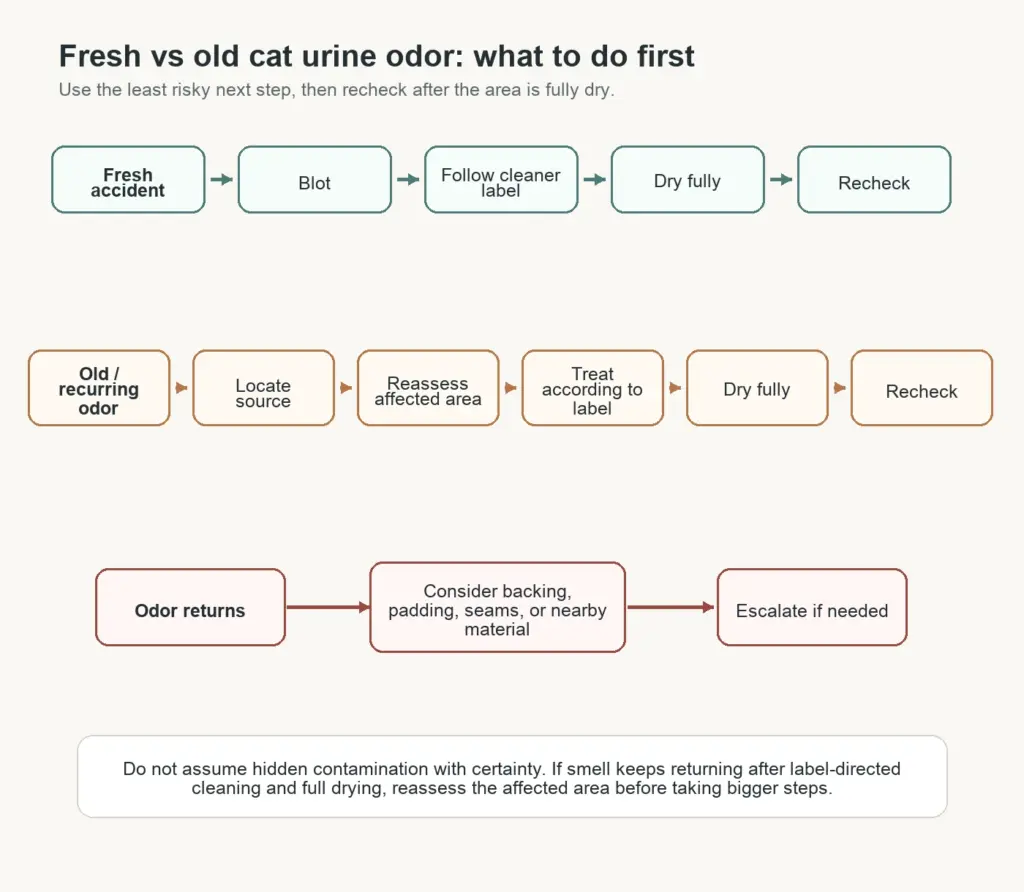
Fresh vs Old Cat Urine in Carpet
Fresh urine and old urine need different thinking.
| Situation | What It Usually Means | First Move | What Not To Assume |
|---|---|---|---|
| Fresh wet spot | Liquid is still in the fibers and possibly moving downward | Blot and absorb as much as possible | Do not assume the visible circle is the full affected area |
| Dry spot but visible stain | Some residue may remain in fibers or backing | Re-locate the full affected area and treat by label directions | Do not assume surface cleaning reached all residue |
| Smell but no visible stain | The source may be dried, hidden, or below the surface | Inspect nearby carpet edges, corners, and furniture zones | Do not spray the whole room randomly |
| Smell returns after cleaning | The last treatment may not have reached the odor source | Recheck depth and drying before repeating | Do not keep adding products on top of each other |
| Room smells stronger in humid weather | Moisture may be making old residue noticeable again | Treat it as a possible remaining-residue problem | Do not assume the odor was new just because it came back |
The Carpet and Rug Institute pet urine technical bulletin notes that complete odor removal is unlikely unless cat urine is completely removed, and that odor may reappear during high humidity. That is the main reason this page focuses on depth, not just cleaner choice.
The Three Depth Levels
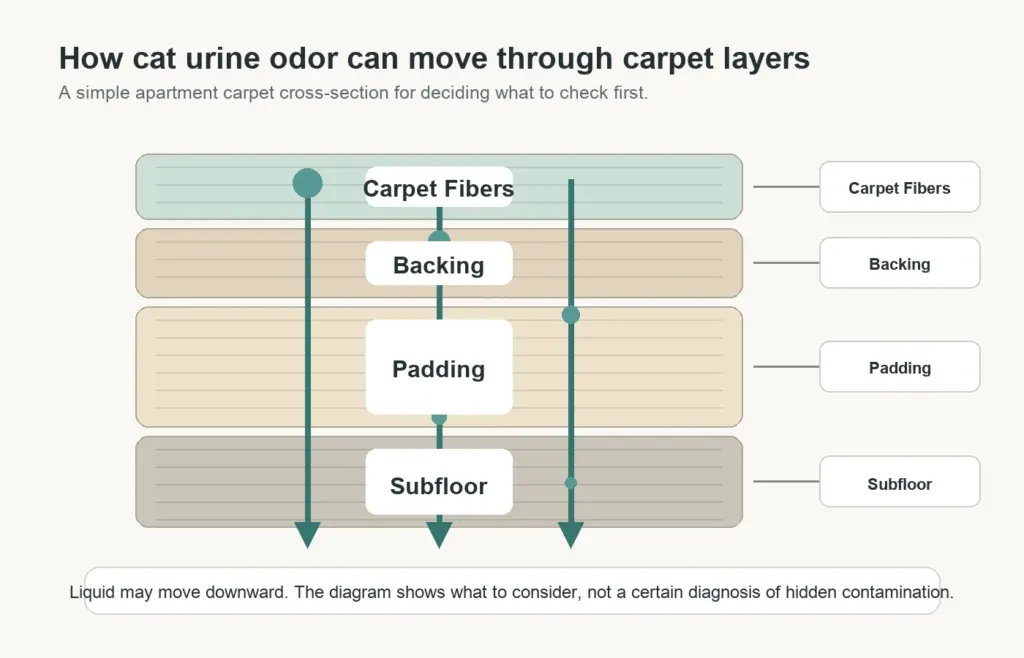
Think of apartment carpet in layers.
Level 1: Carpet fibers
This is the surface layer you can touch. Fresh accidents may still be mostly here if you catch them quickly.
Level 2: Carpet backing
This is the material beneath the fibers. If the spot was large, old, repeated, or heavily soaked, odor may be in the backing even if the top looks better.
Level 3: Padding or subfloor concern
This is the deeper layer under wall-to-wall carpet. In rental apartments, this is where DIY decisions get risky because you may not own the flooring and may not be allowed to lift carpet.
You cannot perfectly diagnose hidden contamination from above. But you can make a better next decision by watching how the odor behaves.
What To Do First for a Fresh Accident
If the spot is still wet, move quickly but calmly.
1. Blot, Do Not Rub
Press clean towels or paper towels into the spot and lift moisture out. Rubbing can spread the liquid sideways and push it deeper into the fibers.
Work from the outside toward the center if the spot is spreading.
2. Keep the Spot Contained
In a small apartment, the affected carpet may be near your bed, sofa, desk, or main walkway. Block off the spot so people and pets do not step through it and transfer urine to other surfaces.
3. Follow the Cleaner Label
If you use an enzyme-based or pet urine cleaner, follow that product’s directions. Manufacturer instructions vary. Some products tell you to spot test, saturate the area, keep traffic off the spot while drying, and repeat if needed.
For example, Simple Green’s cat urine cleaning directions include removing excess urine, testing an inconspicuous area, applying cleaner, allowing time for the cleaner to work, and blotting. Nature’s Miracle product directions also emphasize testing surfaces first and keeping people and pets off treated areas until dry.
Do not invent your own dwell time if the label gives one.
4. Let It Dry Before Judging
A spot can smell different while wet, partially dry, and fully dry. Do not decide that a treatment failed five minutes after applying it unless the product label says the step is complete.
What To Do for Old or Dried Cat Urine Smell
Old cat urine smell in apartment carpet is harder because the visible stain may be gone.
Start by asking:
- Where does the smell seem strongest?
- Is it near a wall, door, litter area, bed, sofa, or corner?
- Does it smell stronger after humidity, mopping nearby floors, or wet carpet cleaning?
- Did the smell return after the carpet looked clean?
- Is this a single accident or a repeated spot?
If the odor is old, the real task is source location. Treating the wrong square foot wastes cleaner and can leave the actual odor source untouched.
Why the Smell Comes Back
Cat urine odor can return when the urine source was not completely removed. In some cases, residue may remain in carpet backing, padding, seams, or nearby materials even after the visible surface looks clean.
Surface cleaning can improve the carpet fibers while leaving residue in:
- the lower pile
- the backing
- the edge of the stain
- the carpet pad
- a seam, wall edge, or baseboard area
The Carpet and Rug Institute specifically notes that cat urine odor may reappear during humid conditions if odor-causing material remains. In an apartment, that can feel worse because the room is smaller and the carpet may be close to sleeping or sitting areas.
If the smell returns only after the area gets damp again, think deeper before adding another surface spray.
When an Enzyme Cleaner May Make Sense
An enzyme-based pet odor cleaner may be appropriate when the problem is urine residue in carpet fibers or fabric surfaces and the product label says it is suitable for that surface.
Use it as a product class, not a magic guarantee.
An enzyme cleaner may be a reasonable next step when:
- the accident is fresh or recently discovered
- the carpet material is label-compatible
- you can keep pets and people off the spot while it dries
- you can apply enough product to reach the affected material
- you can wait for the full label-directed drying period
Be cautious when:
- the carpet is wool, specialty fiber, old, or dye-sensitive
- the urine may have reached padding
- several products have already been applied
- the area is near unfinished wood, laminate, or baseboards
- you rent and may not be allowed to lift carpet
Always spot test first when the label instructs it.
What Not To Mix or Use
Keep this simple: do not mix cleaning products. If you are unsure which cleaner choices are unsafe or inappropriate, review what not to use on pet urine smell before repeating treatment.
The CDC’s bleach and cleaner-mixing guidance warns not to mix household bleach or disinfectants with other cleaners or disinfectants because dangerous vapors can be released. It also recommends good ventilation when using bleach products indoors.
For this article, the practical rule is:
- Do not mix cleaning products.
- Do not combine bleach with other cleaners or disinfectants.
- Follow product labels.
- Ventilate as directed.
- Follow label instructions about when people and pets can re-enter treated areas.
- Do not use a product on carpet, wool, wood, or laminate unless the label says it is compatible.
This is only the safety guardrail. A full chemical mistake guide should be handled separately.
Apartment and Renter Considerations
Cat urine smell in apartment carpet has extra constraints.
You may be dealing with:
- wall-to-wall carpet you do not own
- carpet padding you cannot inspect
- limited ventilation
- a small bedroom or living room where odor feels stronger
- a security deposit concern
- rules against lifting carpet
- previous tenant pet contamination
- a landlord-approved cleaner requirement
- restrictions on wet cleaning machines
Before aggressive work, ask yourself:
| Situation | Renter-Friendly Next Step |
|---|---|
| One fresh accident | Blot, treat by label directions, dry, recheck |
| Old smell in one small spot | Locate the source, use label-directed treatment, document what you did |
| Smell returns after drying | Consider backing or padding involvement |
| Multiple spots or room-wide odor | Avoid guessing; consider property management or professional inspection |
| Carpet edge, wall, or baseboard smells | Be cautious; odor may not be only in the carpet face |
| You want to lift carpet | Check lease rules or property process first |
This is not legal advice. It is a practical cleanup boundary: do not damage landlord-owned flooring while trying to solve an odor problem.
When DIY May No Longer Be Enough
DIY treatment may no longer be enough if:
- odor returns after full drying
- the same area has been treated repeatedly
- the spot was large or soaked
- the smell is strongest near a seam, wall, or baseboard
- the carpet feels damp long after treatment
- the room smells even when the carpet surface looks clean
- you suspect previous pet contamination from before you moved in
At that point, the question is no longer “Which spray should I use?” It is “Which layer is holding the odor?”
If padding or subfloor may be involved, a surface-level article can only take you so far. Renters should be especially careful before pulling up carpet or using heavy wet extraction.
When To Think Beyond Cleaning
This page is about home cleanup, not cat behavior or veterinary diagnosis.
If inappropriate urination is new, repeated, or accompanied by health or behavior concerns, contact a veterinarian.
For behavior context, IndoorCatExpert’s guide to cat spraying vs peeing can help separate marking behavior from urination. For health-adjacent context, see IndoorCatExpert’s guide to indoor cat urinary health and FLUTD prevention.
A Simple Decision System
Use this before choosing your next action.
If It Is Fresh
Blot first.
Treat by label directions.
Keep pets and people away while drying.
Recheck after full drying.
If It Is Old
Find the exact source.
Do not treat the whole room randomly.
Assume the affected area may be larger than the visible stain.
Use a compatible cleaner by label directions.
If It Comes Back
Stop repeating surface sprays.
Ask whether the backing, padding, seam, wall edge, or subfloor may be involved.
If you rent, document the issue and consider property-approved next steps.
If It Is Repeated
Clean the carpet, but do not ignore the cat-side problem.
A repeated accident pattern needs behavior or veterinary attention, not just more cleaner.
How to Read the Clues Before Treating Cat Urine Smell in Apartment Carpet
Cat urine smell in apartment carpet needs a slower first read than many renters want to give it. The visible spot, if there is one, may not show the whole affected area. At the same time, it is not accurate to assume every odor means padding or subfloor contamination. Start with clues that help you decide which depth level is plausible.
- Fresh surface clue: dampness, a recent event, and odor strongest directly over the spot.
- Old residue clue: odor is noticeable after the surface looks clean or when the room has been closed.
- Possible deeper clue: odor returns after drying, appears larger than the visible area, or is strongest near a seam, edge, or repeated accident location.
- Non-carpet clue: smell peaks near a wall, baseboard, litter area, laundry, pet bed, or nearby fabric rather than the carpet face.
These clues do not diagnose hidden contamination with certainty. They help you decide whether to blot and treat the surface, reassess the affected area, or stop repeating surface-only steps.
Apartment and Renter Scenarios
Fresh accident in a studio: protect the surrounding walking path first. Blot, follow the cleaner label, and keep people and pets from stepping through the damp area. In a studio, one small wet spot can transfer to socks, bedding, or a rug within minutes.
Old odor near a bedroom doorway: think beyond the center of the room. Doorways collect foot traffic, litter-box routes, and repeated pet paths. If the smell is near an edge or seam, avoid soaking the area repeatedly without a plan.
Rental carpet with an unknown history: you may not know whether the residue came from your pet, a previous tenant, or an old cleaning attempt. Keep notes and photos before major treatment, use products only as directed, and avoid actions that could violate lease or flooring rules.
Multi-cat home: separate cleanup from behavior interpretation. This page covers carpet odor cleanup. If inappropriate urination is new, repeated, or paired with health or behavior concerns, the next step is veterinary or cat-behavior guidance, not stronger carpet products.
When the First Treatment Does Not Hold
If the smell improves and then returns, do not assume the cleaner failed. The product may not have reached the affected material, the treated area may have been too small, the surface may not have dried fully, or a new event may have happened. The Carpet and Rug Institute notes that humidity can reactivate odor from urine residues, but that does not mean humidity is always the cause. Treat it as one clue among several.
Use a recheck sequence: first smell the exact treated spot after full drying. Then check the surrounding perimeter. Then check nearby fabric, baseboards, and litter-area routes. If odor is strongest outside the treated circle, the original affected area may have been larger than expected. If odor is strongest on fabric or bedding, the carpet may not be the main source anymore.
Avoid repeating the same wet treatment over and over. More liquid is not automatically more cleaning. In carpet, excess moisture can spread residue, slow drying, or create new problems. Follow product directions and stop when the situation moves beyond surface cleanup.
Product-Class Fit Without Turning This Into a Buying Guide
An enzyme cleaner may be appropriate when the product label supports pet urine use on the affected surface. The key is not the word “enzyme” by itself; it is whether the product is compatible with the material, used at the correct amount, allowed to dwell as directed, and given enough drying time. A portable carpet cleaner or extractor is a different product class. It can help remove liquid and rinse compatible surfaces, but it does not replace label-based urine treatment in every case.
For a direct comparison, see enzyme cleaner versus carpet cleaner for pet urine.
Do not use this page to choose the “best” enzyme cleaner. That is a future commercial decision page. Here the decision is simpler: fresh surface accidents need prompt blotting and label-directed treatment; old or recurring odor needs source location and depth reassessment; suspected backing or padding issues need escalation rather than endless surface spraying.
Escalation Without Overclaiming
Escalate when the evidence says the problem is no longer a simple surface cleanup. That may mean contacting a landlord before altering rental carpet, asking a professional carpet cleaner about pet urine procedures, or moving to a deeper carpet-padding decision guide. Escalation does not always mean replacement, and it does not prove hidden contamination. It means the next step needs more information than the surface can provide.
Use careful language with yourself: “possible residue beyond the surface,” not “the padding is definitely ruined.” “Odor returned after drying,” not “the cleaner did nothing.” “The affected area may be larger,” not “the whole carpet is contaminated.” This keeps the decision practical and avoids both panic and repeated ineffective cleaning.
A Careful Recheck After Drying
The recheck matters because wet carpet can temporarily change how odor behaves. Do not judge the final result while the area is still damp unless the product label gives a specific inspection step. After drying, smell the treated spot, the edge of the treated area, the nearest seam or wall edge, and any fabric that touched the area during cleanup. If only the center smells better, the affected area may have been larger than the treated area. If the edge smells stronger, the liquid may have spread outward or the original spot may have been misread.
Also check whether the apartment routine is reintroducing odor. Towels used for cleanup, a laundry basket, socks, slippers, or a small rug can move odor cues away from the original carpet. This does not mean the whole apartment is contaminated. It means the cleanup path should be part of the diagnosis. Bag or wash cleanup textiles according to their care needs, keep pets away from the damp area as directed, and avoid walking through the spot while it dries.
When the recheck still points to carpet, decide whether you are dealing with a surface, backing, or escalation question. This article can help you choose the first response, but it should not pretend to solve every padding or subfloor problem. If the pattern suggests a deeper issue, move to a more specific carpet-padding decision instead of adding more surface cleaner.
Treatment History: What Has Already Touched the Carpet?
Old cat urine smell in apartment carpet is harder to interpret when several treatments have already been tried. Before adding another cleaner, make a quick treatment history. Was the spot blotted when fresh, or rubbed? Was water added? Was an enzyme cleaner used according to its label, or sprayed lightly and judged immediately? Was a carpet machine used? Was baking soda, vinegar, fragrance, disinfectant, or another cleaner layered on top?
This history helps you decide whether the next problem is source location, treatment reach, drying, residue, or surface compatibility. If a label-directed product was used on too small an area, the next step may be reassessing the affected perimeter. If several products were layered, the next step may be stopping and letting the area dry rather than adding another chemical. If a machine added moisture but odor returned after drying, the question becomes whether the source was fully reached, not whether the room needs more perfume.
For renters, treatment history also protects the security deposit conversation. Keep notes about what happened, what product class was used, and whether the carpet changed color, texture, or odor after drying. Do not pull up carpet, cut padding, or saturate landlord-owned flooring without permission. A professional or property manager may need that sequence to decide whether spot treatment, extraction, inspection, or replacement discussion is appropriate.
When Repeated Treatment Stops Being Productive
Repeated treatment stops being productive when each round gives the same short-lived result. If the odor fades while the area is wet and returns after drying, stop measuring success too early. If the smell is strongest around the edge of the treated area, the original treatment may not have covered the full affected zone. If the carpet face looks clean but odor is strongest at a seam, wall edge, or repeated accident path, the next decision is escalation or a deeper-material check, not another surface-only spray.
Escalation does not mean declaring the padding ruined. It means the evidence no longer supports casual surface cleaning. At that point, ask whether the carpet is yours to treat, whether the product label supports another round, whether the area can dry fully in your apartment, and whether professional guidance would reduce risk. That decision boundary keeps this article from becoming a padding-remediation guide while still helping the reader stop wasting effort.
One final renter-safe decision is whether the next step could change the carpet permanently. If the answer is yes, pause before doing it yourself. More moisture, stronger products, or physical alteration may make the situation harder to explain later. When the odor pattern suggests more than a fresh surface accident, the responsible next step is better documentation and a more specific escalation path, not another blind treatment.
If the same odor pattern returns after a careful dry recheck, treat that as a decision signal. Stop repeating the same surface step and move to documentation, source reassessment, or escalation.
That keeps the next step proportionate and renter-safe.
Pause there.
Sources
- CDC: Cleaning and Disinfecting with Bleach
- Carpet and Rug Institute: Pet Urine and Carpet
- Simple Green: Cat Urine Cleaning Tips
- Simple Green: Pet Stain & Odor Remover
- Nature’s Miracle: Advanced Stain and Odor Eliminator for Cats
- IndoorCatExpert: Cat Spraying vs Peeing Guide
- IndoorCatExpert: Indoor Cat Urinary Health and FLUTD Prevention