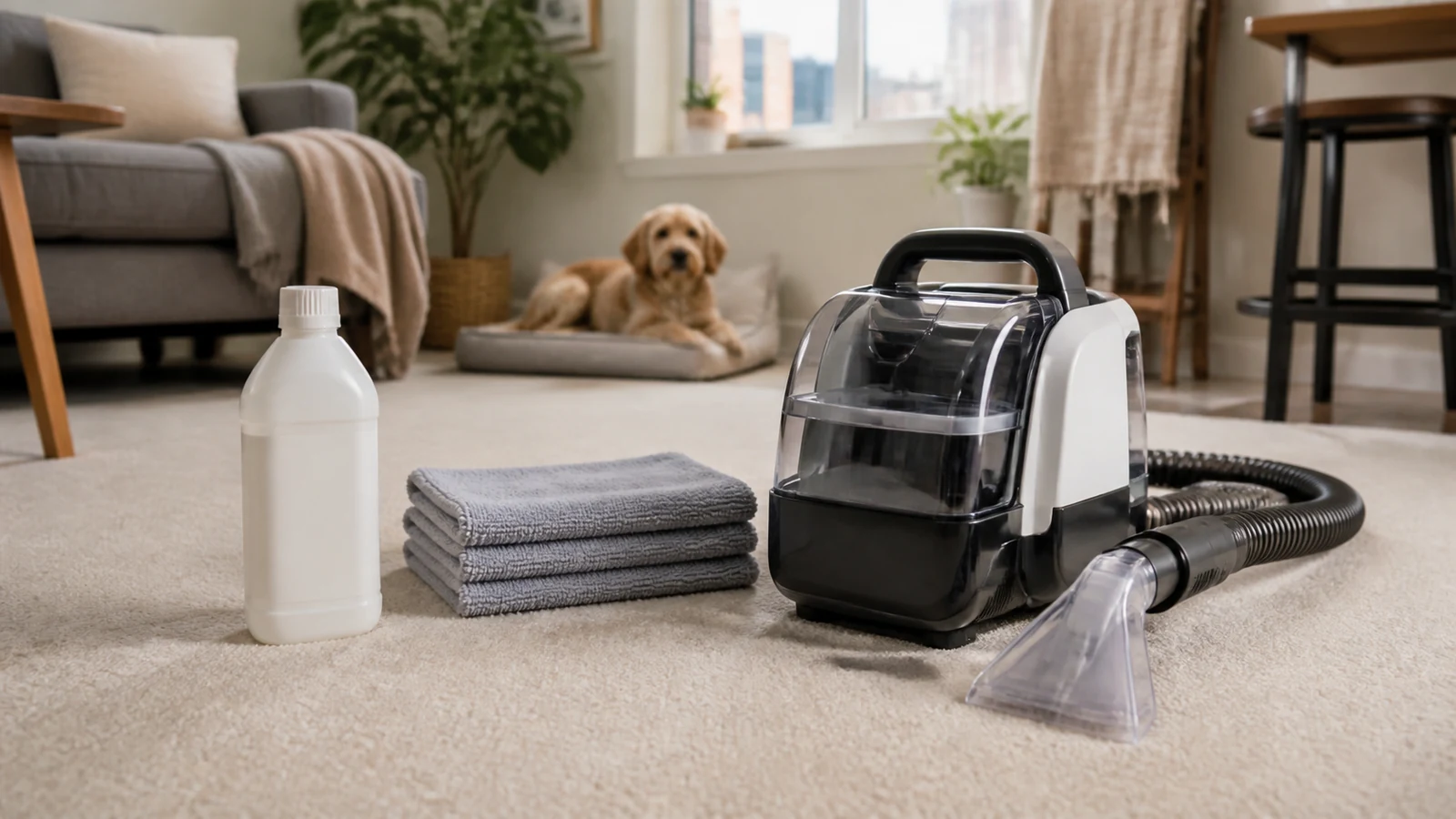
Quick Answer: For pet urine, an enzyme cleaner is usually the better fit when the main problem is odor from a specific accident spot. A carpet cleaner or extractor is usually the better fit when the carpet is broadly dirty, sticky, or holding soil across a larger area. In many apartment situations, the right answer is not “enzyme cleaner or carpet cleaner forever.” It is choosing the method that matches the job, then following the product label and machine directions instead of stacking cleaners at random.
Table of Contents
What This Comparison Is Really About
The phrase enzyme cleaner vs carpet cleaner for pet urine sounds like a simple product comparison, but it is really a decision about the kind of problem you are trying to solve. One method is meant to treat an odor source. The other is meant to rinse and extract soil from carpet. Those jobs can overlap, but they are not the same.
That distinction matters even more in an apartment. You may have limited ventilation, shared walls, a smaller drying area, rental carpet, and less storage space for a machine. A choice that sounds practical in a house with a spare utility room may be awkward in a studio apartment where one damp carpet zone affects the whole living area.
The goal is to help you decide which tool fits the current job: a fresh accident, an old odor spot, a broadly dirty carpet, a repeated problem area, or a carpet that may need deeper evaluation.
What an Enzyme Cleaner Is Designed to Do
An enzyme cleaner is usually used as a targeted odor and stain treatment. The product is applied to the affected area and left in contact for the amount of time directed on the label. Many pet urine products tell users to blot excess liquid first, apply enough product to reach the affected material, allow dwell time, and keep the area away from pets and people until it is dry or as otherwise directed.
That label-based contact time is the important part. Enzyme-style pet odor products are not meant to work like a quick wipe. They are usually intended to sit on the contaminated area long enough to treat residue rather than simply wet the surface for a few seconds.
Official product directions vary. For example, Nature’s Miracle urine-destroyer directions emphasize saturating the affected area, allowing time for the product to work, and letting it dry. Simple Green pet stain and odor directions also frame use around direct treatment of the soiled area, label directions, and surface compatibility. Those details matter more than the general word “enzyme.”
An enzyme cleaner makes the most sense when the question is: “Where is the urine odor source, and how do I treat that spot without guessing?” It does not automatically clean an entire apartment carpet, remove general foot traffic soil, or solve a deeper carpet problem that has already moved beyond the reach of surface treatment.
Once that product class fits, compare the best enzyme cleaners for pet urine.
What a Carpet Cleaner or Extractor Is Designed to Do
A carpet cleaner, carpet shampooer, or portable extractor is usually meant to apply cleaning solution and remove dirty liquid from carpet. It can be useful when carpet is broadly soiled, when a larger area needs rinsing and extraction, or when residue from an accident needs to be removed after the right spot treatment has had time to work.
The extractor’s strength is physical removal. It can pull up soil, moisture, and cleaning solution from carpet better than towels alone in many situations. That does not mean it automatically neutralizes a urine odor source. If urine residue remains in backing, padding, seams, or nearby material, extraction of the surface may make the carpet look cleaner while the odor returns after drying.
Machine directions also matter. BISSELL’s pet urine carpet guidance separates blotting, pretreatment, machine cleaning, and drying rather than treating every pet accident as one generic shampoo job. Rug Doctor’s pet mess guidance also describes immediate pickup or blotting and product-specific use before extraction. The machine is part of the workflow, not a magic replacement for diagnosis.
A carpet cleaner makes the most sense when the question is: “Is the carpet dirty enough that I need rinsing and extraction, not only spot treatment?” It is less helpful when the actual issue is a small, clearly located odor source that has not received proper dwell time from a suitable urine product.
Can You Put Enzyme Cleaner in a Carpet Cleaner?
Only put an enzyme cleaner in a carpet cleaner if the enzyme cleaner label explicitly allows machine use and the exact carpet-cleaner manufacturer or manual allows that type of solution. If the enzyme cleaner is approved only for spot treatment, apply it separately according to its label, then use the machine only with the solution or water its instructions permit. If compatibility is unknown, do not mix products or improvise a tank combination; check both labels and manuals first.
| Situation | Best action |
|---|---|
| Cleaner label and machine manual both approve use | Use only as directed. |
| Enzyme cleaner is approved for spot treatment but not the machine tank | Pretreat separately, then use the machine with approved solution or water as directed. |
| Compatibility is unknown or products would be mixed | Do not combine; check both labels and manuals first. |
The Core Difference: Odor Source vs Soil Removal
The simplest way to compare the two methods is this: an enzyme cleaner is usually chosen for a specific urine odor source, while a carpet cleaner is usually chosen for broader carpet cleaning and extraction. The best choice depends on what you can observe after the area is dry.
If the carpet looks mostly clean but one spot smells like urine, a targeted cleaner is usually the more logical first decision. If the whole carpet feels grimy, has tracked-in soil, or has several pet mess areas, extraction may be part of the plan. If the odor keeps coming back after correct spot treatment and full drying, the problem may no longer be a simple surface-cleaning decision. That is where a deeper troubleshooting guide, such as pet urine smell in carpet padding, becomes more useful.
This distinction also helps prevent over-cleaning. Repeatedly wetting carpet with different products can make a small problem larger, especially in a rental where you do not know the carpet’s history. When you understand whether you are treating an odor source or extracting soil, you are less likely to keep adding moisture because the first attempt did not work instantly.
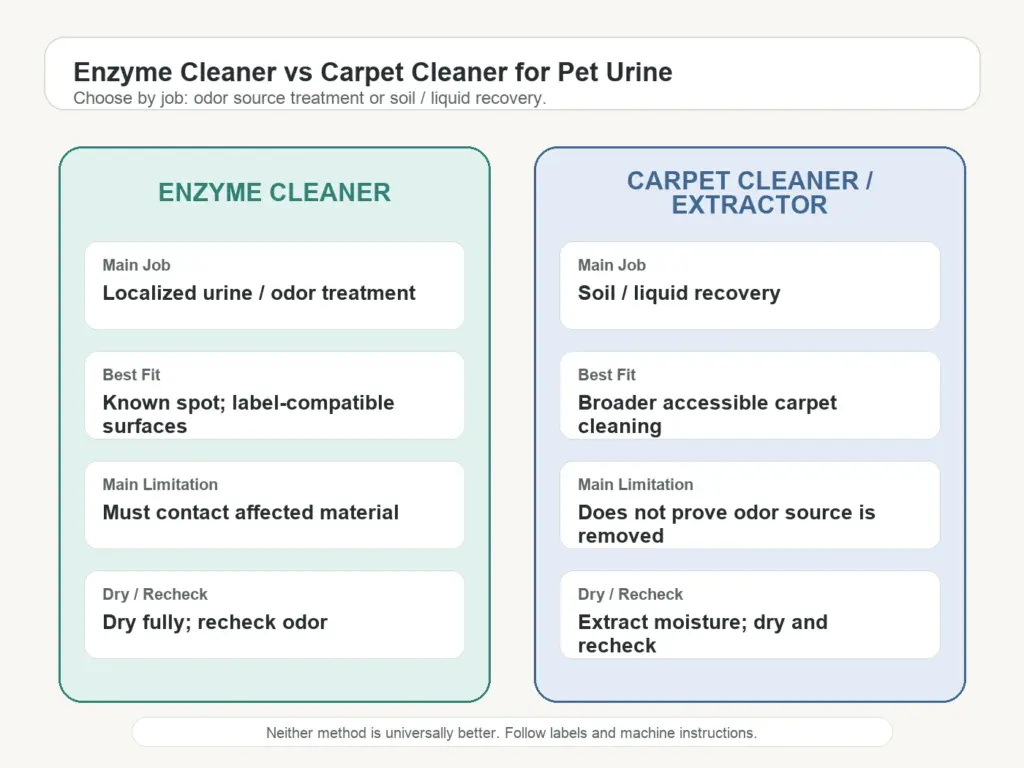
| Decision Point | Enzyme Cleaner Usually Fits When… | Carpet Cleaner / Extractor Usually Fits When… |
|---|---|---|
| Main problem | One urine odor spot or a known accident area | Broad soil, sticky carpet, tracked-in dirt, or larger-area cleaning |
| Primary job | Treat the odor source according to the product label | Apply solution and extract dirty liquid from carpet |
| Best timing | After blotting a fresh accident or when a specific dry odor spot is identified | After loose mess is removed and any needed spot treatment sequence is clear |
| Main limitation | May not clean a whole dirty carpet or solve deeper material involvement | May not resolve odor if urine residue was not treated or removed |
| Apartment concern | Requires dwell time, drying time, and pet access control | Requires machine storage, noise tolerance, drying space, and careful moisture control |
When an Enzyme Cleaner Makes More Sense
An enzyme cleaner usually makes more sense when the urine problem is localized. That means you know the approximate spot, the issue is more odor than general soil, and the carpet is not so dirty that the entire room needs extraction. This is common after a fresh pet accident, a recurring small spot near furniture, or a recently discovered area that smells after the room is closed up.
For a fresh accident, the practical first step is usually to remove as much liquid as possible before applying any cleaner. Blotting matters because extra liquid spreads the affected area and dilutes the cleaner. After that, the cleaner should be used according to its label, including surface testing, dwell time, drying, and re-entry instructions for pets and people.
For an older spot, the decision is slower. You may need to locate the strongest odor point, check whether the smell is centered in one spot or spread along an edge, and avoid judging the result while the area is still damp. Some products smell stronger while wet or while the treated area is drying, so the useful check is what remains after full drying and ventilation.
An enzyme cleaner may also be the more apartment-friendly choice when machine use would be impractical. In a small upstairs rental, a loud extractor may be difficult to use at night, and a large damp carpet area may be hard to keep away from pets. A small, targeted treatment can be easier to manage if the problem is truly local.
The boundary is important: targeted cleaner does not mean unlimited saturation. If the spot has been repeatedly soaked, if several products have already been layered, or if odor returns after correct treatment and drying, the next step may be reassessment rather than more cleaner. If the accident involves cat urine specifically, the guide to cat urine smell in apartment carpet gives a more focused fresh-versus-old workflow.
When a Carpet Cleaner or Extractor Makes More Sense
A carpet cleaner or extractor makes more sense when the carpet itself needs broader cleaning. If the room has tracked-in dirt, pet traffic paths, food residue, muddy paws, or multiple small messes, a single bottle treatment may not address the wider soil load. In that case, extraction may help remove grime and cleaning residue from a larger area.
Extraction can also be useful after a spot treatment has done its job and the label or machine guidance supports the sequence. The key is not to assume that machine cleaning should replace dwell time. If a urine product says it needs time to remain on the area, immediately extracting it may work against the directions. If a machine solution says it is designed for use in a carpet cleaning machine, use that product in the machine rather than improvising with a random spot cleaner.
This is where many pet owners get into trouble. They treat “carpet cleaner” as both the machine and the chemical. A machine can extract. A solution has its own instructions. A urine product has its own instructions. Those three things are not interchangeable. The safest comparison is not brand versus brand, but job versus job: odor-source treatment, broad soil extraction, or deeper material evaluation.
In apartments, a machine also introduces practical constraints. You need room to move furniture, time for the carpet to dry, a plan to keep pets off damp areas, and enough ventilation without disturbing neighbors. Over-wetting is especially risky when you cannot easily lift carpet or inspect padding. If your main problem is a single urine odor spot, a full-room machine pass may be more work and moisture than the problem needs.
When You May Need Both Methods
Some pet urine situations do need both targeted treatment and extraction, but the sequence should come from labels and machine instructions, not from a fixed internet rule. A common practical pattern is: remove loose or wet material, identify the affected area, apply the appropriate urine cleaner as directed, allow the required dwell and drying time, then decide whether extraction is needed for remaining soil or residue.
That does not mean every urine accident needs a machine. It also does not mean every carpet cleaning should begin with an enzyme cleaner. The right sequence depends on what happened, what was already used, whether the area is dry, whether the carpet material allows the product, and whether the machine manufacturer allows the cleaning solution you plan to use.
If the first treatment did not follow the label, the next decision is not simply “try something stronger.” It may be better to restart the process carefully: document what was used, let the area dry, check the strongest odor point, and choose one compatible next step. If several cleaners were already layered, the safest next step may be to stop and reassess. The guide on what not to use on pet urine smell covers the cleaner-mixing and product-stacking boundary in more detail.
The most useful mindset is sequence control. Pick one job at a time. Do not pour, spray, shampoo, deodorize, and extract in one anxious session. Let the result dry before deciding whether it worked. Pet urine odor is often judged too early, while the carpet is still damp and the air in a small apartment is still carrying product smell.
Six Apartment Scenarios and the Better First Choice
Scenario A: One Fresh Localized Accident
If a pet urinates on one clear carpet spot and you notice it quickly, start with liquid removal and a compatible urine cleaner. Blot first, avoid scrubbing the spot outward, and follow the cleaner label. A carpet cleaner may be useful later if the area is also dirty, but it is usually not the first thing to drag out for one small fresh accident.
The decision impact is simple: the cleaner needs contact with the affected spot, and the area needs enough time to dry before you judge success. If you immediately shampoo the area, you may spread moisture and make it harder to know what actually worked.
Scenario B: Old Odor With Little Visible Staining
If the carpet looks clean but smells in one place, an enzyme cleaner or other urine-specific odor product usually fits better than broad carpet shampoo. The job is to treat a source you cannot fully see, not to make the room look cleaner.
Map the odor before adding more liquid. Find the strongest point, check the edge of the spot, note whether the smell is near a seam or baseboard, and document whether furniture was covering the area. This does not prove hidden contamination, but it helps you treat the right area instead of guessing.
Scenario C: Dirty Carpet Plus Urine History
If the carpet has both general soil and a known urine history, you may need a two-part plan. Treat the urine source according to the product label, then use extraction if the larger carpet area needs cleaning and the machine instructions support the products being used.
The mistake is treating the entire problem as either odor or dirt. A dirty carpet can hold normal pet and household soil even after a urine spot is treated. A freshly shampooed carpet can still smell if the urine source was never handled. Separating those two jobs makes the next step clearer.
Scenario D: Odor Returns After Correct Treatment and Drying
If the odor comes back after the correct product was used correctly and the area fully dried, do not assume another round of the same surface treatment will solve it. Recheck the affected area, note whether the odor is wider than the visible spot, and consider whether backing, padding, seams, baseboards, or nearby material may be involved.
This does not mean you can diagnose carpet padding contamination with certainty from smell alone. It means the decision has changed. You may be moving from product selection into depth evaluation, where repeated DIY wetting can become counterproductive.
Scenario E: Small Rental Apartment With No Storage for a Machine
If you rent a small apartment and have no place to store a machine, a targeted urine cleaner may be more realistic for occasional accidents. Renting or buying a carpet cleaner can make sense for broad soil, but it should match the scale of the problem.
Rental status also changes your risk tolerance. If the carpet belongs to the landlord, avoid aggressive experiments, unknown chemical combinations, or repeated soaking. Keep notes about what happened, what you used, and when the area dried. That documentation can help if the problem escalates or if you need to discuss carpet care with property management.
Scenario F: Multi-Pet Home With Broad Soil Plus One Hotspot
In a multi-pet apartment, you may have both a general cleaning issue and one urine hotspot. Treat the hotspot like a source problem. Treat the traffic paths like a soil problem. Do not expect one pass with one product to solve both perfectly.
This is where a simple map helps. Mark the odor point, the furniture edge, the walking path, and any areas that feel sticky or look dull. The hotspot may need label-based urine treatment, while the traffic path may need extraction or routine carpet maintenance. The clearer the map, the less likely you are to over-treat the whole room.
A Safe Sequence for Choosing the Next Step
Before choosing between an enzyme cleaner and a carpet cleaner, pause long enough to answer five questions. Is the area fresh or dry? Is the problem mainly odor, mainly soil, or both? Do you know what was already used? Is the carpet compatible with the product or machine? Can the area dry fully in your apartment?
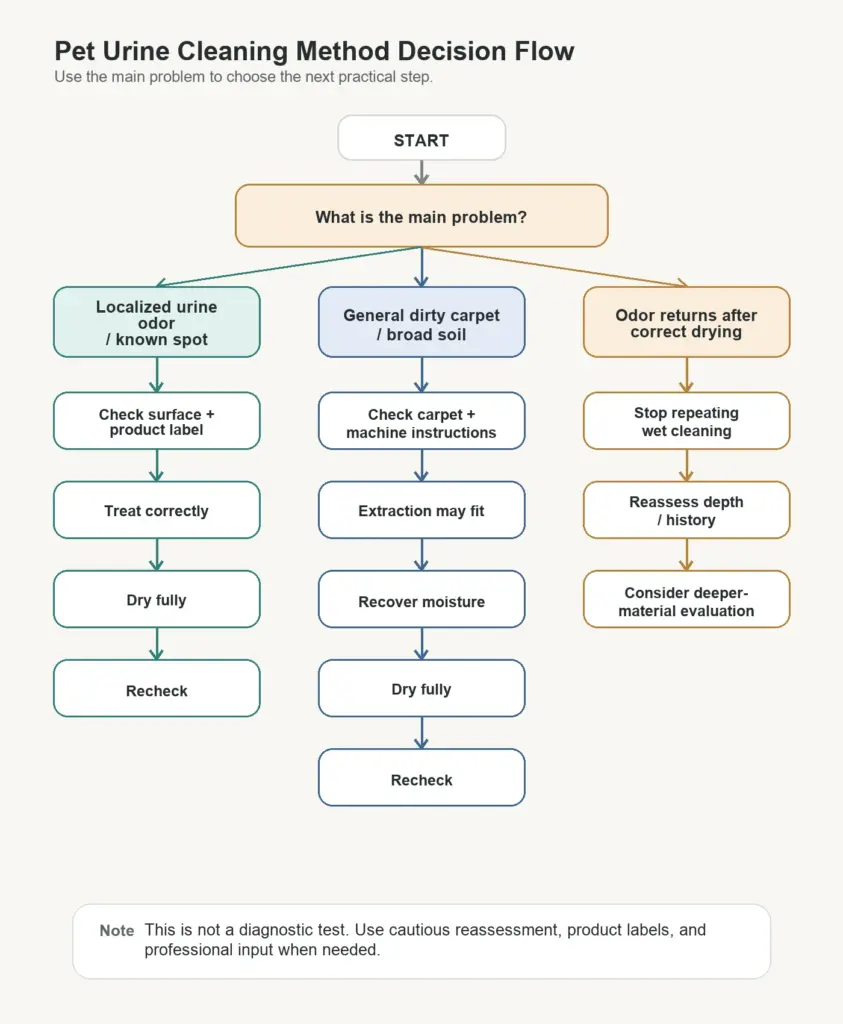
If the area is fresh, remove excess liquid first. If the area is dry and odor is localized, choose a urine-specific treatment that matches the surface and follow the label. If the carpet is broadly dirty, consider extraction according to the machine and solution directions. If the same odor returns after proper treatment and drying, stop treating it like a normal surface cleaning problem.
This sequence is deliberately cautious because pet urine cleanup often fails from impatience. The area is judged before drying. The visible center is treated but the edge is missed. A machine is used before the spot product has had time to work. Several products are layered because the first one did not seem instant. Each of those choices can make the next decision harder.
The stronger decision is to move one step at a time. Treat the known issue, let it dry, recheck, then decide whether the next job is extraction, repeat treatment, or escalation.
What If the Odor Comes Back After Drying?
Odor that returns after drying should change how you think about the problem. It may mean the original urine source was not fully treated, the affected area was larger than expected, the wrong product was used, the product was removed too soon, or the odor is coming from material below or beside the visible carpet surface.
The Carpet and Rug Institute pet urine technical bulletin notes that urine can affect dyes and carpet materials and that odor can become more noticeable in humid conditions. That supports a careful recheck after drying, but it does not support guessing blindly. Returning odor is a clue to reassess the source and depth, not proof of one specific cause.
In practical terms, start by asking whether the full affected area was treated. The visible center may not be the whole problem. Liquid can spread outward and downward. If only the center was sprayed, the edge may remain. If the area is near a seam or baseboard, nearby material may also matter. If the same spot has been repeatedly affected, surface cleaning may become less reliable.
At that point, a carpet cleaner may remove soil and residue, but it may not fix deeper odor. Another enzyme treatment may help if the prior use was incomplete or removed too quickly, but repeated saturation can become risky. The right next step depends on history: what was used, how much, how long it stayed wet, and what happened after it dried.
When Neither Method Is Enough
Neither an enzyme cleaner nor a carpet cleaner is guaranteed to solve every urine odor problem. If urine has reached backing, padding, subfloor, seams, tack strips, or nearby trim, surface-level decisions may not be enough. A machine may clean the carpet face. A urine cleaner may treat what it can reach. But access, material condition, and treatment history can limit the result.
This is especially important in apartments because you may not be allowed to lift carpet or inspect padding. If you rent, check your lease or contact property management before attempting anything that could damage flooring. This is not legal advice; it is a practical boundary. Carpet replacement, padding replacement, or subfloor sealing decisions belong with the owner, property manager, or qualified flooring professional.
A professional may be able to evaluate the affected area, moisture history, carpet construction, accessibility, and whether cleaning is still reasonable. They may also explain when replacement is more realistic than repeated surface treatment. What they cannot honestly provide in every case is a guaranteed odor-removal promise. Results depend on material, age, contamination depth, prior products, drying, and access.
Apartment-Specific Constraints That Change the Decision
Small homes compress the cleanup problem. A damp treated spot may be in the same room where you sleep, work, and keep the litter box or dog bed. That makes drying time more disruptive. It also means product fragrance, normal damp-carpet smell, and lingering urine odor are easier to notice because you are physically closer to the treated area.
Ventilation is another constraint. A house may have more rooms, exterior doors, and utility space. An apartment may have limited window access or shared hallway restrictions. If a label calls for ventilation, plan the timing before you start. Do not begin a large extraction job late at night if you cannot keep the area open, dry, and undisturbed.
Storage also matters. A full-size machine may not earn its space if you only deal with rare, small accidents. A small bottle treatment may be easier to keep on hand. On the other hand, if you have multiple pets, frequent muddy traffic, and wall-to-wall carpet, periodic extraction may be more realistic than treating every dirty-looking area as a urine odor problem.
Noise and neighbor impact can matter too. Carpet cleaners are not silent, and repeated passes in an upstairs unit may be annoying. If you need a machine, choose a reasonable time and plan the room before starting. Move only what you need to move, keep pets away, and avoid over-wetting areas you cannot dry well.
Common Mistakes to Avoid
- Using a machine before identifying the odor source. A clean-looking carpet can still smell if the urine source was missed.
- Extracting a spot treatment too soon. If a product requires dwell time, removing it immediately may work against the label.
- Layering several products. More products can create residue, safety concerns, surface compatibility problems, and confusion about what worked.
- Judging the result while the carpet is damp. Wait until the area is fully dry before deciding whether odor remains.
- Treating only the visible center. The affected area may include edges, seams, backing, or nearby material.
- Assuming every recurring odor needs another DIY round. Recurrence after correct treatment and drying may call for reassessment or professional input.
Safety rules still apply no matter which method you choose. Do not mix cleaning products unless the label specifically supports that use. Follow product directions for dilution, ventilation, surface testing, machine compatibility, drying, and pet access. The CDC’s bleach guidance warns against mixing bleach with other cleaners or disinfectants, and Poison Control explains why even ordinary household products should not be treated as harmless in all combinations.
A Simple Decision Table
| What You Notice | Better First Decision | Why |
|---|---|---|
| Fresh, clearly located urine accident | Blot, then use a compatible urine cleaner according to the label | The immediate job is source treatment, not full-room shampooing |
| One dry odor spot with little visible soil | Map the spot and use a targeted odor product if compatible | The problem is localized odor rather than broad carpet soil |
| Large dirty carpet area with pet traffic | Consider carpet extraction according to machine directions | The main job is soil and residue removal across a wider area |
| Dirty carpet plus one known urine hotspot | Treat the hotspot and handle broad soil separately | Odor treatment and carpet cleaning are related but different jobs |
| Odor returns after correct treatment and drying | Reassess depth, edges, seams, and treatment history before adding more product | Repeated surface treatment may not match the real problem anymore |
| Rental carpet with repeated same-spot accidents | Document the area and consider landlord or professional input | Ownership, material access, and prior saturation affect the safest next step |
The Practical Next Step
If you are deciding between enzyme cleaner vs carpet cleaner for pet urine, start by naming the job. If it is one odor source, choose a compatible urine cleaner and give it the label-directed time to work and dry. If it is broad carpet soil, use a carpet cleaner or extractor according to the machine and solution directions. If it is both, separate the source problem from the whole-carpet cleaning problem.
Do not let urgency push you into a pile of products. One clear step, followed by drying and rechecking, gives you better information than several rushed attempts. In a small apartment, that restraint matters. It keeps the affected area smaller, reduces moisture, avoids unnecessary chemical overlap, and helps you know whether the next decision is treatment, extraction, or escalation.
The best cleanup choice matches the evidence in front of you: what happened, where the odor is strongest, what was already used, what the label allows, and what your apartment can realistically dry.
Sources
- Carpet and Rug Institute: Pet Urine and Carpet technical bulletin
- BISSELL: How to remove dog and cat urine smell from carpet
- Rug Doctor: How to clean up pet messes
- Nature’s Miracle: Urine Destroyer Plus product directions
- Simple Green: Pet Stain and Odor Remover directions
- Rocco & Roxie: Stain and odor remover use tips
- CDC: Cleaning and disinfecting with bleach
- Poison Control: Dish soap and cleaner safety context