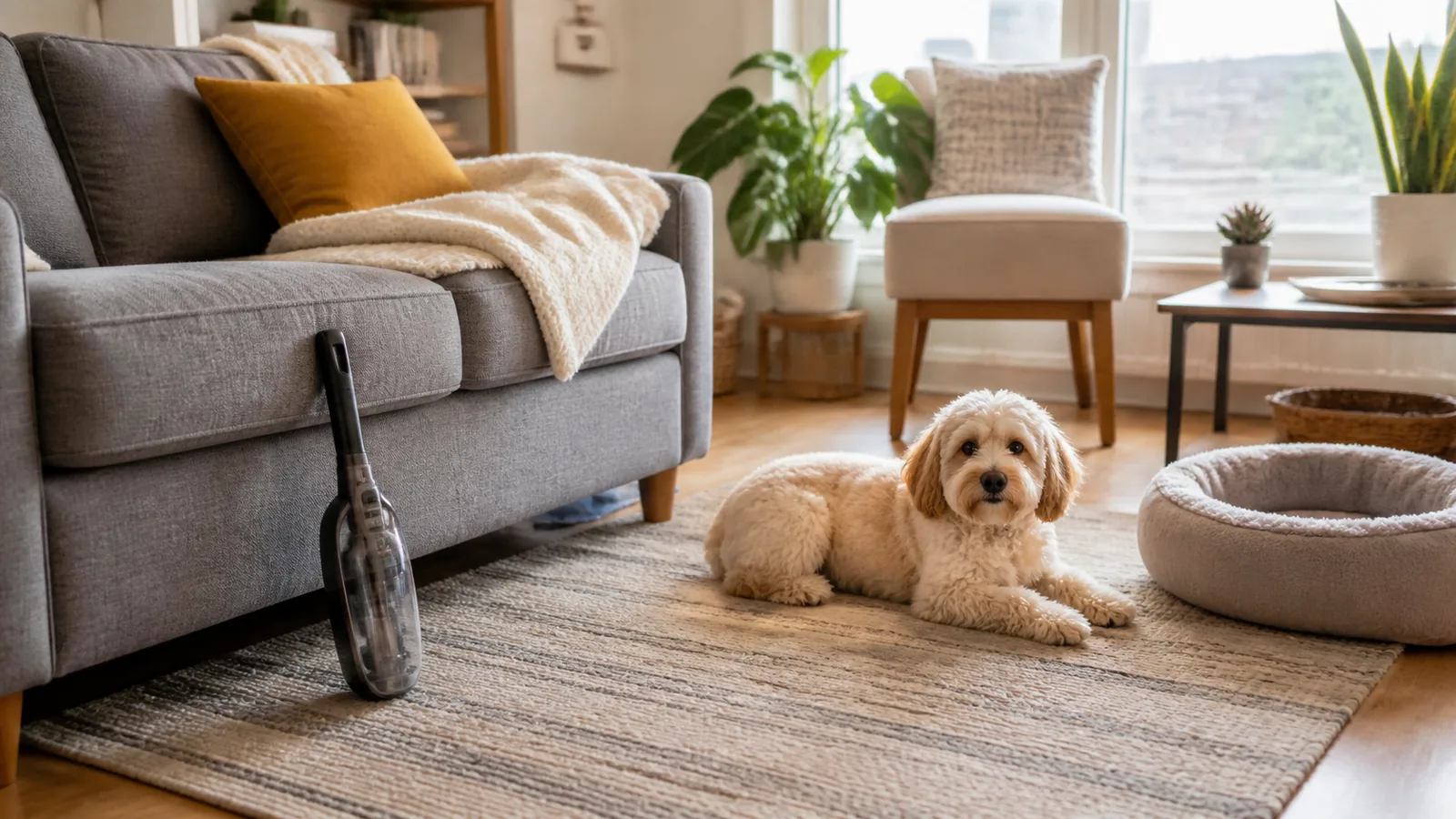
Pet hair in apartment living is usually not just a “vacuum more” problem. Hair moves from pet resting spots to floors, rugs, sofa cushions, bedding, clothing, laundry, corners, baseboards, and under furniture. If you only clean the surface where you notice it, the same hair path keeps restarting.
The goal is to find the main transfer path in your apartment and interrupt it in the easiest place.
A good pet hair system has four parts:
Source → Transfer → Capture → Prevent Re-Transfer
Table of Contents
Quick Answer
Start where your pet rests most often, then clean the main path from that spot to your sofa, bed, rug, or laundry area.
Best first order:
- Pet bed or favorite resting spot
- Main floor or rug path
- Sofa or fabric hotspot
- Clothing before it reaches laundry
- Corners, baseboards, and under furniture
In a small home, floors, fabric, clothing, and laundry are connected.
The Pet Hair Pathway
Use this as a practical household model, not a scientific rule:
Pet / resting area
→ floor or rug
→ sofa / bedding
→ clothing
→ laundry
→ corners / baseboards / under furniture
→ redistribution
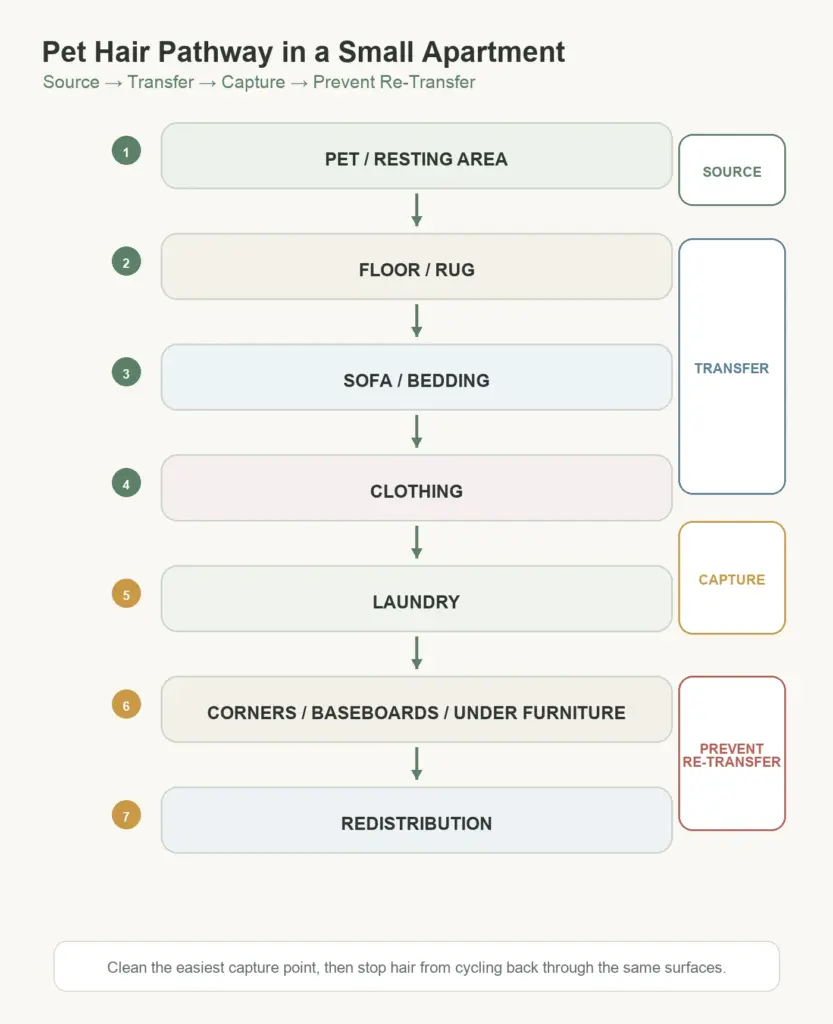
A cat sleeping on the sofa can leave hair on cushions. That hair transfers to your clothes. The clothes go into a hamper. The hamper sits near the bed or closet. Some hair goes into laundry; some stays on fabric; some ends up back on the floor.
A dog lying on a rug can shed into the rug pile. Foot traffic, play, and daily movement spread that hair toward edges, furniture legs, and under the sofa. Vacuuming the open floor helps, but if the rug edge, pet bed, and sofa fabric are ignored, the apartment still feels hairy.
The problem with pet hair in apartment homes is that there are fewer buffer zones. The pet bed, sofa, work chair, bed, laundry basket, and main walkway may all be close together.
Source: Where Hair Starts
The source zone is the place where loose hair first builds up enough to keep spreading.
Common source zones include:
- Pet beds
- Sofa cushions
- Favorite blankets
- Rugs where pets nap
- Bedding if pets sleep on the bed
- Window perches or floor mats
- Crates or soft pads
- The area beside your desk or couch
You do not need to deep-clean the whole apartment first. Find the source zone and reduce the loose hair there.
That may mean shaking out or washing a cover, vacuuming a pet bed, brushing your pet briefly, or using a fabric tool on the cushion where your pet sleeps. Grooming can help as upstream source control, but this page is not a grooming guide. Coat type, shedding cycles, skin health, and brush selection need more specific care guidance.
Transfer: Where Hair Moves Next
Once hair leaves the source zone, it usually transfers through contact.
In apartments, the main transfer routes are:
- Pet bed to rug
- Rug to socks or slippers
- Sofa to clothing
- Bedding to pajamas
- Clothing to laundry basket
- Laundry basket to closet floor
- Floor to corners and baseboards
- Rug edges to under-sofa buildup
This is why cleaning only the visible hair on the floor can feel disappointing. The floor may be the place you notice hair, but the source may be the sofa, pet bed, bedding, or laundry pile.
Before cleaning, ask:
- Where does my pet rest most?
- What surface touches that spot next?
- Where do I see hair again after cleaning?
- Is hair mostly loose, embedded, or stuck to fabric?
- Is the problem worse near a rug, bed, sofa, laundry basket, or corner?
That gives you a better first move than cleaning randomly.
Capture: Remove Hair Where It Is Easiest
The best capture point is not always the place with the most visible hair. It is the place where removal is fastest and prevents the most re-transfer.
For example:
- Hair on a washable throw may be easier to remove than hair embedded in the sofa.
- Hair on a hard floor may be easier to capture before it reaches a rug.
- Hair on clothing may be easier to remove before it goes into the washer.
- Hair along a baseboard may be easier to vacuum with an edge attachment than to chase across the room later.
Think in zones:
Resting zone: pet bed, sofa spot, blanket
Walking zone: main floor path, rug edges, entry area
Fabric zone: sofa, bedding, clothing
Laundry zone: hamper, washer, dryer, clean folding area
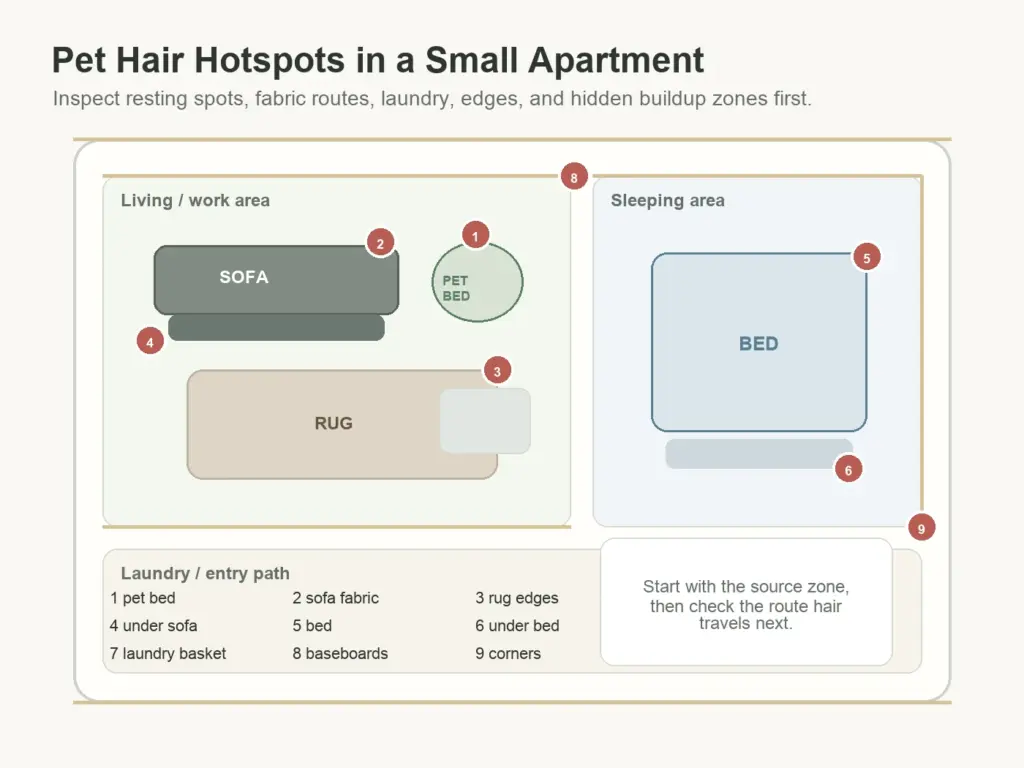
Edge zone: corners, baseboards, under bed, under sofa
When you know the zone, the tool choice becomes simpler.
Surface / Tool Matrix
| Where Hair Collects | Likely Transfer Source | Best First Method | Tool Category | Common Mistake | Next Step |
|---|---|---|---|---|---|
| Pet bed or blanket | Direct shedding/resting | Remove loose hair before it spreads | Lint tool, upholstery attachment, washable cover | Cleaning floors first while the source stays loaded | Wash or rotate the cover |
| Hard floor | Pet bed, rug edge, sofa area | Capture before hair reaches fabric | Vacuum, dry mop, edge attachment | Pushing hair around with a poor tool | Clean nearby fabric hotspot |
| Rug | Pet resting, foot traffic | Vacuum slowly in overlapping passes | Vacuum with brush roll / rug setting | Rushing over the center only | Check rug edges and under furniture |
| Sofa or upholstered chair | Pet sleeping spot, clothing transfer | Remove from the favorite cushion first | Upholstery attachment, fabric hair tool | Treating every cushion equally | Add a washable throw if practical |
| Bedding | Pet sleeping, clothing transfer | Remove loose hair before washing | Lint tool, vacuum attachment, washable cover | Putting heavy hair straight into washer | Use a pre-laundry step |
| Clothing | Sofa, pet contact, bedding | Remove visible hair before hamper | Lint roller, fabric brush | Letting hairy clothes mix with clean laundry | Keep a small tool near closet or hamper |
| Laundry basket | Clothing, bedding, throws | Keep hairy items separated when possible | Small hamper, washable bag | Mixing pet blankets with work clothes | Remove loose hair before washing |
| Corners / baseboards | Floor movement, missed edges | Target edges after open floor | Crevice tool, edge attachment | Vacuuming only open floor | Repeat after main source zone |
| Under bed / sofa | Settled accumulation | Clean on a predictable interval | Low-profile vacuum head, extension wand | Waiting until buildup spreads back out | Add to a recurring routine |
Prevent Re-Transfer
Once a surface is clean, the next question is: what will make it hairy again?
In a small apartment, re-transfer usually comes from three places:
- A loaded pet resting zone
- A fabric surface that was skipped
- Hairy laundry or clothing returning to clean areas
So after cleaning, do one small prevention step:
- Put a washable cover on the favorite sofa spot.
- Keep a lint tool near the closet, not hidden in a drawer.
- Empty a small vacuum dustbin before it loses performance.
- Clean the rug edge nearest the pet bed.
- Remove loose hair before bedding or throws go into laundry.
- Store one compact attachment where you will actually use it.
The goal is not a perfect hair-free apartment. The goal is to stop the same hair from cycling through the same surfaces.
What Matters in an Apartment Vacuum
This is not a vacuum ranking. The important question is whether your vacuum fits the way hair moves through your apartment.
For pet hair in apartment living, useful vacuum characteristics can include:
- A head or setting that works on your floor type
- An attachment for sofa cushions and fabric
- A crevice or edge tool for baseboards and furniture legs
- A dustbin or bag size that does not need constant stopping
- Brush-roll access for hair removal
- Filter maintenance that you can realistically keep up with
- Storage that fits your closet or small utility space
- Noise level that works for your building and schedule
Brush-roll maintenance matters because hair, thread, and debris can wrap around rotating parts. Manufacturer support documents from BISSELL and Hoover both describe brush-roll, dirt-tank, or filter care as part of routine vacuum maintenance.
Laundry: Stop Hair Before It Enters the Washer
Laundry is part of the pet hair pathway, but this page should not become a full laundry tutorial. For the full clothing, bedding, and washer workflow, see how to remove pet hair from laundry.
The key point is simple: remove as much loose hair as practical before washing.
That may mean using a lint roller, fabric brush, brief dryer step where appropriate, or separating pet bedding from clothes. Maytag’s laundry guidance also emphasizes removing pet hair before washing and checking machine areas where hair can collect. Always follow garment care labels and appliance guidance.
If you regularly wash pet bedding, sofa throws, and dark clothing in the same small apartment laundry flow, the laundry basket can become a transfer zone. Treat it as part of the system, not as an afterthought.
What About Dander and Allergens?
Visible pet hair and pet allergens are related, but they are not the same thing.
AAFA explains that pet allergy reactions are connected to proteins found in dander, saliva, and urine, and that hair or fur can collect dander and other material. That means removing visible hair may make surfaces cleaner, but it should not be framed as allergy treatment.
EPA guidance on indoor particulate matter also notes that many larger particles, including animal dander, are often found settled on surfaces rather than floating continuously in the air. Cleaning surfaces can matter, but this page is not medical advice and does not claim that vacuuming prevents asthma or solves pet allergies.
For this article, keep the goal practical: reduce visible hair, settled debris, and repeated transfer through the apartment.
A Short 10-Minute Priority Reset
If you only have 10 minutes, do not try to clean everything.
Use this order:
- Pet resting zone: remove loose hair from the pet bed, blanket, or favorite cushion.
- Main floor/rug path: vacuum or dry-capture the path from that zone to the sofa or bed.
- One fabric hotspot: clean the cushion, throw, or bedding area that transfers hair to clothing.
- Loose hair before laundry: use a lint tool on the worst clothing or washable cover.
- One edge hotspot: hit the baseboard, corner, or under-sofa edge where hair keeps returning.
Stop there. This is a priority reset, not a full cleaning schedule.
When Species-Specific Guides May Help
If your main concern is cat-specific shedding, grooming, coat care, or brush selection, IndoorCatExpert’s guide to controlling cat hair in a small apartment may be more useful.
If the issue is specifically dog hair on clothes, couches, bedding, rugs, and other apartment surfaces, ApartmentDogExpert’s guide to getting dog hair off everything may help with dog-focused cleanup details.
This guide stays focused on the small-home system: where hair collects, how it moves, and where to interrupt the transfer path efficiently.
How to Control Pet Hair in Apartment Living Without Cleaning Everything
The most useful way to control pet hair in apartment living is to reduce the number of surfaces that keep passing the same hair back and forth. You do not need to clean every surface every day. You need to find the two or three transfer points that reload the apartment after you clean.
Start with a simple test. Clean the visible floor hair, then wait until the next normal pet rest period. If hair reappears near the same rug edge or sofa leg, the source is probably the resting zone, not the open floor. If your clothes become hairy before the floor looks bad, the sofa, bedding, or lap blanket may be the stronger transfer surface. If clean laundry comes out with hair, the problem may be pre-wash removal and washer/dryer maintenance rather than vacuuming.
Apartment Scenarios That Change the Hair Plan
Studio apartment: the pet bed, sofa, bed, work chair, and hamper may be only a few feet apart. Put your first effort into the pet’s favorite rest zone and the fabric surface you touch most. A washable throw on one chair can reduce more daily transfer than trying to vacuum the entire studio twice.
One-bedroom apartment: bedroom textiles often become the quiet transfer route. If pets sleep on or beside the bed, hair can move from bedding to pajamas, hamper, clean clothes, and closet floor. Add a pre-laundry step for bedding and a quick fabric pass before clothes enter the hamper.
Hard floor plus area rug: hard floors make hair visible, but rug edges often store what the floor does not hold. Capture loose hair on the hard floor before it reaches the rug, then vacuum rug edges slowly. If you only clean the center of the rug, hair can keep rolling out from the perimeter.
Multi-pet household: do not split the routine by cat versus dog unless the problem truly requires species-specific grooming help. For household cleaning, the bigger question is usually which surfaces are shared: sofa, throw blanket, rug, bed, hallway, or laundry pile.
Failure Modes: Why Pet Hair Comes Back After You Clean
If the apartment looks clean and then feels hairy again the same day, one of four things usually happened. First, the source zone stayed loaded. A pet bed, blanket, or favorite sofa cushion kept releasing hair. Second, the capture point was too late. Hair reached clothing, bedding, or rugs before it was removed from the easier surface. Third, the wrong tool pushed hair around instead of lifting it. Fourth, laundry returned hair to clean areas.
- Hair returns to the same floor path: check the nearby resting spot and rug edge.
- Hair is mostly on clothes: check sofa fabric, bedding, lap blankets, and the hamper area.
- Hair collects under furniture: add an edge and under-furniture pass, not just open-floor vacuuming.
- Hair survives laundry: remove loose hair before washing and avoid mixing pet blankets with lightly worn clothing.
- Hair sticks to upholstery: use a fabric-oriented tool before relying on a floor vacuum.
Tool Fit by Apartment Constraint
A tool is useful only if it fits your space and routine. A large vacuum may perform well but be skipped if it is hard to store or loud enough to avoid using in a noise-sensitive building. A compact cordless vacuum may be better for daily edges and sofa areas, even if a larger machine is better for deeper rug passes. A robot vacuum can help with maintenance, but it will not remove embedded hair from upholstery, pre-treat laundry, or clean the pet bed.
For small homes, prioritize access and friction. Can the tool reach under the sofa? Can it handle the rug pile without scattering hair? Is the dustbin easy to empty before odor or clogs build up? Is there an upholstery attachment close enough that you will actually use it? Can it be stored where the hair problem starts, not in the back of a closet?
This page should not become a vacuum buying guide. The buying decision belongs to the dedicated vacuum page. The job here is to show when a vacuum is the right product class, when a lint or fabric tool is enough, and when laundry handling is the better first move.
When hair volume requires a primary floor tool, compare a vacuum for pet hair in a small apartment.
A Practical Reset for Different Time Budgets
If you have two minutes: remove hair from the pet’s favorite resting spot or the fabric surface you touch most. That is often more useful than a rushed open-floor pass.
If you have ten minutes: clean the resting zone, the nearby floor path, and one fabric transfer point. For many apartments, that means pet bed, rug edge, sofa cushion, and visible clothing area.
If you have thirty minutes: add laundry sorting, baseboards, under-sofa edges, and bedding. This turns hair control from visible cleanup into transfer prevention.
The point is not to create a perfect schedule. For a repeatable cadence, use the weekly cleaning schedule for apartments with pets. The point here is to match the available time to the highest-value transfer point.
When Not to Add More Cleaning
Sometimes more cleaning is not the next useful step. If a pet is shedding heavily because of grooming, coat, seasonal, or health-related factors, household cleaning can only manage what reaches the apartment. If the issue is mainly cat-specific shedding, grooming, coat care, or brush selection, a focused cat guide may help. If the issue is dog-focused shedding or dog hair removal from household surfaces, a dog-specific guide may be the better next step.
For Tidy Pet Living, keep the decision centered on the apartment: where hair starts, where it transfers, where it is easiest to capture, and how to stop the same hair from cycling through floors, furniture, and laundry.
A No-Filler Room Walkthrough
Walk the apartment in the same direction hair travels. Begin where the pet rests, not where the hair is most annoying. Touch the cover, blanket, rug edge, and cushion around that spot. If hair lifts easily from the source zone, remove it there first. Then move to the nearest floor path. Hair on a hard floor should be captured before it reaches a rug or fabric edge. After that, check the fabric you use most: sofa seat, work chair, bedding, or lap blanket. Last, check the laundry path: hamper, closet floor, washer area, and folding surface.
This order matters because pet hair in apartment spaces often feels like a whole-home problem when it is really a short transfer chain. A small room can make the chain look messy, but the fix is still specific. One loaded pet blanket can reload the sofa. One hairy sofa can reload clothing. One mixed hamper can reload bedding. Cleaning the chain in order prevents the same hair from moving back to the surfaces you just cleaned.
Pet hair is only one part of the cleanup problem in a small home; if odor is also building up, use our guide to pet odor in apartments to identify the source first.
If you share furniture with pets, decide which surface is allowed to collect hair on purpose. A washable throw, pet blanket, or removable cover can act as the planned capture surface. That is not a design trick; it is a maintenance decision. It gives hair a predictable place to land so you are not fighting the sofa, bed, rug, and laundry at the same time.
Choose the Transfer Zone Before Choosing the Tool
If you can name the transfer zone, you can avoid buying or using the wrong tool. A floor-driven problem means hair is mostly loose, visible, and moving through walkways, rug edges, corners, and baseboards. A fabric-driven problem means hair is loading the sofa, bed, chair, throw blanket, or pet bed and then moving to clothing. A laundry-driven problem means hair is already past the living space and is being redistributed through hampers, bedding, washer areas, and clean folding surfaces.
Each zone changes the first action. Floor-driven hair usually needs capture before it reaches fabric: slow vacuum passes, edge work, or a dry floor tool that actually lifts hair instead of pushing it. Fabric-driven hair usually needs a cover, upholstery attachment, fabric brush, or washable layer at the favorite resting spot. Laundry-driven hair needs a pre-wash removal step and separation of pet textiles from lightly worn clothing.
Use a one-time priority workflow when the apartment feels out of control. First clear the pet resting zone. Second clean the nearest floor or rug path. Third clean the fabric surface that touches your clothes. Fourth remove loose hair from bedding or clothing before laundry. Fifth finish with corners and under-furniture edges. That sequence stops the highest-transfer surfaces first and leaves the low-visibility edges for last.
This is also where storage and noise matter. A tool that lives near the transfer zone is more useful than a stronger tool stored where you never reach for it. In a quiet building, a short upholstery pass during the day may be more realistic than a loud late-night vacuum session. In a studio, a compact tool near the sofa can prevent more re-transfer than a full-size vacuum hidden behind other storage.
If hair comes back quickly, check whether the cleaning order matched the transfer zone. Cleaning the open floor first will not hold if the sofa cushion is still loaded. Washing bedding will not hold if loose hair was not removed before the washer. Vacuuming a rug will not hold if the pet bed beside it is still releasing hair. The right order is the one that interrupts the path, not the one that looks most satisfying first.
One last check before you stop: decide what surface you are willing to let collect hair. If there is no planned capture surface, every surface becomes the capture surface. For many apartments, the practical answer is one washable throw, one pet bed cover, and one visible fabric tool near the sofa or closet. That choice helps you protect the harder-to-clean surfaces without turning the article into a recurring cleaning schedule or a vacuum buying guide.
If the apartment still feels hairy after this reset, the next decision is not more random cleaning. Identify which zone reloaded first, then solve that zone before repeating the whole sequence.
That keeps the fix targeted, quiet, and repeatable.
Start there.
If you are choosing between two next actions, pick the one closest to the reload point. Clean the pet bed before the hallway if the bed reloads the hallway. Clean the sofa before the laundry if the sofa reloads clothing. This keeps the work small, visible, and tied to the surface that actually restarts the problem.