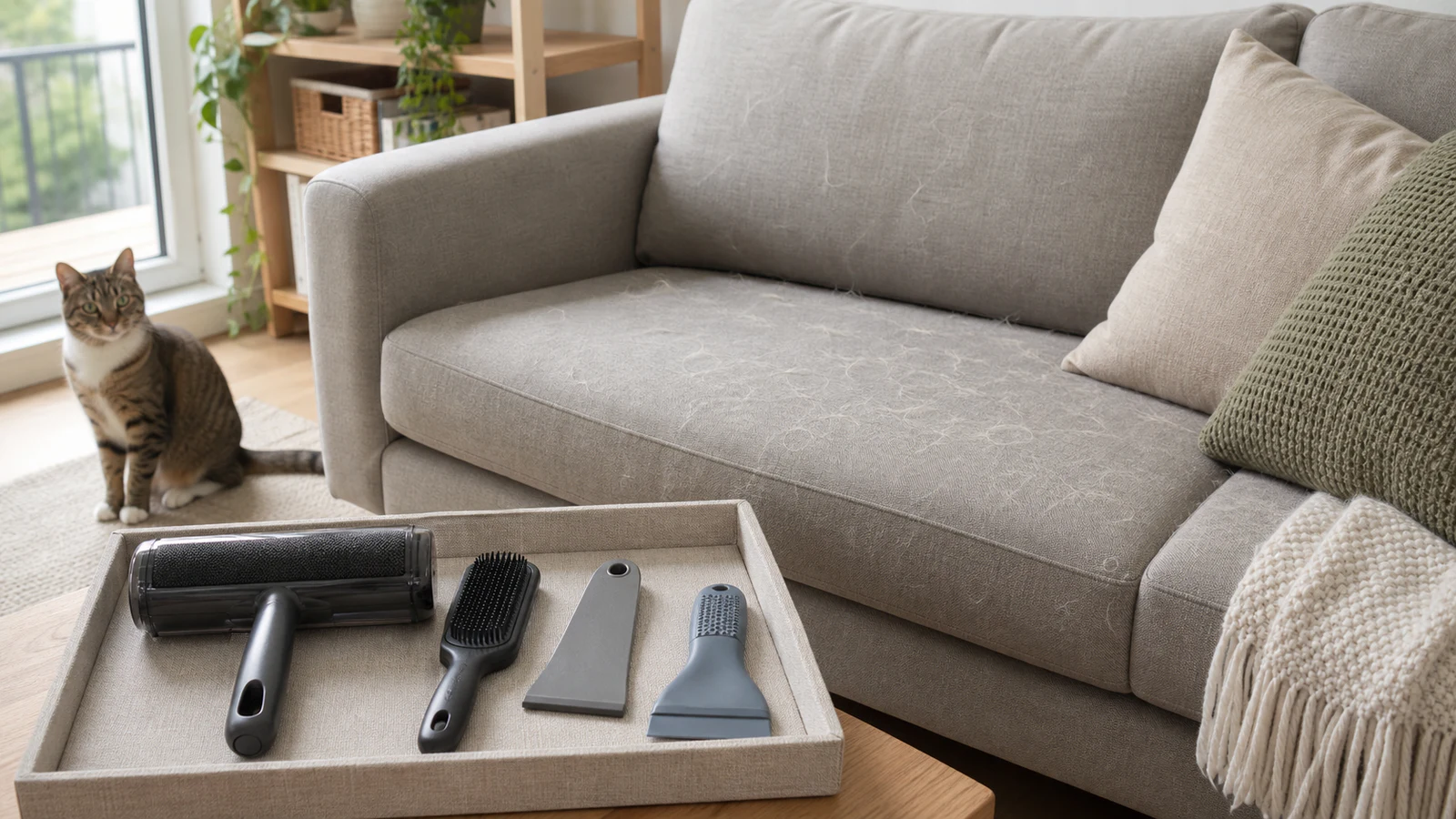
The best pet hair removers for furniture do not need disposable sticky sheets or constant refills. For apartment living, a reusable manual tool can be especially practical when it matches the furniture material, the way pet hair is embedded, and the amount of cleanup you actually need.
This guide compares six nonpowered options for apartment furniture. Every pick works without disposable adhesive sheets, charging, or a fresh consumable for each cleanup. The tools do not all solve the same problem, however. A chamber roller is convenient for routine surface fur, a directional brush offers a tidy self-cleaning reset, and a compact rubber edge can provide more focused contact for embedded hair.
Research disclosure: Tidy Pet Living did not hands-on test these tools. Selections are based on current manufacturer documentation and specifications, each tool’s mechanism and stated material limits, debris-reset method, apartment practicality, current product status, and clearly attributed independent testing where useful. Product fit below is an editorial assessment from that evidence, not a claim of universal fabric safety or measured durability.
Quick Answer(Best Pet Hair Removers for Furniture)
The ChomChom Roller Pet Hair Remover is the best overall choice for routine sofa and chair hair because its manual bidirectional roller combines broad coverage with an internal debris chamber. Choose the OXO Good Grips FurLifter Furniture Brush for a directional brush and self-cleaning base, or the Lilly Brush Mini Blade for focused work on embedded short or wiry hair.
The compact ANALAN Mini Pet Hair Remover supplies three serrated silicone edges, though its blade wears and replacement availability is unclear. Neater Pets FurDozer X6 combines broad and narrow elastomer profiles for mixed surfaces and crevices. Gonzo Pet Hair Lifter is the washable dry-contact sponge option.
No one tool is automatically best for every couch. Start with the furniture care instructions, test an inconspicuous area, and use light pressure. Stop if the surface catches, pills, distorts, scratches, develops a glossy track, changes pile direction in a lasting way, or picks up tool residue.
Table of Contents
What Counts as a Reusable Pet Hair Remover?
In this guide, a reusable pet hair remover has a working surface that can be reset and used again without installing a new adhesive sheet for the next session. It does not require a battery or charging. Hair may be emptied from a chamber, pulled from a base, pinched off an edge, rinsed from a tool when the manufacturer allows it, or washed from a sponge. The tool itself may eventually wear, but its normal operating model does not depend on a fresh consumable every time you clean.
That definition separates a genuinely reusable tool from a reusable plastic handle that accepts disposable lint-roll refills. A refillable handle may last for years, yet the hair-catching surface is still single-use. It also excludes tape, dryer sheets, fabric softener, anti-static sprays, disposable rollers, and other methods that introduce recurring waste or chemistry this comparison is not designed to evaluate.
Reusable does not mean maintenance-free or permanent. Working surfaces can wear, and manufacturer instructions still control cleaning, drying, and storage. Because shedding, furniture area, cleaning frequency, and tool care vary, this guide does not invent a lifetime-cost figure.
| Product | Best For | Mechanism | Loose Hair | Embedded Hair | Debris Handling | Consumables | Storage | Main Limitation |
|---|---|---|---|---|---|---|---|---|
| ChomChom Roller Pet Hair Remover | Best Overall | Manual bidirectional roller with internal chamber | Strong fit for routine surface pickup | Can gather some worked-in hair, but not a precision edge | Open chamber and empty collected hair | None for normal use | Drawer, basket, or slim utility bin | Broad roller is less precise in narrow seams |
| OXO Good Grips FurLifter Furniture Brush | Best Self-Cleaning Brush | Directional micro-bristle surface with self-cleaning base | Good for broad upholstery passes | Best when hair releases under directional brushing | Insert brush into base, then remove debris from base | None for normal use | Base supports neat upright storage | Working direction matters, and pile fabrics need caution |
| Lilly Brush Mini Blade | Best for Embedded Short or Wiry Hair | Compact rubber blade | Works, but its strength is focused pickup | Strong candidate for short, wiry, or more stubborn strands | Gather hair into piles and lift away by hand or vacuum | None for normal use | Very small drawer or caddy footprint | Focused edge covers less area per pass |
| ANALAN Mini Pet Hair Remover | Best Compact Multi-Edge Tool | Triangular tool with three serrated silicone edges | Useful for quick localized pickup | Multiple edges can address firmer hair with controlled contact | Pull collected hair from the edge or gather it into a pile | No session-by-session refill | Compact enough for a small bin or drawer | Blade wears, and replacement availability is unclear |
| Neater Pets FurDozer X6 | Best for Crevices and Mixed Furniture Surfaces | Multiple elastomer pads, ridges, squeegees, and detail edges | Broad elements gather loose hair | Narrow and textured elements help with seams and worked-in hair | Form piles, then lift or vacuum them away | None for normal use | Larger than mini tools but still drawer-friendly | Many surfaces require learning which edge and motion work best |
| Gonzo Pet Hair Lifter | Best Washable Sponge | Dry-contact hair-lifting sponge | Good for wiping accessible surfaces | May help on clinging hair with light repeated strokes | Remove debris, wash with mild soap, and dry fully | No disposable sheets | Needs ventilated drying space before enclosed storage | Sponge wears and cannot be stored damp |
How the Six Tool Mechanisms Differ
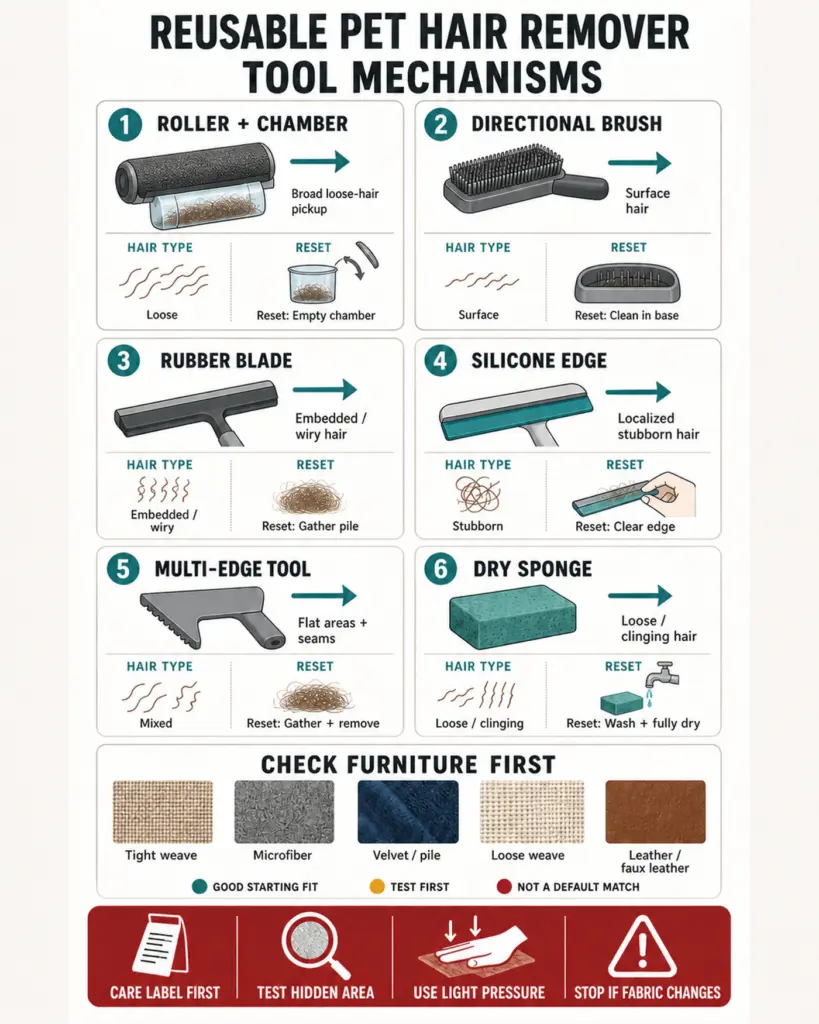
A product name tells you less than its contact mechanism. That mechanism controls the required motion, whether loose or embedded hair is the stronger fit, where debris goes, and how the tool resets. Chamber rollers and directional brushes favor broad passes; rubber, silicone, and multi-profile elastomer edges provide more focused contact; a dry sponge uses wiping friction and needs a later wash-and-dry reset. The comparison below summarizes the practical differences.
| Tool Mechanism | Motion That Matters | Best Initial Furniture Fit | Hair Pattern It Favors | Reset Style | Contact or Storage Caution |
| Bidirectional chamber roller | Short, controlled back-and-forth passes | Broad, stable woven upholstery | Loose and moderately clinging surface hair | Empty internal chamber | Housing is less useful in deep seams; do not force it over unstable fabric |
| Directional micro-bristle brush | Stroke in the marked working direction | Firm, flat upholstery that passes a hidden-area test | Loose hair and strands that release under brushing | Clean in supplied base | Direction matters; check pile change before broad use |
| Compact rubber blade | Light, short pulls | Durable tight weave and small target areas | Short, wiry, or more embedded hair | Lift the gathered pile separately | Concentrated edge contact can mark or distort sensitive surfaces |
| Serrated silicone multi-edge tool | Select one edge and make controlled pulls | Localized upholstery areas and contours | Clinging or embedded strands | Remove hair from edge or gathered pile | Blade wears; inspect for damaged edges before use |
| Multi-profile elastomer tool | Match pad, ridge, squeegee, or crevice end to the area | Mixed-shape furniture with seams and corners | Loose hair plus crevice accumulation | Gather and lift or vacuum the pile | Start with the gentlest profile; tool choice within the tool matters |
| Dry-contact sponge | Light wiping strokes while dry | Accessible surfaces approved by care guidance and patch test | Loose and statically clinging hair | Wash with mild soap and dry fully | Requires open drying space; never seal away damp |
Check the Furniture Material Before the Tool
Tight woven upholstery is the most straightforward starting point for broad rollers and brushes because the structure is stable, but a hidden-area test is still necessary. Work with light pressure and watch for fuzzing, raised threads, or a polished-looking track.
Microfiber can release hair readily, yet different finishes respond differently to friction and moisture. Check the manufacturer’s care instructions before using any tool, especially a washable tool that might retain moisture after cleaning. Never move a damp sponge directly from the sink to the sofa.
Velvet and other pile fabrics require extra restraint. Brushing can temporarily change pile direction, and aggressive repeated strokes can create an uneven appearance. Test in a concealed area, compare the spot from more than one viewing angle, and stop if the pile does not settle back as expected.
Loose weaves, knits, boucle-like textures, and looped textiles can catch on corners, serrations, or damaged tool edges. Avoid dragging a tool across a loop that begins to lift. If the test patch catches, pills, stretches, or changes the weave, that tool is not a good match.
Leather and faux leather should not be treated as ordinary fabric upholstery. Follow the furniture maker’s care guidance and avoid assuming that a friction edge, directional textile, or sponge is approved. A soft cloth or another maker-approved method may be the better route. Stop immediately for scratching, gloss change, color transfer, or residue.
Removable covers may allow a separate care route when their labels permit it. Remove loose hair before washing so it does not simply migrate through the load; our guide to removing pet hair from laundry explains that workflow. Mixed-material furniture needs zone-by-zone decisions: the tool that suits a woven cushion may not suit a faux-leather arm, wood trim, exposed zipper, or decorative piping.
The 6 Best Reusable Pet Hair Removers for Furniture
1. ChomChom Roller Pet Hair Remover — Best Overall
Why We Picked It: ChomChom combines broad manual pickup with an internal chamber, containing everyday furniture fur without adhesive refills, a cord, or charging.
Best Fit: Use it for routine passes over accessible upholstery that passes a patch test, especially when visible surface shedding returns often.
How It Works: Short back-and-forth strokes transfer hair into the built-in chamber; avoid long, forceful scrubbing.
Furniture and Hair Fit: The broad working area favors loose and moderately clinging hair on stable upholstery. It may gather some hair worked into the surface, but a large roller housing is not the most exact tool for deep seams, narrow piping, or the inner edge of a fixed cushion.
Debris Handling and Reset: Open the chamber and remove the collected bundle. That contained reset is cleaner than carrying an exposed hair pile across a studio apartment. Check that the chamber and working surface are clear before putting the tool away.
Apartment Storage: One shallow drawer, utility basket, or narrow caddy is sufficient; no backup rolls are needed.
Important Limitations: ChomChom does not remove stains, sanitize fabric, or replace deep cleaning. It is also not a universal match for delicate pile, loose weaves, or leather-like surfaces. Test first and stop for catching, distortion, or an unwanted finish change.
Bottom Line: Pick ChomChom when frequent broad-surface hair, simple emptying, and contained debris matter more than precision in tight crevices.
2. OXO Good Grips FurLifter Furniture Brush — Best Self-Cleaning Brush
Why We Picked It: OXO pairs a directional hair-lifting surface with a self-cleaning base that keeps the brush organized and reduces hand-picking fur from its working face.
Best Fit: Consider it for broad, firm upholstery and households that value directional brushing plus an upright storage station.
How It Works: Brush in the indicated direction, then insert and remove the brush from its base to strip debris. Random scrubbing is not the intended motion.
Furniture and Hair Fit: The brush is a good candidate for loose hair and strands that cling to woven upholstery. Pile fabrics, delicate weaves, and surfaces that show directional marks need a cautious hidden-area test. Use light passes instead of pressing down to chase every strand.
Debris Handling and Reset: The base resets the brush, but the captured debris still needs to be removed from the base. Empty it over a waste bin so fur does not return to the room, and inspect both components before storage.
Apartment Storage: The base protects the working surface and supports upright storage, though it needs more vertical room than a mini blade.
Important Limitations: This is not a precision crevice tool, and its directional contact is not automatically appropriate for velvet, boucle, loose knit, or leather. A self-cleaning label describes the brush reset; it does not mean the base empties itself or the furniture is cleaned beyond hair pickup.
Bottom Line: Choose the FurLifter Furniture Brush when a tidy, repeatable reset and dedicated storage base outweigh the need for the smallest possible tool.
3. Lilly Brush Mini Blade — Best for Embedded Short or Wiry Hair
Why We Picked It: A small rubber edge gives focused control over stubborn short or wiry strands, while its listed 3 by 4 by 0.75-inch size is easy to store.
Best Fit: It suits localized hair in compatible tight woven upholstery and can complement, rather than replace, a broad tool.
How It Works: Short, light pulls shift clinging strands into a pile. Change angle before adding pressure, because concentrated force can be harder on fabric.
Furniture and Hair Fit: The blade’s strength is controlled work on embedded short or wiry hair. It can also collect loose fur, but its small contact area makes it slower across an entire sectional. Avoid loops, unstable knits, delicate pile, and any surface where the edge catches or leaves a visible track.
Debris Handling and Reset: Hair generally gathers outside the tool rather than inside a chamber. Pinch up the pile, use an already available suitable vacuum, or transfer it directly to a waste bin. Wipe or clean the tool only as its care directions permit, then let it dry before storage if moisture was used.
Apartment Storage: Give this small tool a fixed drawer or caddy compartment rather than leaving it between cushions.
Important Limitations: A small blade trades broad-area speed for precision. The friction that helps with stubborn hair also demands careful material screening. It does not justify hard scraping, and it should never be treated as universally safe for every upholstery or finish.
Bottom Line: Choose the Mini Blade when embedded short or wiry hair is the main problem and you want focused control in a very small storage footprint.
4. ANALAN Mini Pet Hair Remover — Best Compact Multi-Edge Tool
Why We Picked It: Three serrated silicone edges in one triangular body provide several contact profiles without requiring separate tools.
Best Fit: It suits localized clinging hair when several edge depths or contact angles are useful and the user will choose carefully.
How It Works: Make controlled pulls with one selected edge. Switch edge or angle before increasing force, and avoid loose threads, stitching, and exposed zippers.
Furniture and Hair Fit: The multiple edges can address both loose strands and more embedded hair on compatible, stable upholstery. The small shape navigates localized contours better than a broad roller. On looped, knitted, piled, leather, or faux-leather surfaces, assume nothing until care guidance and a patch test support use.
Debris Handling and Reset: Collected hair may cling to an edge or form a pile on the furniture. Remove it by hand over a bin or use an appropriate separate pickup method. Inspect the silicone after cleaning and before each use; a worn or damaged edge changes how it contacts fabric.
Apartment Storage: Keep it clean and dry in a divided drawer, without heavy objects pressing against its edges.
Important Limitations: The manufacturer notes that the blade wears, while replacement availability is unclear. That makes this reusable but not permanent. Do not promise a lifespan, and do not assume a replacement edge will be obtainable when the original contact surface is no longer serviceable.
Bottom Line: Pick ANALAN when you value three contact options in one compact body and accept that its blade is a wear component with an uncertain replacement path.
5. Neater Pets FurDozer X6 — Best for Crevices and Mixed Furniture Surfaces
Why We Picked It: Its elastomer pads, ridges, squeegees, and crevice features address flat cushions, seams, piping, corners, and narrow hair traps.
Best Fit: It suits mixed furniture geometry; its listed 7.5 by 3.88 by 1.75-inch body remains manageable in an apartment caddy.
How It Works: Match a broad, textured, or narrow profile to the zone and pull with low pressure. Patch-test each contact surface separately.
Furniture and Hair Fit: The broad profiles can corral loose hair, while the narrower ridges and crevice shapes can address strands lodged along cushion boundaries. This versatility is useful on mixed-shape furniture, but material limits still apply. Do not drag a narrow ridge across loops, unstable stitching, leather, or trim without explicit care compatibility.
Debris Handling and Reset: FurDozer generally forms visible lines or piles rather than enclosing debris. Lift the pile into a bin or use a suitable vacuum for the final pickup. Clear hair from its profiles so dried debris does not interfere with the next session.
Apartment Storage: It needs more room than a mini blade; a dedicated bin protects its profiles from lint and pressure.
Important Limitations: Six working features can be useful, but they also create a learning curve. The most aggressive-looking edge is not automatically the correct one. Start broad and gentle, observe the surface, and move to a narrower profile only when necessary.
Bottom Line: Choose the FurDozer X6 when seam and crevice access matters as much as open-surface pickup and you are comfortable matching different profiles to different zones.
6. Gonzo Pet Hair Lifter — Best Washable Sponge
Why We Picked It: This dry-contact sponge uses no adhesive sheets and can be washed with mild soap, making it the clearest washable option here.
Best Fit: It suits approved, patch-tested surfaces when quiet wiping and a separate wash-and-dry reset are acceptable.
How It Works: Use it dry with light wiping strokes. Afterward, remove debris and wash with mild soap according to the product directions.
Furniture and Hair Fit: The sponge can address loose and statically clinging fur on compatible accessible surfaces. Repeated light passes may help with more persistent strands, but it is not a rigid crevice edge. Check carefully for drag, residue, color transfer, pile disturbance, or gloss change.
Debris Handling and Reset: Unlike a chamber tool, the sponge requires a deliberate aftercare step. Wash it with mild soap, rinse as directed, and allow it to dry fully in a ventilated location. A damp sponge should not return to an enclosed cabinet or touch the furniture.
Apartment Storage: Provide open drying space, then store it away from dish sponges and food-contact items.
Important Limitations: The sponge wears with use, so reusable does not mean indefinite. Drying time may be inconvenient when storage is enclosed or ventilation is poor. This method also leaves debris management more hands-on than a chamber roller or self-cleaning base.
Bottom Line: Choose the Gonzo sponge when washable simplicity matters and you can provide a hygienic, fully ventilated drying and storage routine.
Loose Hair, Embedded Hair, and the Right Amount of Contact
Loose surface hair rewards coverage. Use a material-compatible chamber roller, directional brush, broad elastomer profile, or dry sponge, and reset it before overload. For a broader plan, see how to control pet hair in an apartment.
Embedded hair needs precision, not automatically more force. Use short passes with a compatible rubber, silicone, or narrow elastomer edge. Stop if a thread rises or the surface pills, stretches, shines, or holds a lasting mark.
Crevice hair may simply be inaccessible to a broad tool. Use an approved narrow profile, collect the pile, and never push into mechanical parts or spaces you cannot see safely.
Self-Cleaning Reset vs Manual Reset
“Self-cleaning” describes working-surface reset, not the complete cleanup. OXO’s base strips its brush and ChomChom’s chamber contains debris, but both still require emptying. Their advantage is containment.
Lilly Brush, ANALAN, and FurDozer usually leave an exposed pile for separate pickup. Gonzo adds a later wash-and-dry reset. Choose the handling step you will complete.
Reset at the end of the zone and return the clear, fully dry tool to storage.
Apartment Storage and One-Tool vs Two-Tool Setups
In a small apartment, a nearby tool may be used more consistently than a specialized one stored out of reach. Keep it separate from kitchen sponges, grooming tools, and wet supplies in a divided caddy or dry bin.
A one-tool setup suits similar, stable upholstery and mostly loose hair. ChomChom is balanced, OXO prioritizes its base, and FurDozer handles varied geometry.
For broad shedding plus embedded spots, pair a chamber roller or brush with Lilly Brush, ANALAN, or a FurDozer detail profile.
Protect working edges and dry washable tools fully. For prevention, compare couch covers for pets in apartments; a hair remover does not protect against moisture, claws, or soil.
Reusable Tools vs Disposable Lint Rollers
Disposable lint rollers require another adhesive sheet when one fills. A reusable chamber, brush, edge, or sponge resets without that normal refill cycle.
The tradeoff is technique and care: directional strokes, pressure control, or drying time. Reusable tools also wear, so the choice is a maintained resettable mechanism versus recurring sheets—not “free forever.”
Washable sticky rollers are excluded because they form a different mechanism category with separate residue, washing, and drying questions.
Manual Pet Hair Remover vs Handheld Vacuum
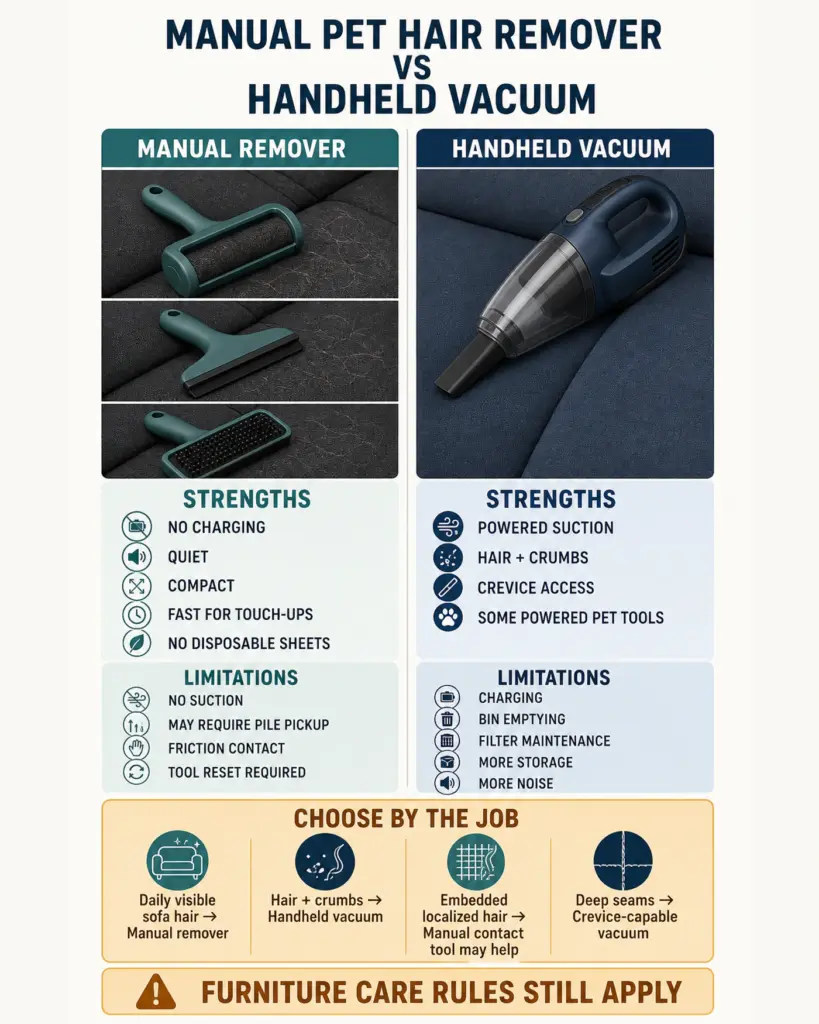
A manual remover is quiet, compact, and useful for quick touch-ups or focused embedded strands. It can gather seam hair for final pickup.
A suitable vacuum can handle final pickup, larger areas, floors, and furniture in one session. Compare vacuums for pet hair in small apartments for that primary role; a manual tool is a complement.
Neither category guarantees fabric safety; follow care instructions and stop at surface change.
Match the Tool to the Apartment Situation
| Apartment Situation | Best Tool Trait | Good Match | Main Tradeoff |
| Daily loose hair on a compact sofa | Broad pickup with contained debris | ChomChom Roller | Less precise in narrow seams |
| You want a defined storage station and quick brush reset | Directional brush with self-cleaning base | OXO FurLifter Furniture Brush | Base takes vertical space and still needs emptying |
| Short, wiry hair is worked into one cushion | Small focused rubber edge | Lilly Brush Mini Blade | Slower across a large sofa |
| Storage is extremely limited but several edge profiles help | Compact triangular multi-edge body | ANALAN Mini Pet Hair Remover | Wear component has an unclear replacement path |
| Hair collects across flat cushions, piping, and crevices | Multiple broad and narrow elastomer profiles | Neater Pets FurDozer X6 | Requires learning which profile suits each zone |
| You prefer a washable non-adhesive tool | Dry-contact washable sponge | Gonzo Pet Hair Lifter | Needs mild-soap washing and complete ventilated drying |
| Broad surface hair plus stubborn seam hair | Two complementary mechanisms | ChomChom or OXO plus Lilly, ANALAN, or a FurDozer detail edge | More storage and two reset routines |
Use the table only after material screening. Mixed furniture may require a different decision for every zone—and no listed tool on some zones.
Common Buying Mistakes
Buying by pet type instead of hair behavior. Identify whether the dominant problem is loose, embedded, or trapped in a seam.
Assuming every surface tolerates friction. Materials respond differently. Follow care instructions and test out of sight; “furniture tool” is not universal approval.
Pressing harder when pickup slows. Reset the tool or change a compatible motion; stop for distortion, catching, pile change, or gloss.
Confusing self-cleaning with self-emptying. A base or chamber still needs manual emptying.
Ignoring final pickup. Edge tools often corral rather than contain hair, so plan how the pile reaches the bin.
Treating “reusable” as “permanent.” Inspect for wear, cracks, roughness, deformation, or residue, and retire damaged tools.
Storing a washable tool while damp. The Gonzo sponge needs complete drying in a ventilated place. A damp tool in a closed caddy can create odor and hygiene problems and may transfer moisture on the next use.
Using a furniture tool as a cleaning or sanitizing method. These products remove hair. They do not remove every soil, treat stains, disinfect upholstery, or resolve odor at its source. Follow the furniture maker’s care method for those separate jobs.
Buying too many overlapping mechanisms. A broad tool plus one precision tool is often more useful than a drawer full of similar products. Start with the mechanism that addresses the largest recurring zone, then add a second only if a distinct gap remains.
Choosing a refill handle while expecting a refill-free system. Read the operating model, not just the word “reusable.” If the working surface is discarded and replaced after it fills, it does not meet this guide’s definition.
Final Verdict
The ChomChom Roller Pet Hair Remover is the best overall reusable choice for routine apartment furniture because it combines broad manual pickup, an internal debris chamber, and a refill-free workflow. The OXO Good Grips FurLifter Furniture Brush is the better fit for shoppers who prioritize a self-cleaning base, while the Lilly Brush Mini Blade offers the most focused option here for embedded short or wiry hair.
Choose ANALAN for compact multi-edge control, FurDozer X6 for mixed furniture shapes and crevices, or the Gonzo Pet Hair Lifter for a washable sponge workflow. Whichever mechanism you choose, let the furniture material set the boundary: follow care instructions, patch-test, work lightly, reset the tool fully, and stop at the first sign of catching or surface change.
Sources
- ChomChom Roller — Official Product Page
- OXO Good Grips FurLifter Furniture Brush — Official Product Page
- Lilly Brush Mini Pet Hair Detailer — Official Product Page
- ANALAN Mini Pet Hair Remover — Official Product Page
- Neater Pets FurDozer X6 — Official Product Page
- Gonzo Pet Hair Lifter — Official Product Page
- Good Housekeeping — Best Pet Hair Removers