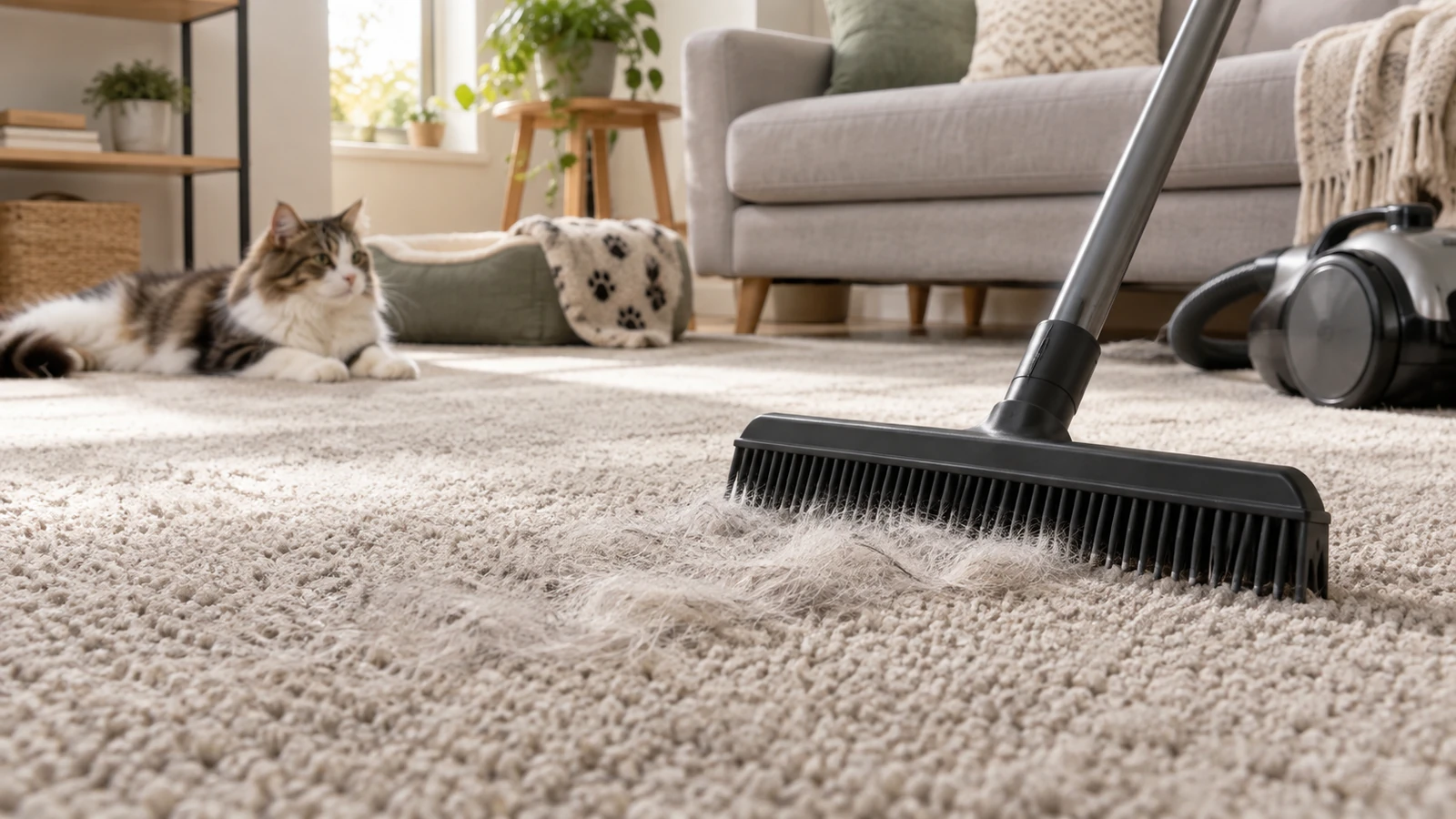
To remove pet hair from carpet without damaging the pile, begin with dry pickup and the gentlest compatible contact. Collect loose hair with a vacuum set for the carpet construction, then work embedded hair in small zones with slow overlapping passes. Use an edge tool for baseboards and corners and a compact attachment for stairs. Stop if the carpet fuzzes, sheds long yarns, snags, stretches, or becomes harder for the vacuum to move across.
The right method depends on the carpet. Most ordinary cut-pile styles can use a correctly adjusted rotating brush, while shag, long pile, thick loop, wool, wool-blend, and very soft carpets may require suction only or a brush lifted away from the pile. The carpet manufacturer’s care instructions always take priority over a generic pet-hair trick.
This guide covers dry hair removal from installed carpet. It does not cover urine, stains, odor treatment, wet extraction, or washing an area rug.
Quick Answer
Use this sequence:
- Identify the carpet construction and read its care or warranty instructions.
- Pick up large objects and check the pile for loose loops, sprouts, fringe, cords, or wet messes.
- Empty the vacuum bin or fit a fresh bag; inspect the approved-access brush and airflow path.
- Make a slow test pass in a hidden area with the gentlest suitable setting.
- Vacuum the main field in overlapping lanes, then cross the direction only if the carpet permits it.
- Use a crevice or edge tool along walls, under radiator edges, and around fixed furniture.
- Treat stubborn hair in a small section with a compatible upholstery or carpet tool, using light pressure.
- Finish with another vacuum pass so loosened hair leaves the carpet instead of moving to another room.
Do not scrape with a knife, razor, metal blade, or sharp card. Do not pull a loop or long tuft. Do not mist the carpet with a homemade solution simply to make dry hair easier to grab.
Table of Contents
Why Pet Hair Stays in Carpet
Loose hair rests on the top of the pile and usually responds to airflow and ordinary vacuum contact. Embedded hair has been pressed between yarns by foot traffic, furniture, rolling chairs, or repeated pet movement. It may lie with the pile direction, collect at a transition, or twist around surface fibers.
Static and fiber texture can affect how easily hair releases, but the practical question is simpler: is the hair sitting on top, lying between tufts, packed at an edge, or wound around a damaged loop? Each location needs different contact.
Fast passes often collect only the visible layer. If the vacuum head moves too quickly, airflow and agitation have less time over each section. The Carpet and Rug Institute recommends slow, repetitive, overlapping motions and extra attention at edges. Shaw similarly recommends slow overlapping strokes for routine carpet care.
More aggression is not automatically better. A low brush setting can press too hard into some carpets. Shaw advises testing a beater or brush bar in a hidden area to make sure it does not produce excessive fuzzing. CRI warns that rotating brushes can cause severe, sometimes irreparable texture change in some high-pile carpets.
The goal is to create enough airflow and safe agitation to release hair, then capture it. A tool that merely rolls hair into clumps has completed only the loosening step.
Identify the Pile Before Choosing a Tool
You do not need to become a carpet technician, but you do need to notice how the yarn is built.
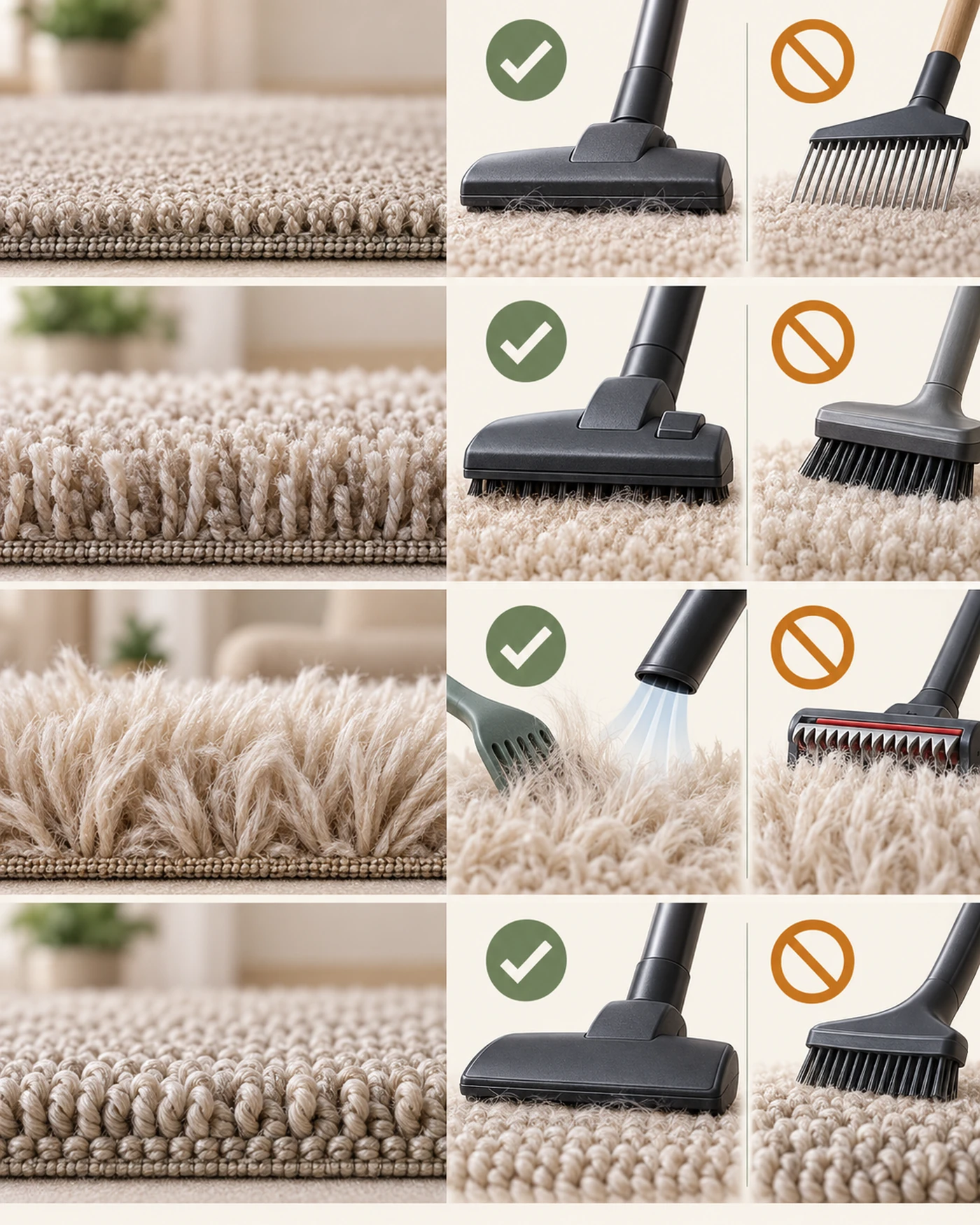
Cut pile has yarn ends cut at the surface. It may look plush, textured, frieze-like, or dense and short. Many cut-pile carpets tolerate a rotating brush when the height is correct, but very soft, high, or long styles can still require special care.
Loop pile has uncut loops. The loops may be level, patterned, or combined with cut sections. A protruding loop can catch on a rake, hook, brush defect, or sharp tool. Do not pull it.
Shag, cable, and other long-pile styles can wrap around a rotating brush. CRI recommends a suitable straight-air system for some high-pile carpets, using a head without brush-roll agitation or abrasive hook-like strips.
Wool and wool blends can be sensitive to brushing or rubbing. Shaw advises suction-only cleaning or a raised adjustable brush for thick loop, wool, wool-blend, shag, and some long-pile carpet.
If you are unsure, find the manufacturer and product name in the lease packet, purchase receipt, leftover sample, or installation paperwork. A renter should ask the property manager before using a high-friction tool on an unknown floor.
| Carpet condition | First vacuum setup | Manual-tool boundary | Stop sign |
|---|---|---|---|
| Ordinary low or medium cut pile, maker permits agitation | Rotating brush at the correct height; test first | Soft carpet or upholstery tool with light pressure | New fuzzing, pulled yarn, or difficult head movement |
| Dense plush or premium soft carpet | Manufacturer-approved vacuum; often higher adjustment and open airflow | Use only a tool the carpet maker permits | Head seals down, pile distorts, or vacuum is hard to push |
| Thick loop, wool, or wool blend | Suction only or brush lifted away if directed | Avoid hooked, toothed, or high-friction contact | A loop lifts, yarn frays, or surface becomes fuzzy |
| Shag, cable, or long pile | Purpose-suited straight-air head; no rotating brush when directed | Avoid rakes or tools that can catch long yarn | Yarn wraps around the tool or brush |
| Unknown installed carpet in a rental | Gentlest suction test in a hidden area | Pause before using rubber edges, stiff brushes, or scraping tools | Construction or care rule cannot be verified |
| Carpet with a loose loop, sprout, wrinkle, or open seam | Do not vacuum directly over the defect | Keep tools away and document the defect | Any pulling, zippering, seam movement, or increased damage |
Prepare the Carpet and Vacuum
Dry hair removal should begin on a dry carpet. If there is urine, vomit, a spill, cleaning solution, or damp residue, isolate that area and follow the appropriate material-specific cleanup. Vacuuming a wet biological mess can contaminate a machine and spread residue.
Pick up strings, cords, socks, small toys, food, litter clumps, and hard debris that can jam a brush or damage the pile. Look for staples at a transition, a loose seam, a lifted loop, or a carpet sprout. Do not run a rotating head over a known defect.
Check the vacuum by its manual. Empty a bagless bin before it reaches its maximum line, or replace a bag when the indicator or instructions call for it. Inspect the floor head, brush ends, intake, hose, filter status, and wheels only where the manual permits access.
Pet hair around the brush ends can change how the head contacts carpet. A damaged wheel, burr, sharp edge, or jammed roller can mark the pile even when suction still sounds normal. If the vacuum needs maintenance, use the guide to clean pet hair out of a vacuum before another carpet pass.
Adjustable height should let the head contact the carpet without pressing deeply into it. If the vacuum is difficult to push, the motor pitch changes sharply, the carpet lifts, or the brush visibly digs in, stop. Raise the height, reduce suction if the manual allows it, disengage the brush, or use a compatible straight-air head.
Test inside a closet or behind fixed furniture where any appearance change will be less visible. Make several slow passes, then look from more than one direction. Cut-pile carpet can show normal light-and-dark shading as the pile direction changes, so distinguish a reversible grooming mark from fuzzing, fraying, or a pulled yarn.
How to Remove Pet Hair From Carpet Step by Step
1. Divide the room into small lanes
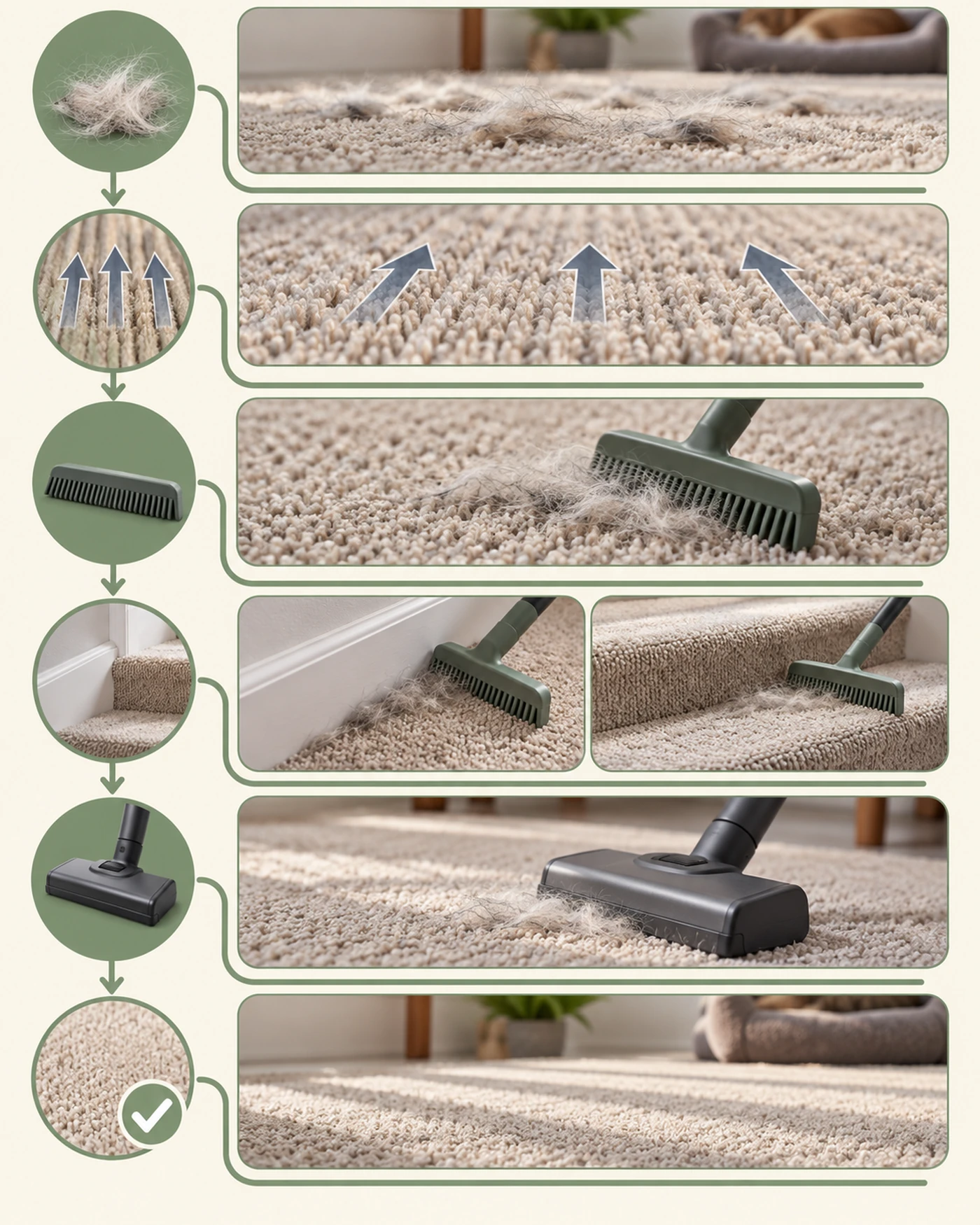
Start at the far side and work toward the exit. In a studio or one-bedroom apartment, use furniture edges or imaginary strips about the width of the vacuum head. A lane system shows what has been covered and prevents rushed diagonal passes.
Move only light objects you can handle safely. Do not drag furniture across carpet. Vacuum the exposed field first, then address accessible edges and furniture footprints.
2. Collect the loose layer
Use slow forward-and-back passes that overlap. Let the machine’s airflow and approved brush action do the work instead of pressing down on the handle. Extra force can reduce airflow at some heads and increase friction without improving pickup.
Check the bin or bag early during the first session. A small apartment can produce a surprising volume of hair when the carpet has not been cleaned in lanes. If the bin fills or the bag indicator changes, reset it according to the manual before judging performance.
3. Change direction only when the carpet allows it
For many ordinary carpets, a second set of passes across the first direction can expose hair lying between tufts. CRI notes that cleaning efficacy on high pile can improve when a suitable tool works from multiple directions.
That is not a universal command. Do not turn a heavy rotating head across a long, looped, delicate, or damaged pile. If the manufacturer specifies a pile direction or suction-only tool, follow that instruction.
4. Release embedded hair in a test zone
Choose a small square near the pet’s resting or traffic area. First make additional slow vacuum passes. If hair remains, try the carpet-safe attachment supplied or approved for the vacuum.
A manual tool may help gather hair when it has a smooth, clean working edge and the carpet maker permits that contact. Use short strokes with light pressure. Work over the tops of the yarns rather than digging into the backing.
Pause after several strokes. If you see pet hair collecting, vacuum it up. If you see carpet fiber, fuzz, long yarns, or a lifted loop, stop. Do not assume every fiber in the pile is pet hair.
5. Finish the edges and corners
Hair concentrates where the main head cannot reach: along baseboards, at door transitions, beside floor vents, under cabinet toes, and around furniture legs. Use a crevice or edge tool without scraping the wall or pulling at the carpet edge.
Move the tool parallel to the edge and keep the opening slightly above any exposed yarn or seam. Do not jam it under a tack strip, transition bar, or baseboard gap.
6. Clean stairs one tread at a time
Switch off and unplug a corded machine before changing attachments. Place a canister or full-size vacuum on a stable floor or landing rather than balancing it on a step. Follow the manual’s stair-use instructions and keep the cord behind your work path.
Use a compact, compatible head. Clean the tread field, then the back edge and the curve or nose only as the carpet construction permits. Do not run a large rotating head over an unsupported stair edge if the manual does not approve that use.
7. Capture every loosened clump
Manual tools often roll hair into cords or piles. Pick up large clumps by hand with a glove if appropriate, then vacuum the fine remainder. Do not leave piles at the room edge where shoes, paws, or airflow will redistribute them.
8. Reset the equipment
Check the bin, bag, brush, attachment, wheels, and filter indicators after the job. Follow the manual for removing wrapped hair and cleaning parts. Let any washable part dry for the specified time before reassembly.
Store the vacuum and manual tool clean and dry. A hair-covered rake in a closet simply moves debris into the next room.
Use Manual Hair Tools Without Treating Carpet Like Fabric
Reusable furniture tools, damp gloves, rubber-edged brushes, carpet rakes, squeegees, lint rollers, and pumice-like blocks often appear in pet-hair advice. Their contact varies widely, and a tool that works on a sturdy sofa fabric can be too aggressive for installed carpet.
A smooth rubber or silicone edge can create friction that gathers hair on some durable cut-pile surfaces. Use it only after a hidden test and only if the carpet guidance does not warn against rubbing. Keep the angle low, the pressure light, and the stroke short. Clean the edge so trapped grit does not become an abrasive.
A soft carpet brush or upholstery attachment can loosen surface hair when its bristles do not catch yarn. Stiff teeth, metal tines, hook material, and damaged plastic edges add snag risk. Avoid them on loop, shag, cable, wool, delicate, or unknown carpet unless the manufacturer explicitly approves the tool.
An adhesive lint roller can collect a small remaining patch, but it is inefficient for a room and may leave residue depending on the product. Do not press tape into a deep pile or use an adhesive that the carpet maker has not approved.
A lightly damp glove is sometimes suggested to reduce flying hair, but adding moisture changes this from a dry process. On an unknown carpet, skip it. Moisture can transfer soil, leave residue from the glove, or interfere with a later stain treatment.
Do not use a razor, utility knife, metal scraper, serrated blade, pet deshedding tool, or abrasive stone. These can cut yarn, pull tufts, or change the pile surface. If a carpet fiber stands above the surface, CRI advises clipping a true sprout rather than pulling it, but identifying and repairing a snag or loop can require a professional. Do not treat every visible strand as expendable.
Match the Technique to the Hair Location
Open floor
Use lanes and slow overlap. If the pile permits cross-direction work, make the second pass at roughly a right angle. The open field should take most of the vacuuming time because this is where foot traffic presses hair down.
Baseboards and corners
Use the crevice tool after the main field. Pulling the edge pile upward with fingers or a hook can loosen the installation. Keep suction at the surface and move parallel to the wall.
Doorways and transitions
Hair can bind against a metal, wood, or vinyl transition. Inspect for sharp edges before vacuuming. Approach from the carpet side and avoid striking the bar repeatedly with a rotating head.
Under beds and sofas
Use the vacuum’s low-profile head or approved wand attachment. Check first for cords, fabric dust covers, rug pads, and lost objects. A head that fits under the frame may still catch sagging upholstery.
Stairs
Work from a stable position with a light attachment. The back edge and stair nose need separate angles. Secure the power cord and avoid placing the main machine where it can fall.
Pet resting zones
These areas often combine hair with skin flakes, tracked soil, toy fibers, and food crumbs. Remove the bed or washable cover first and clean it by its own care label. Vacuuming the carpet while a dirty bed remains beside it invites immediate re-transfer.
| Zone | Best first pass | Detail step | Common damage risk |
|---|---|---|---|
| Open room field | Slow overlapping lanes with the correct head height | Cross-direction pass only if the pile permits | Low brush setting, rushed passes, repeated pressure |
| Baseboard edge | Main head close to the edge without striking the wall | Crevice tool parallel to the edge | Pulling edge yarn or pushing into the tack area |
| Door transition | Approach slowly from the carpet side | Crevice tool beside, not under, the strip | Catching loose yarn or hitting a sharp transition |
| Under furniture | Low-profile approved head after object check | Wand or upholstery attachment | Catching cords, dust covers, or rough furniture hardware |
| Stair tread | Compact stair tool from a stable position | Crevice tool at the back edge | Balancing the vacuum, snagging the nose, cord trip hazard |
| Pet bed footprint | Remove the bed and vacuum the exposed carpet | Clean bed separately by its care label | Moving hair back from an unchanged bed |
Vacuum Settings Matter More Than Headline Suction
Pet-hair pickup is a system: airflow, floor-head seal, brush contact, pass speed, filtration, bin or bag condition, and carpet construction. A larger suction claim does not show whether the head will glide on plush carpet or protect long pile.
For most ordinary carpet styles, Shaw recommends a rotating brush or combination bar to agitate the pile and loosen soil. It also tells users to adjust the height to the pile. For shag, long yarn, thick loop, wool, and wool blends, Shaw recommends suction only or lifting the brush away.
Mohawk likewise emphasizes adjustable height. Too high can leave material behind; too low can fuzz the surface. The correct setting lets the brush lightly contact compatible carpet without burying the head.
If your current vacuum cannot be adjusted or safely moved on the installed carpet, an attachment change may solve the problem. When it does not, the buying decision belongs in the guide to best vacuums for pet hair in small apartments. This article does not rank machines.
A handheld vacuum can be useful on stairs and small edges, but only with a carpet-compatible attachment. Compare that role in the handheld vacuum guide for pet hair. A compact motorized brush can still snag unsuitable pile.
How Many Passes Should You Make?
Use the result rather than a fixed universal number. CRI’s consumer guidance describes slow, repetitive, overlapping motions and gives about four swipes as a practical example. That supports patience, not a rule that every carpet needs exactly four passes.
Start with one slow forward-and-back set over a lane. Check the bin and inspect the pile. Add another pass when hair is still releasing and the carpet shows no adverse change. Cross the direction only when allowed.
Stop when pickup has tapered, the carpet looks stable, and another pass produces little hair. Ten aggressive passes over a snag do not become safe because the bin is still collecting something.
During heavy shedding, more frequent short sessions can be gentler than allowing hair and grit to become pressed into traffic lanes. CRI suggests at least weekly vacuuming for floor coverings and more frequent work in pet or high-traffic areas, adjusted to actual use.
For a whole-apartment plan across floors, furniture, laundry, and airflow, see the pet hair in apartments control guide. Carpet is one collection zone within that system.
Troubleshoot Hair That Will Not Come Up
If hair remains after slow compatible passes, do not jump directly to a sharper tool. Diagnose the limiting step.
The bin or bag may be full. A filter indicator may show restricted airflow. The brush may be wrapped or not turning. The height may be too high to contact the pile, or too low to glide. The floor head may be wrong for the carpet. Hair may be packed at an edge the main head cannot reach.
Some visible strands may be carpet fiber rather than pet hair. CRI explains that normal shedding can occur in a new cut-pile carpet and pile shading can make a cleaned area look different as light reflects from another direction. A long continuous yarn, a loop, or a strand attached at both ends should not be pulled.
The carpet may also be matted or crushed. Dry hair removal can collect hair within reach, but it cannot restore every structural appearance change. CRI notes that matting can involve yarn untwisting and intermingling and may be affected by traffic, cushion, vacuuming, or cleaning.
| Result after a test pass | Likely issue to check | Next safe action | Do not |
|---|---|---|---|
| Hair stays on top | Pass too fast, weak airflow, full bin/bag, or wrong attachment | Reset the vacuum and repeat slowly with overlap | Press harder without checking the machine |
| Hair gathers but remains in clumps | Manual tool loosened it but did not capture it | Pick up large clumps and finish with suction | Sweep clumps into another room |
| Vacuum is hard to push | Height too low, suction seal too strong, or head unsuitable | Raise height, use allowed suction control, or change to approved head | Force the machine through the pile |
| New fuzz appears | Brush or manual friction may be too aggressive | Stop and compare the hidden test area | Continue until the surface looks uniform |
| Long yarn or loop lifts | Carpet fiber may be snagged | Stop, protect the spot, and contact the retailer or repair professional | Pull, shave, or cut an unknown loop |
| Hair remains in a traffic lane after safe dry work | Hair may be deeply embedded or pile may be matted | Ask a carpet professional about the carpet condition | Add water or chemical spray to a dry-hair task |
| Pickup drops during the room | Bin, bag, filter, airway, or brush may need service | Follow the exact vacuum manual | Dismantle sealed or powered components |
Common Pet-Hair Removal Mistakes
The first mistake is using the same rotating brush on every carpet. A brush that helps ordinary cut pile can wrap long yarn or alter high-pile texture.
The second is lowering the head until it feels powerful. If it seals to the carpet, the vacuum can become hard to push and the brush can contact too aggressively.
The third is confusing carpet shading with dirt. Plush pile may look lighter or darker after a pass because the yarn points another way. Inspect from multiple angles before repeating the lane.
The fourth is scraping. Sharp tools can cut yarn and stiff tools can pull loops. Even a smooth rubber edge needs a clean surface, light pressure, and a hidden test.
The fifth is spraying water, fabric softener, vinegar, or another solution into the carpet for static control. That introduces residue and moisture into a task that should remain dry. It can also complicate later stain work.
The sixth is working the open floor while ignoring edges, stairs, under-furniture zones, and the pet bed. Hair left in those reservoirs returns quickly to the cleaned field.
The seventh is failing to reset the vacuum. Wrapped brush ends, a full bin, or a restricted filter can make the next session slower and less predictable.
The eighth is treating a damaged pile as a cleaning challenge. Loose seams, wrinkles, sprouts, zippering loops, delamination, or persistent matting may need repair or professional assessment.
Apartment-Specific Setup
In a studio, clear one zone at a time and use the bed or sofa edge as the lane boundary. Keep the vacuum cord and hair piles out of the only walking route. Empty the bin before it overflows; there may be no separate utility room for dusty maintenance.
In a one-bedroom, begin with the pet’s highest-use zone and then the hallway. Closing a finished room can reduce re-transfer while you work elsewhere. Clean attachments before moving from a dirty entry area to a bedroom carpet.
On carpeted stairs, use a lightweight attachment and stable machine position. Do not block the stairway with tools where another person or pet may enter unexpectedly.
If the apartment has hard floors around a carpeted room, vacuum the carpet first or contain its loosened hair, then clean the hard-floor perimeter with the appropriate dry tool. Otherwise, the transition becomes a collection strip.
Store one compact manual tool with the vacuum rather than several unverified scrapers. A simple kit might include the approved floor head, crevice tool, stair or upholstery attachment, clean collection bag, and scissors reserved for vacuum-brush maintenance—not for cutting carpet.
When to Stop DIY Hair Removal
Stop when the carpet develops new fuzzing, fraying, lifted loops, pulled yarn, open seams, ripples, backing exposure, or a burn smell from the machine. Stop if the vacuum repeatedly stalls, overheats, damages a belt, or cannot move at a manufacturer-compatible setting.
Contact the carpet manufacturer, retailer, property manager, or qualified carpet professional when the construction is unknown and valuable, a loop has begun to zipper, a seam is opening, the carpet is loose on stairs, or the pile is severely matted.
A renter should photograph any defect before and after a hidden test. Do not try to disguise damage with shaving, trimming, glue, heat, or a stronger brush.
Hair removal is also the wrong task when the area is wet, contaminated, stained, or odorous. Isolate it and move to the correct cleanup process. This page does not authorize wet extraction on any carpet.
Keep Hair From Becoming Embedded Again
Vacuum high-use carpet before the visible layer becomes dense. The exact cadence should follow household use and carpet guidance; pet and traffic areas often need more attention than a quiet room.
Clean the places that feed hair back to the floor. Wash pet bedding by its label, remove hair from furniture with material-compatible tools, and maintain the vacuum. The guide to remove pet hair from furniture provides the separate upholstery workflow.
Place washable mats only where they do not create a trip or moisture problem. Keep them clean so they do not become another hair reservoir.
Use a final edge pass after the open floor rather than waiting for a dark border to form. Hair at the wall is easier to capture before it mixes with grit and becomes pressed into the edge.
Final Takeaway
The safest way to remove pet hair from carpet is to match the contact to the pile. Start dry, test the vacuum setting, work slowly in overlapping lanes, clean edges and stairs with suitable attachments, and capture every clump loosened by a manual tool.
Ordinary cut pile may benefit from a correctly adjusted brush roll. Thick loop, wool, shag, long pile, and very soft carpet may need suction only or a manufacturer-approved head. Stop at fuzzing, snagging, yarn pull, seam movement, or machine strain.
The goal is a repeatable apartment routine that removes hair before it becomes embedded while preserving the carpet you have.
Sources
- Carpet and Rug Institute: Carpet and Rug Care Guide
- Carpet and Rug Institute: Vacuums for High-Pile Carpet
- Carpet and Rug Institute: Create a Vacuum Schedule
- Carpet and Rug Institute: Carpet Maintenance and Troubleshooting
- Carpet and Rug Institute: Installation Tips and Normal Carpet Changes
- Shaw Floors: Carpet Care and Maintenance
- Shaw Floors: Vacuuming Your Carpet