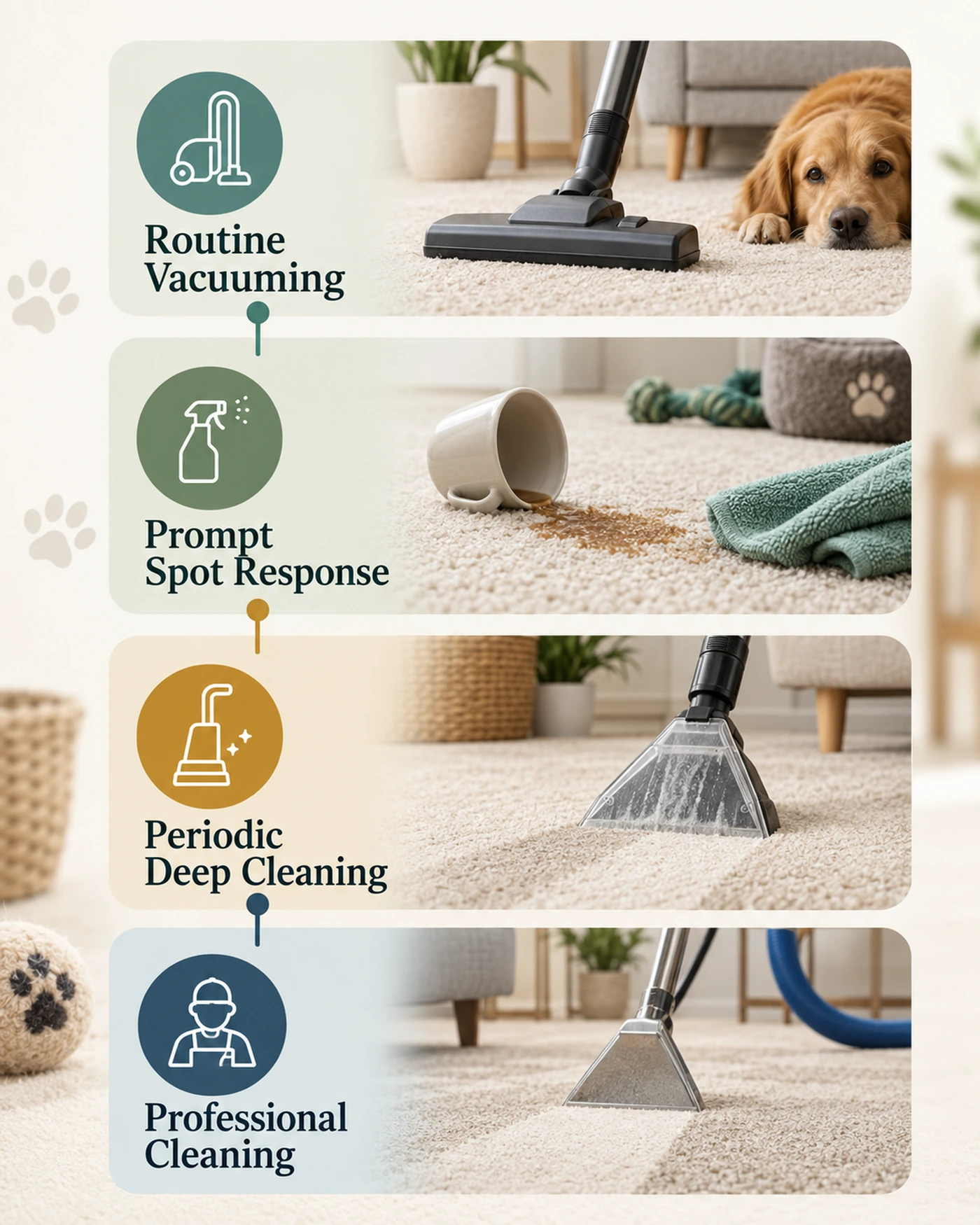
If you are deciding how often should you clean carpet with pets, separate the job into four schedules. Vacuuming is routine maintenance, a fresh accident needs prompt attention, deep cleaning is periodic, and professional cleaning follows the carpet maker’s instructions, warranty, traffic, and actual condition. Those tasks should not share one universal interval.
A practical starting point is to inspect pet-use and high-traffic areas often, vacuum them more frequently than quiet rooms, respond to spots as soon as the carpet’s care instructions allow, and schedule deeper cleaning only when the carpet, household load, and drying conditions justify it. The Carpet and Rug Institute gives once a week as a general vacuuming starting point, with daily attention for high-traffic or pet areas and about twice weekly for medium-traffic areas. Treat those figures as industry baselines, then adjust them to your home rather than turning them into a rigid rule.
This guide helps you build a carpet cleaning schedule for pets. It does not teach stain removal, rank vacuums or carpet cleaners, or provide a wet-cleaning procedure.
Quick Answer
Use four separate clocks:
- Vacuuming: Start with the carpet manufacturer’s guidance. Increase frequency where hair, tracked soil, litter, or traffic accumulates before the rest of the room looks dirty.
- Accident and spot response: Act promptly according to the carpet and cleaning-product instructions. Do not wait for the next scheduled cleaning.
- Periodic deep cleaning: Base it on visible soil, residue, traffic, household load, warranty terms, and your ability to extract moisture and dry the carpet completely.
- Professional cleaning: Follow the warranty first. The Carpet and Rug Institute gives 12 to 18 months as general professional-cleaning guidance, while some manufacturers specify their own interval or method.
The schedule should become more frequent when several pets use the same carpet, outdoor soil enters through one doorway, a shedding period increases the load, or a narrow apartment route receives most of the foot traffic. It may remain lighter in a rarely used carpeted room that stays visibly clean and has no accident history.
Do not deep clean merely because the calendar changed. More moisture and chemistry are not automatically better. If the carpet cannot dry properly, the care label prohibits the method, or the machine cannot recover enough liquid, postpone the wet process or hire a qualified carpet cleaner.
Table of Contents
What “Clean the Carpet” Means
The question becomes confusing when vacuuming, spot treatment, extraction, and professional service are all called carpet cleaning. Each solves a different problem.
Vacuuming removes dry material within the machine’s reach: loose soil, grit, hair, crumbs, and surface debris. It is the most frequent task because dry soil becomes harder to remove after traffic pushes it deeper into the pile. The Carpet and Rug Institute’s maintenance guidance places regular vacuuming at the start of carpet care.
Spot response is event-driven. A liquid spill or pet accident does not belong on a weekly calendar. The immediate goal is to stop spread, follow the carpet and product directions, and prevent people or pets from tracking the material. This page does not provide the treatment method because the correct action depends on the substance, carpet fiber, backing, pad, and cleaner label.
Periodic deep cleaning removes material that routine dry pickup does not. Depending on the carpet, approved methods may include hot-water extraction or another manufacturer-specified process. A portable extractor is a tool for moving compatible solution and recoverable soil; it does not prove that a stain or odor source has been resolved below the carpet.
Professional cleaning adds trained assessment, commercial equipment, and method selection. It may be required by a warranty, useful when the carpet has widespread soil, or safer when drying, construction, or contamination is uncertain. It is not a substitute for routine vacuuming.
| Task | What sets the timing | Useful starting point | What overrides the calendar |
|---|---|---|---|
| Routine vacuuming | Traffic, visible dry debris, hair load, pile and vacuum compatibility | Manufacturer instructions; CRI suggests weekly generally and more often in pet or high-traffic areas | Hair or grit returning sooner, machine strain, delicate pile, or a warranty-specific rule |
| Edge and pet-zone detail | Accumulation at walls, furniture, stairs, beds and feeding routes | Add to regular vacuum sessions or inspect between them | Dark edge buildup, concentrated hair, litter, or trapped debris |
| Accident or spill response | The event itself | Promptly, using the correct material-specific guidance | Unknown chemical, biological hazard, large affected area, or liquid reaching lower layers |
| Periodic deep cleaning | Embedded soil, appearance, residue, traffic, warranty and drying capacity | No single pet-home interval; use manufacturer and condition-based guidance | Slow drying, unsuitable carpet, recurring odor, backing or pad concern |
| Professional cleaning | Warranty, widespread soil, uncertain method, failed routine care | CRI gives 12–18 months as general guidance; exact carpet terms control | Warranty interval, heavy use, construction limits, persistent dampness or damage |
Start With the Carpet, Not the Pet Count
Two homes with one pet can need very different schedules. A short, manufacturer-approved synthetic cut pile in a quiet bedroom does not behave like a thick loop carpet along the only route from an apartment entrance to the living area. Begin with the floor you actually have.
Find the manufacturer, product name, fiber, and warranty if possible. The purchase record, lease inventory, leftover sample, label, or property manager may identify it. Care guidance can specify the vacuum head, brush setting, cleaning products, professional method, and documentation needed for warranty coverage.
Pile construction matters because the wrong vacuum contact can create fuzzing, snagging, or difficult movement. Long pile, shag, wool, wool blends, thick loop, and very soft carpet may need suction-only or specially approved equipment. If hair removal is the main difficulty, use a pile-safe dry technique instead of increasing wet-cleaning frequency.
The backing and pad also affect drying and the consequences of repeated liquid. You usually cannot confirm the condition of hidden layers from the carpet face. Odor that returns after the visible carpet dries, dampness that persists, or a spot that spreads beyond its original boundary calls for diagnosis rather than another calendar-based extraction.
In a rental, ask before using a machine or product that the lease or carpet instructions do not clearly permit. A landlord may already have a required service, approved contractor, or move-out documentation rule. Recording the carpet’s condition before treatment is more useful than guessing at its construction.
Build a Vacuuming Schedule That Responds to Load
The Carpet and Rug Institute recommends slow, overlapping vacuum passes and gives a general pattern of daily vacuuming for high-traffic or pet areas, about twice weekly for medium traffic, and weekly for light traffic. Shaw’s current carpet-care schedule similarly separates daily traffic-lane checks, weekly whole-area vacuuming, and occasional professional cleaning.
These are baselines, not a demand that every square foot be vacuumed daily. A small apartment often has concentrated routes. The strip from the entrance to the sofa may carry most grit and hair, while carpet behind a closed bedroom door receives little use. Schedule zones instead of treating the room as uniform.
Start by checking the carpet before and after a normal interval. If the vacuum collects substantial dry debris and the surface already shows hair, shorten the interval in that zone. If a quiet room produces little material and remains stable, maintain the interval rather than adding unnecessary passes.
Use the vacuum correctly before deciding that frequency is inadequate. Empty the bin or replace the bag as directed, maintain filters, remove accessible brush wrap, select the approved height, and work slowly. A clogged machine or fast pass can make a reasonable schedule look ineffective.
More frequent short sessions can be easier than one heavy session after debris becomes embedded. Focus on entrances, the route to a pet bed, feeding-area approaches, sofa edges, stairs, and the boundary between hard floor and carpet. Finish by cleaning the equipment so it does not release odor or hair during the next use.
If you are organizing cleaning across the entire home, use the weekly cleaning schedule for apartments with pets. That page coordinates rooms and tasks; this guide controls only carpet frequency.
Treat Accidents as Events, Not Schedule Items
A planned Saturday deep clean is not a reason to leave a Tuesday accident untreated. Respond promptly while staying inside the carpet’s care instructions and the cleaner label. Contain the area, keep pets and people away, and avoid spreading liquid through foot traffic or an unsuitable machine.
Do not mix cleaners. Do not add a second product because the first has not produced an immediate result. Residues can be incompatible, and adding more liquid can drive contamination toward the backing and pad. If you do not know what was already applied, pause and identify it before continuing.
An accident does not automatically mean the whole room needs extraction. A small, recent, localized spot on a compatible carpet may have a material-specific response. A large release, repeated accidents in the same place, persistent odor, or moisture beneath the carpet may need a deeper assessment.
After the approved response, let the area dry fully and assess it in its dry state. Fragrance and dampness can obscure the result. If odor returns only after drying or in humid conditions, the problem may extend beyond what surface cleaning can reach. Repeating the same step on a fixed schedule is unlikely to reveal the hidden layer.
Decide When Periodic Deep Cleaning Is Due
Deep cleaning should have a reason. The best timing combines manufacturer guidance with evidence from the carpet and household.
Look for widespread dullness that remains after correct vacuuming, traffic lanes that no longer respond to dry maintenance, residue left by earlier products, or an interval required by the warranty. Also consider whether the household can prepare the space, operate an approved machine, recover moisture, and keep the area unused until fully dry.
Do not use odor alone to select a whole-room deep clean. First identify whether the source is surface soil, a localized accident, dirty equipment, a nearby textile, carpet padding, or another part of the apartment. Extraction across an entire room can add moisture without reaching a source below the pad.
Machine ownership can distort frequency. Having a portable extractor in the closet does not mean the carpet should be extracted whenever hair appears. Conversely, renting or hiring help does not mean you should postpone an appropriate deep clean indefinitely. Use the carpet condition and instructions as the decision gate.
If you need to choose a machine after confirming that extraction is appropriate, compare the best portable carpet cleaners for pet stains. That buying guide covers equipment tradeoffs; it does not replace the carpet maker’s cleaning method or frequency requirements.
Signs that support an earlier deep-cleaning review
- Widespread traffic soil remains after correct vacuuming.
- The manufacturer’s maintenance interval is approaching.
- A permitted spot-cleaning method has left a broad residue boundary.
- Several high-use zones soil much faster than the rest of the carpet.
- A qualified cleaner recommends a compatible process after inspecting the construction.
Signs to pause instead of deep cleaning
- The carpet type or permitted method is unknown.
- The room lacks a realistic drying plan.
- The backing, pad, seam, or transition may be damaged.
- Odor returns after earlier wet cleaning.
- The carpet remains damp from another treatment.
- A previous chemical cannot be identified.
- The lease or warranty requires approval or professional service.
Professional Cleaning Frequency
The Carpet and Rug Institute recommends professional deep cleaning every 12 to 18 months as general guidance and tells readers to check the carpet warranty for specific requirements. That range is a useful reference, not a universal pet-home rule.
Some manufacturers use a different interval or specify hot-water extraction, approved solutions, documentation, or a qualified provider. Shaw describes professional cleaning from 6 to 18 months depending on traffic. The applicable manufacturer and warranty should win when they are more specific.
A professional review may be appropriate sooner when soil is widespread, the carpet is valuable or delicate, the correct method is unclear, repeated spots have created broad residue, or the home cannot support controlled drying. It may also help distinguish a cleaning problem from matting, seam failure, backing damage, or contamination beneath the carpet.
Ask what method will be used, whether it matches the carpet and warranty, how moisture will be recovered, what products will be applied, and what drying conditions are required. Mention every cleaner already used. A useful service plan explains both the process and the stop conditions.
Avoid hiring solely on a promise that all pet odor will disappear. A cleaner can work on accessible carpet, but no surface method can guarantee removal from unknown hidden layers. Diagnosis should precede a permanent-result claim.
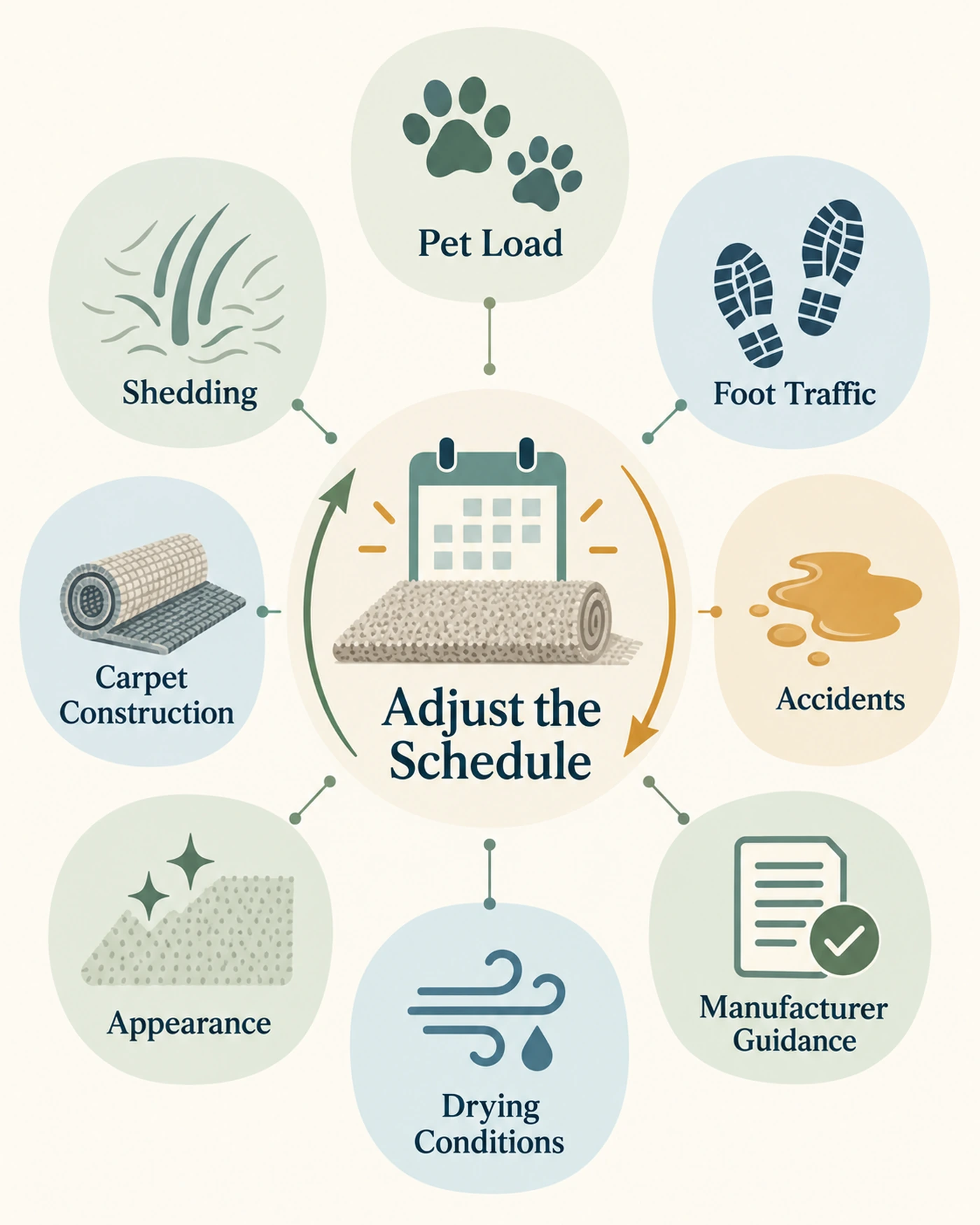
Adjust the Schedule for Your Household
The schedule changes when the rate of material entering the carpet changes. Use observable load rather than stereotypes about a species or breed.
Number of animals and shared routes
Several animals may increase hair and tracked material, especially when they use the same doorway, hallway, or resting area. Concentration matters as much as the total number. Two pets using hard floors most of the day may create less carpet load than one pet that sleeps and plays on a single carpeted route.
Shedding and coat transfer
When hair becomes visible sooner, shorten dry maintenance in the affected zones. Do not answer hair buildup with more frequent wet cleaning. Vacuuming and compatible dry pickup address the problem with less moisture.
Outdoor soil, litter, and crumbs
An entrance next to carpet, a litter route, or a feeding area can introduce grit and dry particles. Catch material at its source, clean mats, and vacuum the route before it spreads. The broader floor-cleaning routine for homes with pets explains how to sequence dry and wet work across different surfaces.
Accidents and repeat locations
One contained accident is an event. Repeated contamination in the same place changes the risk that liquid has reached the backing or pad. Increase inspection and source-specific response; do not simply schedule more whole-room cleaning.
Traffic and furniture layout
Small apartments compress movement. The path around a bed, beside a sofa, and through a doorway may receive many more passes than open carpet. Clean that path more often while leaving low-use corners on a lighter cycle.
Climate, ventilation, and drying capacity
Drying depends on temperature, humidity, airflow, carpet construction, pad, amount of liquid, and recovery. Do not promise a fixed drying time. If weather, building ventilation, or room use prevents complete drying, delay nonurgent wet cleaning or choose qualified help.
| Household condition | Vacuuming adjustment | Deep-cleaning implication | Best checkpoint |
|---|---|---|---|
| One low-traffic carpeted room with little visible hair | Maintain a conservative manufacturer-aligned baseline | Use condition and warranty, not pet presence alone | Inspect edges and traffic lane before changing frequency |
| Concentrated shedding around a sofa or pet bed | Shorten dry-cleaning interval in that zone | Does not by itself justify extraction | Check whether hair is removed before it embeds |
| Several pets share one hallway | Treat hallway as high traffic; clean adjacent edges | Review sooner if dry soil remains after correct vacuuming | Compare hallway with a quiet control area |
| Frequent outdoor entry onto carpet | Vacuum entry route and maintain a clean mat | Embedded grit may justify earlier professional review | Check the first several feet from the door |
| Recent localized accident | Use prompt material-specific response | Deep cleaning depends on affected depth and approved method | Reassess only after full drying |
| Repeated odor after wet cleaning | Pause routine repetition and diagnose source | Another extraction may add moisture without reaching it | Check backing/pad concern and seek qualified assessment |
A Practical Apartment Carpet Schedule
The following patterns are examples, not universal prescriptions. Replace them with the carpet maker’s requirements and what your inspection shows.
Lower-load apartment
A lower-load home might have one carpeted bedroom, limited traffic, no recent accidents, and most pet activity on hard flooring. Inspect the main route several times during the first week. Vacuum the whole carpet on the manufacturer-aligned weekly baseline if it remains appropriate, adding a short edge or resting-zone pass only when material appears.
Review deep cleaning when the warranty calls for it or when correct vacuuming no longer restores the carpet’s normal appearance. A calendar reminder can trigger an inspection rather than an automatic wet treatment.
Typical mixed-use apartment
A living room and bedroom may share one high-use carpeted path. Vacuum that path and the pet resting zone more often than the whole-room field. Include edges and furniture boundaries in one of the regular sessions. Address any accident immediately under the correct guidance.
Check monthly whether the interval still fits. If the vacuum repeatedly collects heavy material before the planned day, shorten the high-load zone. If the carpet remains stable and little is collected, do not create extra work merely to fill a schedule.
Higher-load apartment
Several animals, a carpeted entrance, stairs, or heavy shedding can justify frequent dry maintenance. Break the work into short zones so the entire apartment does not need to be cleared every day. Maintain the machine more often because hair-filled bins, wrapped brushes, and restricted filters can reduce pickup.
Review deep-cleaning needs with the manufacturer instructions and a qualified service provider when soil becomes widespread. Build drying and room access into the plan before choosing a date.
Turn the Schedule Into a Room-by-Room Route
A calendar becomes easier to follow when it names zones instead of vague tasks. “Vacuum carpet” can mean clearing two rooms, moving furniture, doing stairs, and maintaining the machine. That is easy to postpone. “Vacuum the entry lane and sofa edge” is a defined job that can be repeated before debris spreads.
Walk the apartment and mark each carpeted zone as high, medium, or light load based on what you observe. A high-load zone collects material quickly or receives concentrated traffic. A medium-load zone is used regularly but does not show rapid buildup. A light-load zone stays quiet and clean between whole-area sessions. These labels describe use, not carpet quality.
Keep the route stable for a few weeks. Starting at the cleanest room and finishing at the dirtiest may reduce transfer on tools, but the best order depends on the apartment and the type of debris. If an active spill or biological mess exists, isolate it and handle that event under the appropriate instructions before routine vacuuming continues.
Include setup and reset time. The job is incomplete if the vacuum finishes full, the brush remains wrapped, or a dirty attachment returns to a closet beside clean supplies. Machine maintenance belongs to the schedule at the point the manual requires it, not after performance has already dropped.
| Apartment zone | Typical load signal | Routine scheduling approach | Review question |
|---|---|---|---|
| Entry-to-living-room lane | Grit, hair, or darkening appears first here | Short, frequent lane passes plus the regular whole-room session | Is a clean mat or hard-floor pickup reducing what reaches carpet? |
| Sofa and pet-resting perimeter | Hair gathers at edges and under furniture | Add a focused perimeter pass when buildup appears | Is the nearby bed or upholstery transferring hair back? |
| Quiet bedroom field | Little material, low traffic, stable appearance | Keep a lighter manufacturer-aligned baseline | Does the vacuum collect enough to justify a shorter interval? |
| Doorways and transitions | Hair and debris catch against the edge | Detail during a regular session with a compatible tool | Is the transition secure and free of snag hazards? |
| Carpeted stairs | Concentrated traffic and edge buildup | Divide into a safe attachment session rather than rushing | Can the machine and cord be positioned without a fall risk? |
| Area near a prior accident | Odor, residue, or repeated soiling rather than dry debris | Inspect separately; do not fold it into ordinary vacuum frequency | Is this a surface event or a deeper source needing diagnosis? |
The route should stay small enough to complete. In a studio, one high-load lane and one weekly whole-field session may be clearer than a daily room list. In a larger apartment, alternating low-load rooms can keep the main route consistent without increasing the total number of wet treatments.
If the schedule repeatedly fails, identify the friction. The machine may be stored too far away, furniture may block the only lane, the session may be too long, or the vacuum may be poorly matched to the carpet. Change the setup before concluding that the carpet requires more aggressive cleaning.
Do Not Overclean Carpet
Overcleaning is not defined by a single number. It means applying more contact, moisture, chemistry, or repetition than the carpet and situation can safely support.
Repeated wet passes can leave excess moisture when recovery is poor. Reapplying cleaner can leave residue when the method does not remove it. Aggressive brushing can alter some piles. Returning furniture or normal traffic before the carpet is dry can create new marks and slow drying.
Use the least intensive task that solves the current problem. Visible loose hair needs dry pickup. One fresh spot needs a compatible prompt response. Widespread embedded soil may justify deep cleaning. A recurring hidden odor needs diagnosis. These are different decisions.
Stop when the carpet develops fuzzing, pulled yarn, seam movement, rippling, backing exposure, persistent dampness, color change, or a new odor after treatment. Contact the manufacturer, property manager, retailer, or a qualified carpet professional rather than shortening the cleaning interval again.
Review the Schedule Without Constantly Changing It
Give a new routine enough time to show a pattern. For two to four weeks, note which zones show hair or grit before the planned vacuum day, how full the machine becomes, whether edges are missed, and whether the carpet remains stable.
Adjust one variable at a time. Shorten the hallway interval while keeping the quiet bedroom unchanged. Add an edge pass without adding a wet-cleaning day. Service the vacuum before buying a new one or doubling the number of passes.
Seasonal changes may alter the load, but avoid claiming every household has the same shedding season. Let observed hair, traffic, weather, and drying conditions guide the change.
A schedule is successful when it prevents buildup, respects the carpet, and fits the apartment. It does not need to look impressive on paper.
Frequently Asked Questions
Should pet owners vacuum carpet every day?
Some high-traffic or pet-use zones may benefit from daily vacuuming, and CRI uses that as a general baseline for those areas. It is not necessary to apply the same frequency to every quiet room. Follow the carpet instructions and adjust by actual accumulation.
How often should carpets be professionally cleaned with pets?
CRI gives 12 to 18 months as general guidance, while manufacturers may specify another interval or method. Traffic, carpet condition, warranty terms, contamination, and drying constraints can justify a different plan.
Does visible pet hair mean the carpet needs deep cleaning?
No. Hair is primarily a dry-removal problem. Correct vacuuming and compatible tools should come first. Deep cleaning addresses a different layer of soil and introduces moisture.
Should I deep clean after every pet accident?
Not automatically. Respond promptly using the carpet and product directions, then assess the affected depth after drying. The size, substance, construction, and result determine whether a deeper process is appropriate.
Can frequent carpet cleaning cause problems?
Frequency alone does not determine safety. Problems can arise from an unsuitable method, excessive moisture, incomplete recovery, residue, aggressive contact, or inadequate drying. Follow the carpet maker’s requirements.
What if odor returns before the next scheduled cleaning?
Pause the schedule and identify the source. Recurring odor may be in a localized spot, backing, pad, equipment, nearby textile, or another part of the room. More whole-room cleaning is not automatically the answer.
Final Takeaway
The best carpet cleaning schedule with pets uses separate clocks for dry maintenance, accidents, deep cleaning, and professional service. Start with manufacturer and warranty instructions, then adjust by traffic, hair and soil load, accident history, carpet construction, and drying capacity.
Vacuum high-load zones before debris embeds, respond to accidents promptly, and use wet cleaning only for a compatible reason. Let a calendar trigger inspection rather than an automatic treatment. When the carpet remains damp, odor returns, or the construction is uncertain, stop repeating the routine and get qualified guidance.