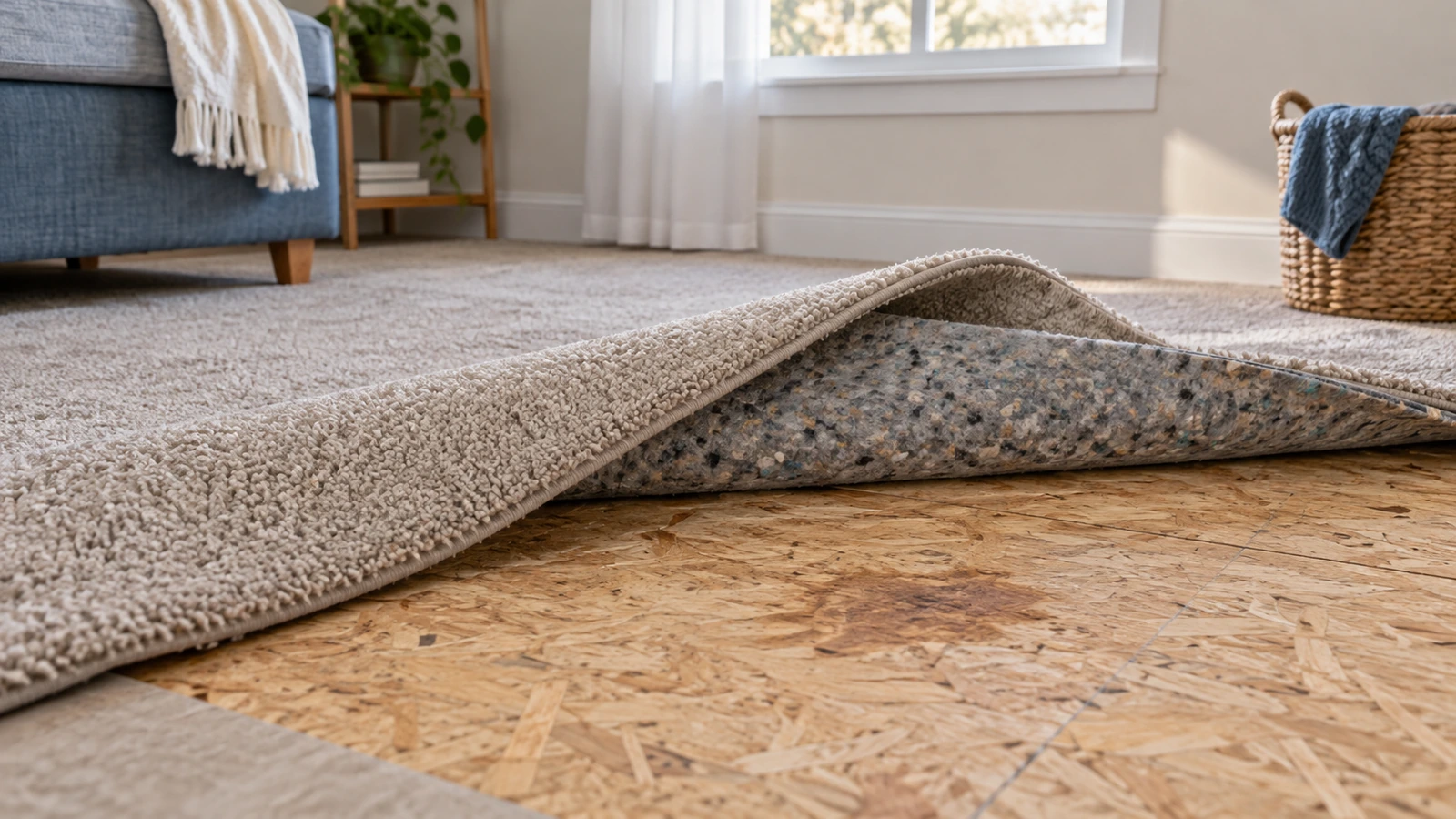
To understand how to get pet urine smell out of a subfloor, first confirm that the odor has reached the structural panel rather than stopping in the carpet, pad, underlayment, or finished floor. Expose only what can be accessed safely, identify the material, and inspect whether it is dry and sound. A small, localized area on a sound panel may allow limited cleaning with a product whose label permits that exact surface. Let it dry completely, then reassess the odor and material before considering a compatible odor-blocking sealer.
Cleaning or sealing is not an appropriate repair for a panel that is soft, swollen enough to affect the floor system, delaminated, persistently damp, extensively contaminated, or structurally uncertain. Those conditions need a flooring or building professional, and damaged sections may require replacement. Renters should involve the landlord or property manager before lifting installed flooring or treating a structural layer.
Do not saturate plywood or oriented strand board, commonly called OSB. Do not mix cleaners, and do not assume that an enzyme cleaner, bleach, vinegar, ammonia, peroxide, or primer is suitable merely because another homeowner used it. The floor assembly, product label, previous chemicals, panel condition, and future flooring system all matter.
Quick Answer
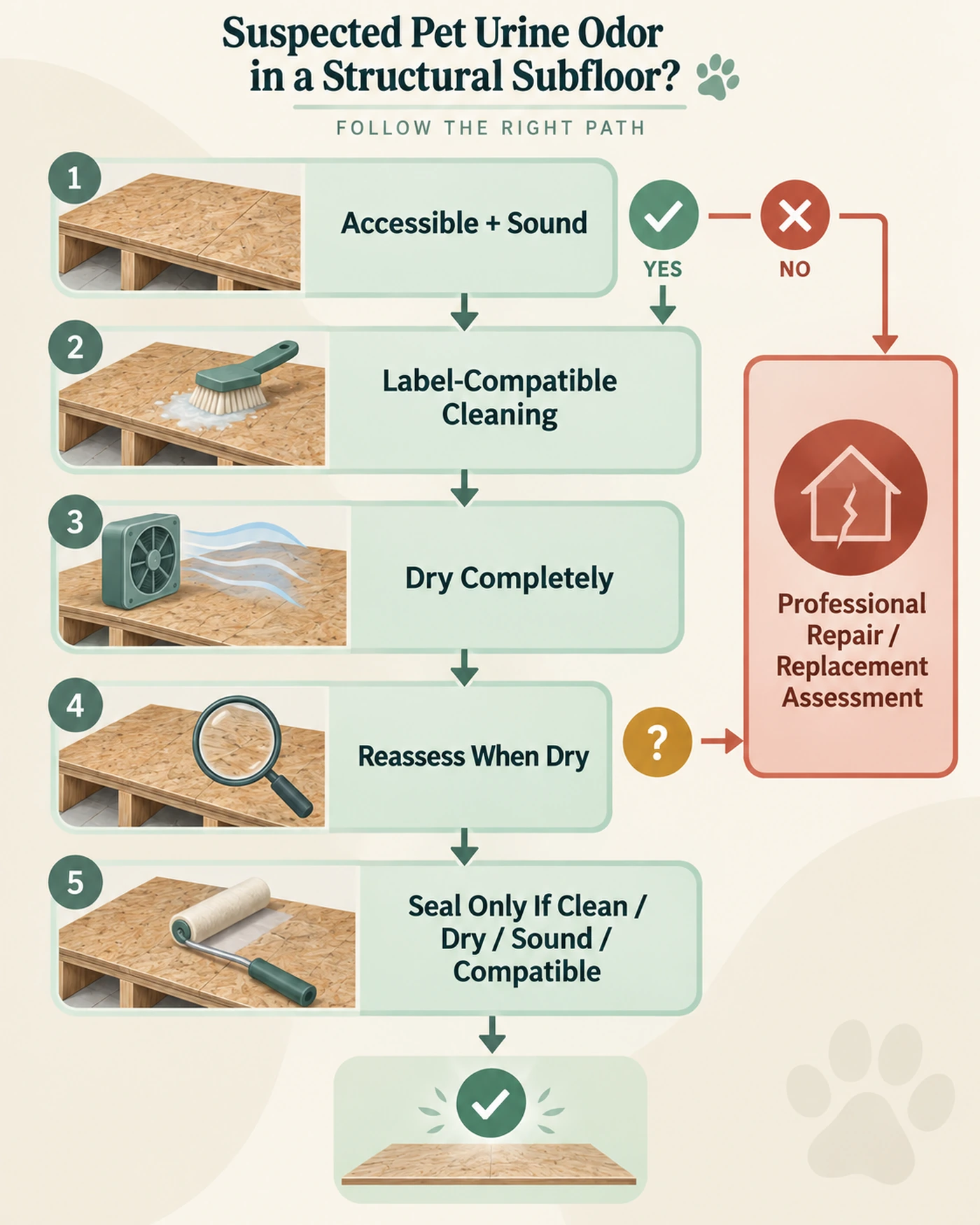
Use this decision order:
- Confirm the odor source and affected layer.
- Stop if access would require demolition, structural cutting, or removal beyond your authority.
- Identify whether the exposed layer is underlayment, plywood, OSB, particleboard, concrete, or another material.
- Check for dampness, softness, swelling, flaking, delamination, open joints, mold-like growth, or loss of support.
- On a dry, sound, localized wood structural panel, choose only a cleaning product whose current label permits the material and use conditions.
- Limit liquid, follow the label, keep people and pets away as directed, and provide appropriate ventilation.
- Let the assembly dry completely and judge the result without relying on fragrance.
- Discuss a sealer only if the substrate is clean, dry, sound, compatible, and ready for the future floor system.
- Hand off structural uncertainty, persistent moisture, extensive damage, suspected mold, or unsuccessful treatment to a qualified professional.
This guide begins at the subfloor. If the problem is still in the carpet pad, use the separate guide to pet urine smell in carpet padding.
Table of Contents
Confirm That You Are Looking at the Subfloor
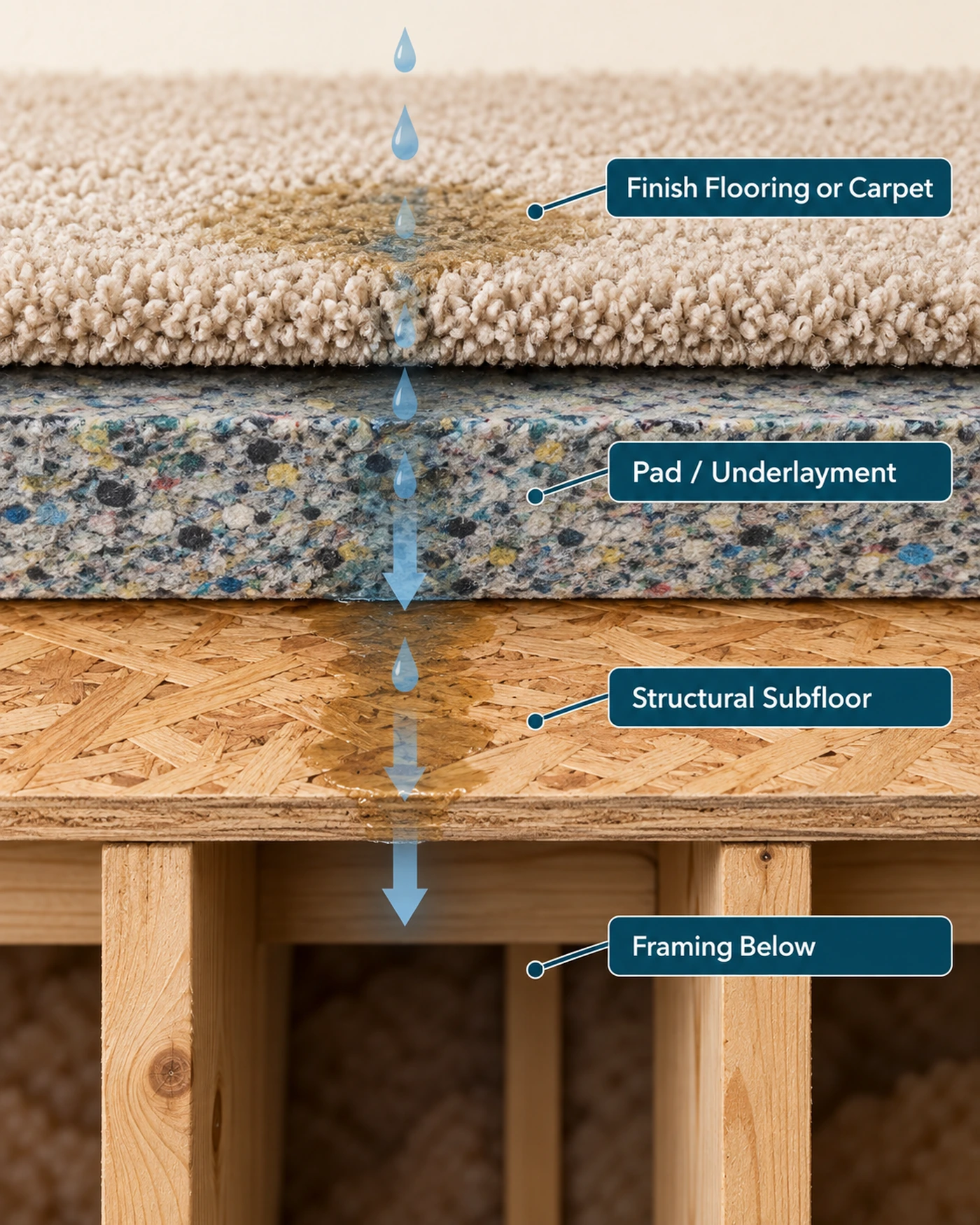
Floors are layered. The surface you walk on may be carpet, hardwood, laminate, vinyl, tile, or another finish. Under it may be a carpet pad or a separate underlayment. The structural subfloor spans or rests on the framing and supports the layers above.
People often call every exposed sheet “the subfloor,” but the distinction changes the decision. A thin underlayment may be intended to create a smooth surface under finish flooring. Plywood or OSB panels may form the structural deck. Some assemblies contain both. A material that looks like compressed wood could be OSB, particleboard, fiberboard, or another panel with different moisture and repair limits.
Do not identify the layer from color alone. Look for panel stamps, installation records, exposed edges, thickness, fastening pattern, and the building or flooring documentation. If the assembly remains uncertain, ask the property manager, flooring installer, contractor, or inspector.
Odor also does not prove which layer is affected. Carpet, pad, tack strips, baseboards, wall bottoms, floor seams, adhesives, dirty tools, and nearby textiles can hold odor. Confirming subfloor involvement becomes more reasonable when the upper layers have been removed by an authorized person and the odor or visible affected area remains localized on the structural panel.
| What you can observe | What it may mean | Appropriate next step | What it does not prove |
|---|---|---|---|
| Odor remains after carpet and pad are removed | A lower layer or nearby building material may be involved | Inspect the exposed assembly and adjacent edges | That the structural panel must be replaced |
| A stain aligns through carpet, pad, and panel | Liquid likely traveled through several layers | Map the visible extent and assess panel condition | That one cleaner will reach the full depth |
| Odor returns after the surface appears dry | Residue may remain in a porous or hidden layer | Reassess the dry assembly and nearby materials | That humidity is the only cause or that sealing will work |
| Panel surface is rough or slightly raised | Moisture exposure or construction texture may be involved | Compare with unaffected panel and consult panel guidance | Automatic loss of structural capacity |
| Panel feels soft, moves, flakes deeply, or separates | Material condition may be compromised | Stop traffic if needed and obtain professional assessment | The safe dimensions of a DIY repair |
| Dampness or mold-like growth persists | An ongoing moisture problem may exist | Stop and arrange moisture or remediation assessment | That pet urine is the only source |
Decide Whether Access Is Safe and Authorized
If carpet and pad are already loose for replacement, the subfloor may be visible without additional destructive work. Even then, tack strips, staples, sharp fasteners, adhesive, contaminated material, and heavy rolls create hazards. Wear protection appropriate to the task and follow local disposal and property rules.
Do not pull up glued flooring, pry hardwood, cut laminate, remove tile, disturb unknown resilient flooring, or cut a structural panel for the purpose of following an online cleaning guide. Older flooring systems can contain materials that need specialized assessment. Plumbing, wiring, heating components, and framing can also be hidden below.
A renter should report the condition and obtain written direction before lifting flooring, applying a product to the building structure, sanding, sealing, or replacing material. The subfloor usually belongs to the property, and an unapproved coating may interfere with a warranty, insurance claim, repair, or future adhesive.
For an owner, access still has a stopping point. Removing a loose pad is different from dismantling a finished floor. If reaching the suspected area changes the floor system, use a qualified flooring contractor.
Document the exposed condition with well-lit photographs and notes. Record which upper layers were present, what products were previously used, when moisture was last added, and whether the odor is localized or broad. This information is useful even if you ultimately hire help.
Identify Plywood, OSB, and Other Panels
Plywood is built from wood veneers arranged in layers. OSB is made from oriented wood strands bonded into a structural panel. Both can be used as subflooring, and both respond to changes in moisture. The APA Engineered Wood Association explains that panel selection and performance depend on rating, thickness, span, exposure classification, installation, and service conditions.
The practical distinction is not “plywood can always be cleaned” and “OSB must always be replaced.” The actual panel must be assessed. APA’s guidance on excessive moisture exposure discusses rough surfaces, thickness swelling, lifting or flaking of OSB strands, and plywood delamination as conditions to evaluate after drying. It also cautions that appearance alone does not always establish loss of structural capacity.
Particleboard and fiberboard are different products and may have different moisture tolerance. Do not transfer plywood or OSB advice to them. Concrete is also outside the wood-panel pathway; it needs its own compatibility and moisture assessment.
If you cannot identify the material, limit your action to documentation, controlled drying where safe, and professional guidance. An uncertain porous panel is a poor place to test a strong cleaner or add enough liquid to imitate a product demonstration.
Inspect the Panel Before Cleaning
Wait until recent cleaning liquid has had a chance to dry under suitable conditions before deciding what the panel is like. A wet panel can feel different from its stable dry state, and fragrance can temporarily cover odor. Do not declare success or failure while either is still changing.
Compare the affected area with a nearby unaffected part of the same panel. Look across the surface under side lighting. Press only gently and do not use a sharp probe. Notice whether the panel is flat and firm, whether fasteners hold, and whether edges or layers have changed.
Surface discoloration alone does not establish structural damage. A panel can also be structurally uncertain without a dramatic stain. The important signs include persistent dampness, pronounced swelling, deep flaking, plywood layers separating, softness, movement between supports, damaged joints, or an uneven surface that would prevent correct finish-floor installation.
APA’s moisture-related dimensional-stability guidance explains that plywood and OSB are hygroscopic and change dimensions with environmental moisture. That supports limiting unnecessary wetting and reassessing after drying; it does not provide a household urine-cleaning formula.
Check beyond the center of a stain. Liquid can follow panel joints, fasteners, wall edges, pad seams, and low points. Do not assume the visible mark shows the complete boundary. If the affected area reaches a wall, cabinet, built-in feature, bathroom fixture, or several panel bays, professional inspection is more appropriate.
Resolve Chemical Safety Before Choosing a Product
Make a list of everything already applied. Include carpet shampoo, enzyme products, disinfectants, bleach, ammonia, vinegar, peroxide, deodorizer, detergent, solvent, and primer. Keep the original containers and labels if available.
Do not mix cleaners or apply them sequentially unless the labels explicitly establish compatibility and any required rinse or drying step. The CDC warns never to mix household bleach or disinfectants with other cleaners. Its ammonia safety guidance likewise warns against mixing household cleaners because ammonia reacts with several chemical classes, including chlorine bleach.
Ventilation, gloves, eye protection, dilution, dwell time, rinsing, storage, and when people or pets may return must come from the specific label. “Natural,” “professional,” and “pet” on marketing copy do not establish unfinished-wood compatibility.
If an unknown cleaner was used recently, pause. Contact the product manufacturer or poison-control service when exposure or incompatibility is a concern. Leave the area and seek emergency guidance if irritating fumes, breathing difficulty, eye symptoms, dizziness, or another acute reaction occurs.
Chemical safety is separate from odor effectiveness. A product can be safe under its label yet unsuitable for a particular panel or future flooring adhesive. It can also be marketed for pet odor without being permitted on unfinished plywood or OSB.
When Limited Cleaning May Be Reasonable
A limited DIY attempt is most defensible when the affected area is localized and fully accessible, the panel is dry and sound, the material is known, no incompatible chemical history exists, and a current product label permits the exact substrate and use.
Begin by removing dry loose debris with a method that does not spread contaminated dust. Do not sand a urine-affected surface as a cleaning shortcut. Sanding can disperse material, alter panel thickness, expose new porous fiber, and affect the finished floor installation.
Read the cleaner label from start to finish. Confirm the approved surface, whether a hidden test is required, how much product to apply, dwell time, whether blotting or extraction is required, ventilation, personal protection, and re-entry conditions. Use no more liquid than directed. Do not “match the depth” by soaking the panel.
Enzyme cleaners are a product class, not a universal permission. Formulas and labels vary. Some are intended for carpet, washable fabric, sealed hard surfaces, or specific water-safe materials. A label that mentions pet urine does not automatically authorize unfinished structural wood.
Work within the visible localized boundary and prevent runoff into joints, wall cavities, or unaffected material. Do not improvise heat to accelerate the process. Do not use steam on the assumption that heat sterilizes the subfloor; moisture and temperature limits must come from the material and product instructions.
If no suitable product can be verified, do not substitute a homemade mixture. Ask the panel, flooring, or cleaner manufacturer or use a qualified odor-remediation professional.
Dry Completely and Reassess
Drying is a required decision stage, not a brief pause before coating. Remove only the moisture the approved process calls for, provide safe airflow, and keep the area open as the assembly and product permit. Do not reinstall pad or flooring over a damp panel.
There is no universal drying time. Panel thickness, liquid amount, humidity, temperature, airflow, access to both faces, building moisture, and the floor assembly all affect it. A dry-looking surface does not prove that an absorbent panel or joint has stabilized.
Where a professional moisture reading is needed, the correct meter, species or material setting, location, and interpretation matter. Do not use an arbitrary internet percentage as a pass/fail rule for every panel and future floor. Flooring and adhesive manufacturers may impose their own substrate requirements.
Reassess in the dry state without adding fragrance. Compare odor at the affected and control areas. Check firmness, edges, layers, fasteners, surface profile, and any change that could interfere with installation. If odor is substantially reduced and the panel remains sound, the next decision may be to stop, repeat only if the product permits it, or discuss a compatible odor-blocking system.
If odor remains strong, do not escalate by adding several products. The affected depth may exceed the surface treatment, the mapped area may be incomplete, or an adjacent material may also be involved.
| Dry-state result | Cleaning decision | Sealer decision | Handoff point |
|---|---|---|---|
| Odor resolved, panel dry and sound | Stop adding cleaner | Usually unnecessary unless the flooring system specifies a primer | Continue with installation requirements |
| Odor reduced, localized, panel sound | Repeat only if the same label permits it | Consider only after cleaning is complete and compatibility is confirmed | Ask manufacturer or flooring professional if uncertain |
| Odor remains strong but panel appears sound | Do not stack chemicals | A labeled odor barrier may be considered after source and compatibility review | Odor-remediation or flooring assessment is prudent |
| Panel remains damp | Stop liquid application | Do not seal | Find and correct the moisture source; obtain professional assessment |
| Softness, delamination, deep flaking, loss of support or severe distortion | Cleaning cannot restore structural condition | Do not coat as a repair | Flooring or building professional must assess repair or replacement |
| Mold-like growth or broad concealed contamination | Stop ordinary DIY cleaning | Do not cover it | Qualified moisture or remediation assessment |
When a Sealer May Be Appropriate
An odor-blocking sealer can form a barrier on a compatible substrate. It does not remove contaminated material, restore panel strength, dry a damp assembly, or fix delamination and swelling.
The surface must be clean, dry, sound, and properly prepared under the selected product’s current technical data. For example, the manufacturer’s technical data for Zinsser Clear B-I-N describes odor-blocking uses that include animal urine, while also requiring surfaces to be clean, dry, sound, and free of material that interferes with adhesion. That is evidence for the named product under its instructions, not approval for every subfloor assembly.
Before selecting any coating, verify:
- the exact panel is an approved substrate;
- the product is intended for the odor-barrier role;
- all cleaning residues are compatible or have been removed as directed;
- the panel is dry and structurally serviceable;
- the coating is compatible with the future underlayment, adhesive, fasteners, and finish floor;
- required ventilation, ignition control, protective equipment, drying, and cure conditions can be met;
- the property owner and warranty terms permit it.
Do not coat over persistent dampness or mold-like growth. Do not use primer as evidence that a hidden source has been corrected. A sealed top face can also leave contamination or odor pathways at panel edges, wall plates, joints, fastener holes, or the underside.
If the flooring installer will warrant the finished system, include that installer in the coating decision. A successful odor barrier that prevents adhesive bonding is not a successful floor repair.
When Replacement or Professional Assessment Is Safer
Replacement becomes a professional consideration when a panel is no longer sound or serviceable, contamination is too extensive to isolate, odor persists through appropriate treatment, or the future floor cannot be installed over the existing condition.
Signs that justify professional assessment include softness, pronounced movement, plywood delamination, severe OSB strand loss or swelling, damaged tongue-and-groove joints, loss of fastener holding, broad contamination across several sheets, persistent dampness, suspected decay, mold-like growth, or an uncertain source below walls or built-ins.
Do not cut out a panel based on online dimensions or a stain outline. Structural panels transfer loads to framing. Safe replacement can require locating joists, blocking edges, protecting utilities, matching thickness and rating, maintaining fastening schedules, and coordinating with walls and finish flooring. Those are construction decisions.
APA’s subfloor preparation guidance treats the subfloor as part of a system involving framing, connectors, adhesive, fasteners, moisture, and surface condition. That is why a structural or installation defect cannot be solved by odor advice alone.
A qualified flooring contractor can determine whether a panel remains suitable for the planned finish. A building professional may be needed when the condition involves framing, support, broad moisture, or uncertain structural performance. An odor-remediation specialist may help map contamination, but structural conclusions should stay with appropriately qualified trades.
Plywood and OSB: Use Condition, Not a Shortcut
It is tempting to create a simple rule: clean plywood, replace OSB. The evidence does not support that universal split.
Both products are wood structural panels. APA notes that prolonged or severe moisture exposure can affect appearance and dimensions, and its technical guidance provides ways to consider condition after drying. The extent, duration, panel rating, edge condition, installation, and service environment matter.
Plywood can delaminate. OSB can show thickness swelling, surface lifting, or flaking. Either may remain serviceable after some moisture exposures, and either may become unsuitable under different conditions. Urine also adds an odor-contamination question that APA’s construction moisture guidance does not resolve.
Use the material identity to choose relevant documentation, then inspect the actual panel. Do not promise that surface cleaning reaches the full thickness. Do not assume that a hard top surface proves every layer and joint are unaffected.
Particleboard deserves separate caution because it is not plywood or OSB and may respond differently to liquid. If a panel cannot be identified reliably, professional assessment is the safer branch.
Apartment and Rental Boundaries
Subfloor work is especially disruptive in a small apartment. Removing a floor layer can block the only bedroom, hallway, or exit route. Fans, open flooring, tools, and coatings can create noise, odor, trip, fire, and access issues.
Plan where people and pets will stay while the area is exposed, cleaned, dried, inspected, or coated. Follow every product restriction. Do not allow paws onto wet cleaner or coating, and do not rely on a closed interior door if fumes require a different control.
Ventilation must fit outdoor conditions and the product label. Opening a window may be inappropriate during outdoor smoke, severe humidity, or unsafe weather. Mechanical exhaust may have building restrictions. If safe conditions cannot be created, hire a professional or postpone nonurgent work.
Renters should notify the landlord promptly, especially when moisture, odor, or material change could affect the building. Do not hide the area under a rug or apply primer without authorization. A dated record can help distinguish an existing condition, a reported accident, and work performed by building management.
In attached housing, broad odor or moisture may cross a wall, chase, or floor assembly. If the source could involve another unit, plumbing, or a common building system, property management needs to investigate.
Common Mistakes
Assuming the stain edge is the contamination edge
Liquid can travel through pad seams, panel joints, wall edges, and low points. Map adjacent materials and stop when the path becomes concealed.
Saturating the panel with enzyme cleaner
An enzyme label may permit some surfaces, but that does not authorize unlimited liquid or unfinished structural wood. Verify the label and control moisture.
Mixing vinegar, peroxide, bleach, ammonia, or another cleaner
Mixtures can create hazardous reactions or incompatible residues. Use one verified system and follow its label. Do not improvise a chemical sequence.
Sealing before the panel is dry
Coating a damp or unsound surface can interfere with adhesion and hide a moisture problem. Drying and reassessment come first.
Treating primer as structural repair
An odor barrier cannot restore panel layers, joints, fastener holding, flatness, or support. Damage needs a construction assessment.
Reinstalling the floor as soon as the surface looks dry
Future flooring and adhesives have substrate requirements. Confirm readiness under their instructions rather than judging by touch alone.
Cutting out the visible patch
Panel replacement requires framing and installation decisions beyond a cleaning guide. The visible stain does not define a safe cut line.
Ignoring the upper layers
New carpet over an unchanged contaminated pad, tack strip, baseboard, or underlayment can leave the odor source in place. Every affected layer needs its own decision.
Match the Scenario to the Next Step
| Scenario | Best immediate action | Do not | Appropriate handoff |
|---|---|---|---|
| Carpet and pad removed; small dry mark on firm identified plywood | Document, verify product compatibility, use limited label-directed treatment, dry and reassess | Soak the panel or mix products | Cleaner or flooring manufacturer if label is unclear |
| Exposed OSB has surface roughness but is dry and firm | Compare with unaffected panel and APA/material guidance | Declare it failed from appearance alone | Flooring professional if surface or installation suitability is uncertain |
| Panel edge is swollen and joint no longer supports a flat floor | Stop cleaning attempts | Cover with primer or force new flooring over it | Flooring or building professional |
| Odor continues along wall after central area is treated | Expand diagnosis to adjacent authorized surfaces | Keep adding cleaner to the center | Property manager, flooring contractor, or odor-remediation professional |
| Recently treated panel remains damp | Stop adding liquid and maintain safe drying conditions | Seal or reinstall flooring | Moisture assessment if drying stalls or source is unclear |
| Rental unit with installed flooring still in place | Report and document | Lift, cut, sand, or coat without authorization | Landlord or property manager |
| Mold-like growth, decay concern, or extensive hidden area | Isolate and stop ordinary cleaning | Sand, vacuum, bleach, or paint over it as a general solution | Qualified moisture/remediation and building assessment |
Frequently Asked Questions
Can an enzyme cleaner remove pet urine smell from a subfloor?
Some products may be labeled for particular unfinished or water-safe surfaces, but enzyme cleaner is not universally safe or effective on every plywood, OSB, particleboard, coating, adhesive, or floor system. Verify the exact label and limit moisture.
Should I use bleach on a urine-smelling subfloor?
Do not assume bleach is an appropriate odor treatment. Surface compatibility, organic contamination, ventilation, and chemical history matter. Never mix bleach or disinfectant with another cleaner. Review the full guide to what not to use on pet urine smell before adding chemistry.
Can vinegar or peroxide be used on plywood or OSB?
There is no universal permission. Acidity, oxidation, concentration, residue, moisture, panel condition, and future-floor compatibility can all matter. Use only a product and method supported by the relevant labels and material guidance.
Does a urine stain mean the subfloor must be replaced?
No. Discoloration and odor do not alone prove structural failure. Inspect the dry panel’s condition and installation suitability. Replacement becomes a professional decision when material is unsound, extensively affected, persistently damp, or unsuitable for the planned floor.
Can I seal the odor instead of cleaning?
A sealer should not replace source removal, cleaning, drying, or damage assessment. A labeled odor-blocking coating may be one part of the plan only on a clean, dry, sound, compatible substrate.
How long should the subfloor dry?
No single time applies to every assembly. Liquid amount, panel, thickness, humidity, airflow, access, and future-floor specifications all affect readiness. If the result matters to an installation or warranty, use the required professional measurement and criteria.
What if the odor is in carpet padding rather than the subfloor?
Stay with the padding decision. Do not expose or treat the structural layer without evidence it is involved. The carpet-padding urine guide covers that boundary.
How do I choose an enzyme cleaner if the panel is suitable?
Start with the current label, surface compatibility, application amount, dwell and removal directions, and safety requirements. The research-based comparison of best enzyme cleaners for pet urine can narrow product classes, but the label still decides whether a specific subfloor use is permitted.
Final Takeaway
Getting pet urine smell out of a subfloor is a material and condition decision before it is a cleaner decision. Confirm the affected layer, identify the panel, limit access to what is safe and authorized, and stop at dampness, softness, delamination, major swelling, loss of support, extensive contamination, or suspected mold.
For a localized area on a dry, sound, known panel, limited label-compatible cleaning may be reasonable. Let the assembly dry completely and reassess it without fragrance. Consider an odor-blocking sealer only when the substrate is clean, dry, sound, and compatible with both the coating and the future floor.
When the condition is structural, concealed, extensive, or uncertain, document it and hand the decision to the appropriate property, flooring, remediation, or building professional.
Sources
- APA Engineered Wood Association: Plywood and OSB
- APA: Questions About Wood Structural Panel Exposure to Excessive Moisture
- APA: Moisture-Related Dimensional Stability
- APA: Subfloor Preparation to Receive Finish Flooring
- CDC: Cleaning and Disinfecting With Bleach
- CDC: Ammonia Chemical Fact Sheet
- Rust-Oleum: Zinsser Clear B-I-N Technical Data