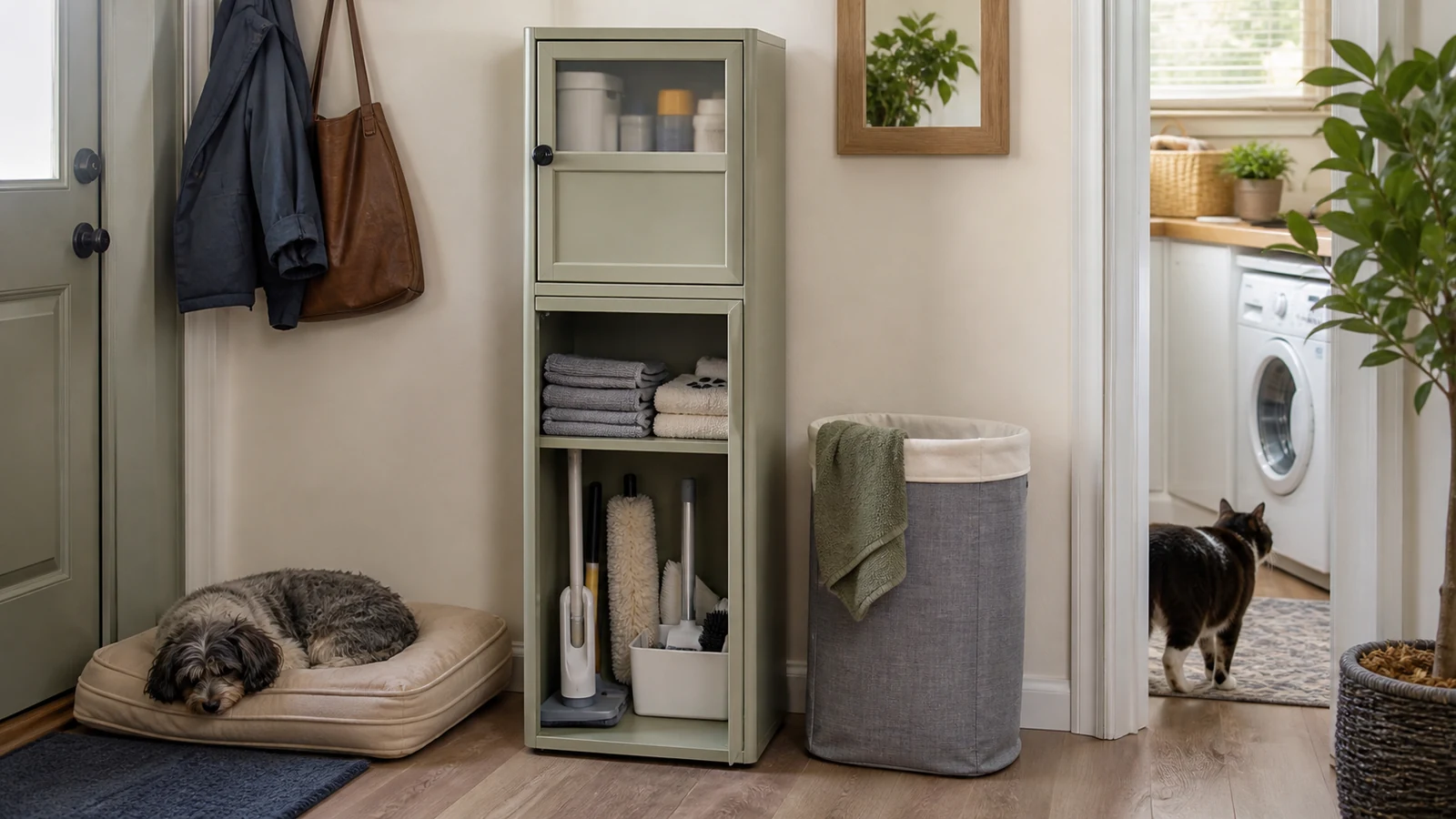
The best way to organize pet cleaning supplies in a small apartment is to build one secured central hub, then place only a few non-hazardous first-response tools near the messes they handle. The goal is not to build a miniature janitor’s closet. It is to shorten response time, eliminate duplicate tools, secure cleaning chemicals, separate clean items from dirty or wet ones, let equipment dry before storage, and make refills easy to track.
Think of the setup as a loop:
MESS SOURCE → FIRST-RESPONSE TOOL → PRIMARY CLEANING TOOL → SAFE STORAGE → DRYING / VENTILATION → CONSUMABLE RESTOCK → RESET
Every item needs a defined job, a compatible surface, one storage home, a cleaning method, and a reset step. If you cannot answer those questions, the item may be taking up more space than it saves.
Quick Answer
- Create one central, secured storage point for chemicals, refills, machine formulas, and less-used accessories.
- Keep only a few non-hazardous first-response items near entry, litter or potty, feeding, furniture, and laundry zones.
- Do not treat an open caddy as permanent storage for every chemical bottle.
- Separate clean, dirty, wet or drying, and laundry-bound items.
- Clean, drain, and dry wet tools before putting them in enclosed storage.
- Give each tool one job and one home instead of duplicating entire kits in every room.
- Put frequent response tools within easier reach than refills or rare-use equipment.
- Store chemicals according to their labels, away from pet food and water, and inaccessible to pets and children.
- Keep one sensible backup only for frequently used consumables.
- Reset tools, cloths, containers, and supplies after each cleanup so the system is ready again.
Table of Contents
Start With a Minimum Viable Pet-Cleaning Setup
A useful apartment system starts with categories, not a 25-item shopping list. Most homes need a way to collect dry hair or debris, a compatible floor tool, washable cloths, waste bags, a small carrying container, pet-textile staging, the cleaners genuinely required for their surfaces, a drying location, and a clear disposal route.
Your exact tools depend on the pet, surfaces, laundry access, and recurring messes. A studio with one short-haired cat may need a litter-side dry pickup tool, one floor tool, a few cloths, and one secured cabinet. A multi-pet home with large washable bedding and a portable extractor needs more separation and drying capacity, not simply more bottles.
Before an item earns space, answer five questions:
- What job does it do? Hair pickup, grit collection, spill absorption, floor care, and textile staging are distinct jobs.
- What surface can it touch? A tool suitable for tile may not suit stone, wood, carpet, or upholstery.
- Where is it stored? Account for access, weight, cords, pet reach, and wet or dry condition.
- How is it cleaned? Cloths, vacuum parts, pads, brushes, and extractor components have different rules.
- How is it reset? Empty, rinse, dry, recharge, replace, or restock as instructed.
Minimal, Standard, and Heavy-Mess Setups
These are complexity tiers, not price tiers. Move up only when recurring messes create a real need for another zone, machine, or staging category.
| Setup Level | Best For | Core Tool Categories | Storage Pattern | Main Risk to Avoid |
|---|---|---|---|---|
| Minimal | Studio, one pet, limited storage, light recurring mess | One dry pickup tool, compatible floor tool, cloth rotation, waste bags, limited cleaners, textile container | One secured hub plus one or two tiny response zones | Buying specialty tools before defining a recurring job |
| Standard | One-bedroom, one or two pets, regular hair, litter, mud, or textile cleaning | Minimal categories plus zone-specific first-response tools, more cloth separation, attachment storage | One secured hub plus entry, litter or potty, and textile response points as needed | Duplicating full kits instead of sharing primary tools |
| Heavy-Mess | Multi-pet home, heavy shedding, frequent accident response, large textiles, extractor ownership | Standard categories plus accident isolation, machine accessories, drying space, larger textile staging | Secured hub, limited response zones, dedicated dirty and drying locations | Sealing damp equipment away or stockpiling chemicals |
A heavy-mess setup is not automatically better. The correct tier is the smallest one that handles the household’s real mess sources without making safe storage difficult.
Build One Central Cleaning Hub First
Start with one central point that pets and children cannot freely access. Depending on the apartment and product labels, this may be a secured utility closet, a locked cabinet, a laundry cabinet, or another stable, label-compliant location. No single location works for every home.
The central hub can hold cleaning chemicals, refills, less-used tools, clean extra cloths, gloves if used, replacement consumables, compatible machine formulas, and accessories. Put heavy items low enough to retrieve safely and keep liquids upright as their labels direct.
Group by function rather than bottle color. Practical categories might include FLOORS, FABRICS, ACCIDENTS, PET TEXTILES, MACHINE PARTS, and REFILLS. Simple labels reduce searching; they do not prove that items are hygienically separated. Physical separation, correct containers, cleaning, and drying still matter.
Do not let refills block the tool you use most. Frequent items should be visible, while backup consumables and rare-use accessories can sit farther back.
Add Small Response Zones — Not Full Duplicate Kits
A response zone holds the first non-hazardous thing needed to stop a mess from spreading—not its own sprays, mop, vacuum, refills, and chemical assortment.
An entry may need a mat, towel, and dry grit tool. A litter or potty area may need a scoop or waste route and a dry scatter tool. A furniture area may need one lint or fabric tool. A feeding area may need a washable mat and dedicated cloth. Primary machines and secured products can remain in the central hub.
| Zone | Mess Type | First-Response Tool Category | Storage Priority | Main Safety / Maintenance Rule |
|---|---|---|---|---|
| Entryway | Water, mud, grit, outdoor debris | Absorbent mat, washable towel, dry grit tool | Fast access near the door | Provide a temporary place for wet items; do not store chemicals beside the door |
| Litter / potty | Dry scatter, waste, small tracks | Waste tool, bags, mat, dry pickup tool | Fast access without blocking the pet’s route | Keep exposed chemicals out of pet reach; clean and dry reusable tools appropriately |
| Feeding | Crumbs, bowl water, food residue | Washable mat, dedicated cloth, crumb tool | Nearby non-chemical access | Keep cleaners separate from food, bowls, treats, and water |
| Furniture | Loose hair, dry debris, washable covers | Lint tool, fabric brush, compatible attachment | Easy access where hair collects | Keep one tool with a defined fabric job; stage dirty covers separately |
| Floors | Hair, grit, tracked debris, compatible wet cleaning | Vacuum, broom, dust mop, microfiber mop | Primary tool accessible; accessories together | Control cords, chargers, weight, damp pads, and attachment storage |
| Laundry / textiles | Dry dirty covers, towels, bedding, damp textiles | Separate staging containers | Near laundry route where practical | Do not seal damp textiles in airtight storage |
| Accident response | Liquid or solid mess requiring prompt containment | Absorbent material, waste bag, clean cloth, optional gloves | Fast access for tools; products secured | Match any product to the actual surface and job; isolate used items |
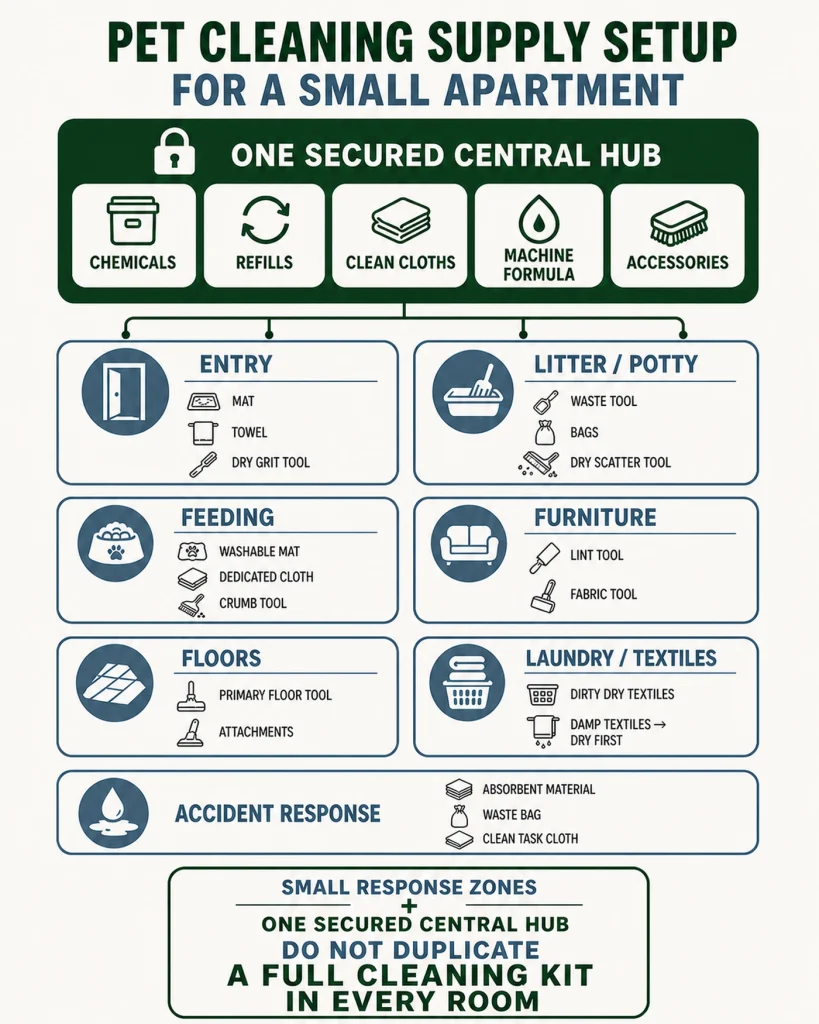
Entryway
Stop the mess at the entry instead of building a full cleaning closet beside the door. Use an absorbent mat that fits the space, a washable towel, a dry tool for grit, and a temporary wet-item drop point. The drop point may be a washable tray, an open drying location, or a towel hook rated for the load—whatever suits the lease and item instructions.
Carriers, shoes, stroller wheels, deliveries, and balcony traffic can also introduce grit or moisture. The response zone contains the transfer; the central hub supplies anything else. Do not store chemical bottles near the door merely because it gets dirty.
Litter / Potty Zone
Keep a waste tool, bags, a mat, and a suitable dry scatter pickup tool along the shortest practical disposal route. A washable cloth may belong nearby only if it has a dedicated home and cannot be confused with feeding or general-purpose cloths.
Avoid a chemical shelf at pet level. Make containment easy without placing exposed cleaners where a pet can investigate or knock them over. This is not a litter product or behavior guide.
Feeding Area
Separate pet food, bowls, treats, and water from cleaning chemicals. The EPA’s pet household-product guidance specifically advises against spraying or storing cleaning and pesticide products near pet food or water dishes.
A washable mat, dedicated cloth, and crumb tool may stay nearby. Return cleaners to secured storage after label-directed use; never decant them into unlabeled food or drink containers.
Furniture and Hair Zone
Choose one easy-to-reach dry hair tool for the fabric you actually maintain: a lint tool, fabric brush, compatible upholstery attachment, or handheld vacuum if already owned. Store washable covers in a clean location and give dirty covers a defined route to laundry.
If hair moves among furniture, beds, clothing, and floors, the small-apartment pet hair system addresses that pattern. If you lack a primary machine, use the small-apartment vacuum buying guide rather than adding overlapping gadgets.
Store Floor Tools Without Creating New Hazards
Vacuum, broom, dust mop, microfiber mop, pads, attachments, cords, and chargers need homes that reflect their size and condition.
Use vertical storage only when the tool and mount support it. Follow mounting instructions and lease restrictions; do not improvise a high mount for a heavy machine. A freestanding rack may suit a rental better.
Keep attachments with the tool or in one labeled container beside it. Store clean, dry pads apart from used pads, and never hang a wet mop above chemicals, chargers, food, or clean textiles.
Route cords so they do not cross a walkway or invite chewing. A charging location should be stable, dry, and compatible with the exact charger instructions. Refills should not make you lift a heavy vacuum every time you need it.
What Belongs in a Cleaning Caddy?
A caddy is for portable response items, not long-term storage for every chemical. Good candidates include clean cloths, waste bags, a lint tool, a small brush, gloves if used, and other non-hazardous tools.
A cleaner may travel for a specific job only when closed, label-compliant, and secured from pets and children. Return it to the central hub. Never leave disinfectant, concentrated formula, or mixed products permanently in an open floor basket.
| Item Type | Keep in Quick-Access Caddy? | Needs Secured Storage? | Main Reason |
|---|---|---|---|
| Clean microfiber | Usually, if dry and task-designated | No, unless contaminated by location | Lightweight first-response tool |
| Waste bags | Usually | No | Fast containment and disposal |
| Lint tool | Usually | No | Dry, low-complexity response tool |
| Gloves | If the household uses them | Follow package and household needs | Keeps response items together; not a substitute for handwashing |
| Cleaner bottle | Only for the active task when appropriate | Usually yes; label controls | Chemical exposure, spills, and pet or child access |
| Machine formula | Usually no | Yes; label controls | It is a chemical product, not a general caddy tool |
| Disinfectant | Usually no | Yes | Label-directed use and restricted access matter |
| Battery or charger | No unless the manufacturer provides a carrying method | Model-specific secure location | Electrical contacts, heat, cord, and damage risks vary |
| Pet towel | Yes when clean and dry | No | Useful for entry response, but needs separate dirty or damp staging after use |
Store Cleaning Chemicals for Safety, Not Aesthetics
Chemical storage is a safety system, not a shelf-styling project. Keep labels readable, lids closed, products inaccessible to pets and children, and storage conditions consistent with each label. Separate cleaning chemicals from pet food, bowls, treats, human food, animal feed, and medical supplies.
For cleaning chemicals and pesticide-type products, keeping them in original labeled containers is the safer default and is explicitly recommended by relevant guidance. This does not mean every household item is legally required to remain in its original package. The package preserves identification, directions, warnings, first-aid information, and its intended closure.
The EPA warns against transferring products into food or beverage containers and recommends retaining original containers. Its pesticide storage guidance also says to follow label storage instructions, keep pesticides out of reach of children and pets, avoid storage near food or animal feed, and avoid stockpiling.
Do not pour cleaners into decorative bottles, drinking bottles, or unlabeled jars that hide safety directions. If a label directs mixing in another container, follow it exactly and handle any remainder as directed.
Never mix cleaning products. The CDC’s pet-supply guidance says to follow disinfectant labels and specifically warns not to mix bleach with cleaners such as ammonia because dangerous gases can result. The CPSC’s poison-prevention guidance recommends keeping household cleaning supplies locked and out of children’s reach and retaining original child-resistant containers.
Pinterest-style symmetry is not worth losing a product name, directions, ventilation instruction, concentration, or emergency information. Use trays and shelf labels around original packages, not instead of them.
For deeper urine-related chemical boundaries, review what not to use on pet urine smell instead of assuming that a stronger or better-smelling bottle belongs in the kit.
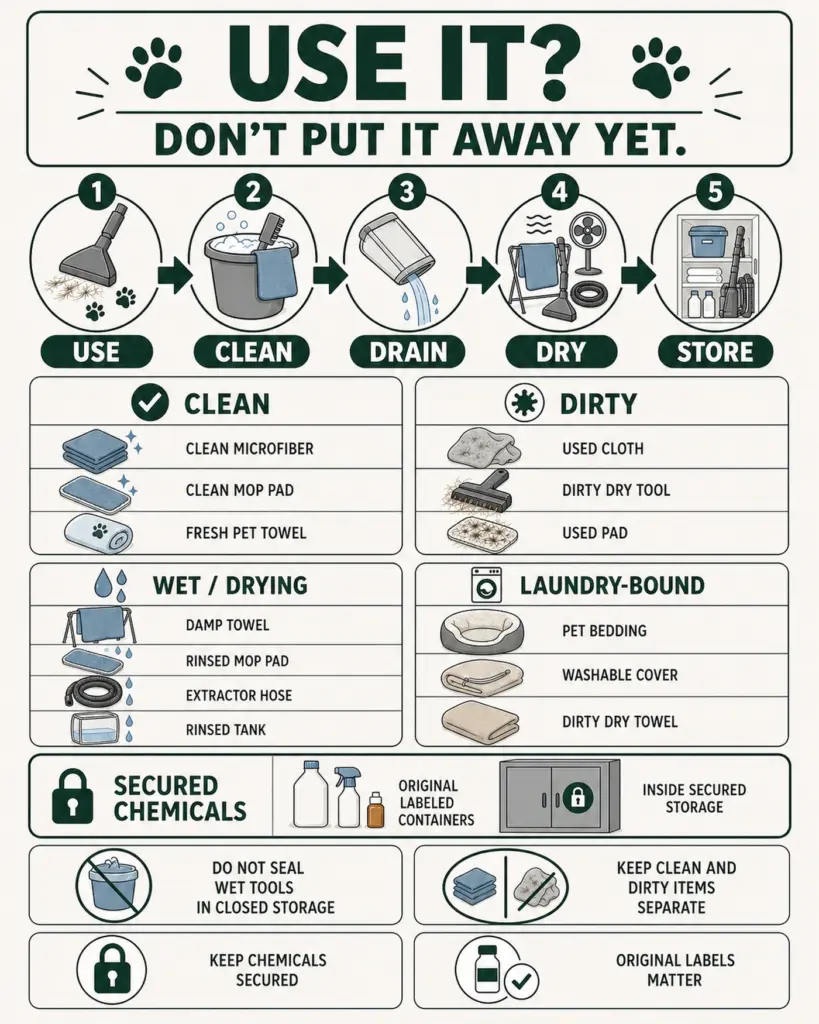
Separate Clean, Dirty, Wet, and Laundry-Bound Items
One large “pet cleaning” bin fails because items in it are not in the same condition. Use four states:
- CLEAN: dry microfiber, unused mop pads, fresh pet towels, clean covers, and cleaned attachments ready for use.
- DIRTY: dry used cloths, debris-filled tools, used litter-area pads, and items awaiting cleaning.
- WET / DRYING: rinsed cloths, damp towels, drained tanks, hoses, brushes, and washable parts that are not ready for enclosed storage.
- LAUNDRY-BOUND: dirty dry covers, bedding, towels, and washable pads waiting for the appropriate laundry process.
The categories can be separate bins, hooks, shelves, or zones. What matters is that a clean cloth does not touch an accident cloth and a damp towel is not sealed behind a closet door.
Color coding can help people return items to the right category. You might assign cloth colors to FLOORS, FABRICS, and ACCIDENTS, or label containers PET TEXTILES and REFILLS. Color does not itself prevent contamination; it is a memory aid that supports physical separation and correct cleaning.
| Item | Can It Be Stored Immediately? | Needs Drying First? | Needs Secured Storage? | Main Mistake |
|---|---|---|---|---|
| Clean microfiber | Yes, when clean and fully dry | No | Usually no | Mixing it with used or damp cloths |
| Used microfiber | Not in the clean bin | If washed or damp, yes | Isolate according to the task | Leaving it folded wet or reusing it on another zone |
| Mop pad | Only when clean and dry | Yes after washing or wet use | Usually no | Returning a damp pad to a closed container or mop head |
| Vacuum | Yes after model-directed emptying or care | Any washable parts must dry as directed | Stable storage away from pet interference | Storing loose attachments elsewhere or washing non-washable parts |
| Handheld vacuum | Yes after model-directed care | Washable parts only as directed | Stable charger and cord location | Leaving it at pet level with an exposed cord or overfilled bin |
| Portable extractor | Not immediately after wet use | Tanks, hose, tools, and removable parts as directed | Formula secured separately; machine stable | Sealing dirty water or damp components inside the machine |
| Cleaning chemical | Yes only in label-compliant storage | Not applicable | Yes, where pets and children cannot access it | Decorative decanting, loose caps, or storage near food |
| Pet towel | Yes when clean and dry | Yes after wet use or washing | Usually no | Mixing a damp towel with clean textiles |
| Dirty-water tank | No | Empty, rinse, and dry as the manual directs | Stable drying point away from clean items | Reinstalling or enclosing it while residue or moisture remains |
| Replacement supplies | Yes in a dry, suitable location | No | Chemicals follow their labels | Letting backups block active tools or buying excessive stock |
Clean → Drain → Dry → Store
Wet-tool storage often fails when a mop pad enters a closed bin, a damp towel enters a hamper, or an extractor hose is wrapped while moisture remains inside.
Use the same reset sequence after wet work:
- Clean: Remove soil and residue using the item’s care instructions.
- Drain: Empty tanks, buckets, hoses, trays, and tools where directed.
- Dry: Place washable parts in an appropriate open drying location until they meet the manufacturer’s storage directions.
- Store: Return only ready components to their clean or enclosed home.
Do not seal wet cloths, pads, towels, brushes, hoses, or tanks in a bin, closet, or machine body. This can retain odor, residue, and dampness. Drying time is not universal; an outer surface may dry before a seam or channel.
Portable Extractor Storage
An extractor reset area needs room for dirty water and removable parts. Empty the tank, rinse and drain only as directed, and let parts dry appropriately. Store formula closed and secured, away from food and open-access tools.
BISSELL’s current SpotClean and Little Green ProHeat maintenance instructions tell owners of the listed models to empty and rinse the dirty-water tank, dry the removable float stack before replacement, and rinse tools. That is model-specific evidence, not a universal instruction for every extractor. Your exact manual controls.
Do not wrap a damp hose tightly, reinstall a wet tank for appearances, or enclose the machine before it is ready. This is storage guidance, not a buying guide.
Vacuum and Handheld Charging
Create a stable charging location where the correct charger, machine, and removable battery do not become trip or chew hazards. Follow the exact manual for mounting, cooling, charging, and storage; never assume a generic hook or charger is compatible.
Battery guidance is model-specific. Dyson’s current vacuum battery care, for example, provides brand-specific temperature, direct-sunlight, heat-source, and cool-before-docking guidance. Those numbers and conditions should not be copied to every cordless vacuum. Use the instructions for the machine you own.
Stage Pet Textiles Without Trapping Dampness
Separate clean textiles, dirty dry textiles, and damp textiles. Clean covers and towels can live in a dry drawer or shelf. Dirty dry bedding may wait in a washable or breathable laundry container where practical. Damp towels, mop pads, or bedding need an appropriate drying step before joining an enclosed laundry load or storage bin.
In shared laundry, use an easy-to-clean transport container separate from clean supplies. This article defines where categories live; the pet-hair laundry process covers washing and drying mechanics.
Build a Small Accident-Response Kit
An accident-response kit should help contain a mess quickly without pretending that one bottle works on every surface. Keep absorbent material, waste bags, a clean task-designated cloth, and gloves if your household uses them in a reachable tool container. Keep the surface-compatible product itself in secured storage unless it can remain safely secured within the setup.
The kit starts the response; it does not diagnose the correct chemistry. Wood, stone, carpet, upholstery, vinyl, and laminate have different boundaries. If the accident affects carpet, use the dedicated guide to remove cat urine smell from apartment carpet. When the question is whether enzyme chemistry or extraction fits the job, see enzyme cleaner versus carpet cleaner for pet urine.
After use, bag waste, isolate cloths, secure products, and move wet tools to drying. Frequent accidents may warrant pet-specific health or behavior evaluation; organization does not identify the cause.
What You Probably Do Not Need
You probably do not need duplicate floor tools, generic sprays without clear surface roles, a lint tool in every room, an oversized cart, full-size equipment for rare jobs, several open chemical bottles, or specialty gadgets without a stable home.
Ask before keeping or buying:
- What mess does it handle?
- What surface is it compatible with?
- Where will it be stored?
- How will it be cleaned and dried?
- Do you actually use it?
If there is no clear answer, the tool may add friction. Keep the strongest tool for the recurring job and remove duplicates only after confirming that another item covers the function.
Store by Access Priority, Not by Perfect Symmetry
Use three access layers:
- FAST ACCESS: non-hazardous first-response tools for recurring mess sources.
- SECONDARY ACCESS: primary vacuum, mop, caddy, larger tools, and clean attachments.
- DEEP STORAGE: refills, rare-use accessories, seasonal textiles, and unopened backup consumables.
This is a storage-access system, not a daily or weekly cleaning schedule. Frequency does not determine whether a chemical can sit at pet level, whether a wet tool can enter a closet, or whether a heavy machine belongs on a high shelf.
Symmetry is optional. The safest chemical cabinet may be across the apartment from the litter mat. Optimize the route and safety constraints, not the photograph.
Use Vertical Storage Carefully
Hooks, rails, over-door organizers, narrow cabinets, stackable bins, and under-bed containers can recover space, but each has limits. Confirm weight ratings, tool compatibility, pet access, wet or dry condition, chemical label requirements, and lease rules.
Do not place a heavy machine high, hang wet tools over electrical equipment, or put chemicals under a bed unless every label and access condition allows it. Temporary storage must safely support the real load.
Use an “Open One → Backup One” Rule
For frequently used consumables, one active item plus one backup can reduce shortages without turning a small cabinet into a stockpile. Apply the rule selectively to waste bags, a working cloth rotation, a manufacturer-required machine formula, or a replacement consumable you reliably use.
Do not buy a spare for every item. EPA pesticide guidance advises against stockpiling pesticides. Check packaging, label requirements, and secure space before adding a backup.
| Category | Keep Open | Keep Backup | Avoid Duplicating |
|---|---|---|---|
| Waste bags | One active roll or pack | One practical refill | Multiple partial rolls in every room |
| Washable cloth rotation | Enough clean cloths for defined tasks | Clean rotation rather than unopened excess | Large stacks with no zone or job |
| Compatible cleaner | One active original container | Only if used reliably and safely stored | Several generic sprays for the same surface |
| Machine formula | One active compatible formula | One only when use rate justifies it | Incompatible formulas or bulk stock without secure space |
| Replacement consumable | One installed or active unit | One when replacement timing is predictable | Parts for tools no longer used |
Studio + Cat
Use one secured cabinet for cleaners, refills, clean extra cloths, and less-used accessories. Near the litter area, keep only the waste tool, bags, mat, and a dry scatter tool. Put one compact floor tool along a wall where it does not block living space, and use a small textile container for dry dirty bedding or covers.
The litter zone handles dry containment; the hub supplies a product only when a compatible job requires it. Dry damp cloths or pads before laundry or storage.
One-Bedroom + Dog
Create an entry response zone with a mat, washable towel, dry grit tool, and temporary wet-towel point. Keep chemicals and refills in a secured central cabinet. Store one furniture hair tool in the living area and route dirty dry towels or covers to a laundry container outside the clean-supply shelf.
Keep the primary floor tool near the hub or stable charging point rather than duplicating it at the entry.
Cat + Dog Household
Scale the zones, not the number of identical kits. A litter-side dry tool and an entry mat serve different first-response jobs. Chemicals, refills, machine formula, and clean extras remain in one secured hub. Shared hair and floor tools can serve the apartment if their attachments stay organized and their reusable parts are reset after use.
Stage pet textiles and accident-used items separately. Two species do not require two of every broom, cloth, or spray.
Heavy-Shedding Household
Prioritize easy access to the primary dry hair tool, keep vacuum attachments with the machine, and give dirty covers and bedding enough staging capacity. Reserve a small location for bin emptying supplies or model-approved brushroll maintenance tools, but do not turn it into a second vacuum station.
One furniture tool, one primary floor tool, and a clear textile path are easier to maintain than scattered gadgets. This setup determines where the tools return.
Frequent-Accident Household
Place a generic response kit where an adult can reach it quickly while keeping compatible chemicals secured. Include absorbent material, waste bags, a clean task cloth, and gloves if used. Create an isolation point for dirty items and, if an extractor is owned, enough open space to drain and dry its parts according to the manual.
Do not preselect one chemical for wood, stone, carpet, sofa, vinyl, and laminate. Group products by supported job and surface, with labels visible.
Small-Apartment and Renter Constraints
Many apartments have no garage or mudroom, a limited closet, shared laundry, rental walls, and temperature swings on a balcony. Treat those limits as design inputs.
Use narrow freestanding storage, rated temporary hooks, over-door space, or a secured cabinet. Ask before drilling or using landlord-owned storage. Do not put chemicals, batteries, or machines on a balcony unless exact instructions approve the temperature, moisture, sunlight, and access conditions.
Under-bed storage may suit clean, dry replacement textiles, but it is not an automatic chemical cabinet. Limited space favors one safe hub, a few purposeful response zones, and no full-room duplicates.
Organize Pet Cleaning Supplies as a Reset Loop
A cleaning setup is ready only when the waste is removed, tools are clean, wet components are draining or dry, chemicals are secured, dirty textiles are staged, chargers are safely arranged, and consumed supplies are noted. Returning an unready item to its shelf hides unfinished work.
Keep the loop simple: identify the mess source, reach for the first-response tool, use the compatible primary tool if needed, move dirty and wet items into the correct state, restock only what was actually consumed, and return each ready item to its one home. That is how a small apartment stays prepared without becoming a storage room for cleaning products.
Sources
- Read the Label First: Protect Your Pets — U.S. Environmental Protection Agency
- Storing Pesticides Safely — U.S. Environmental Protection Agency
- About Cleaning and Disinfecting Pet Supplies — Centers for Disease Control and Prevention
- Poison Prevention — U.S. Consumer Product Safety Commission
- SpotClean / Little Green ProHeat Portable Carpet Cleaner: How to Clean and Maintain — BISSELL
- Vacuum Battery Care — Dyson