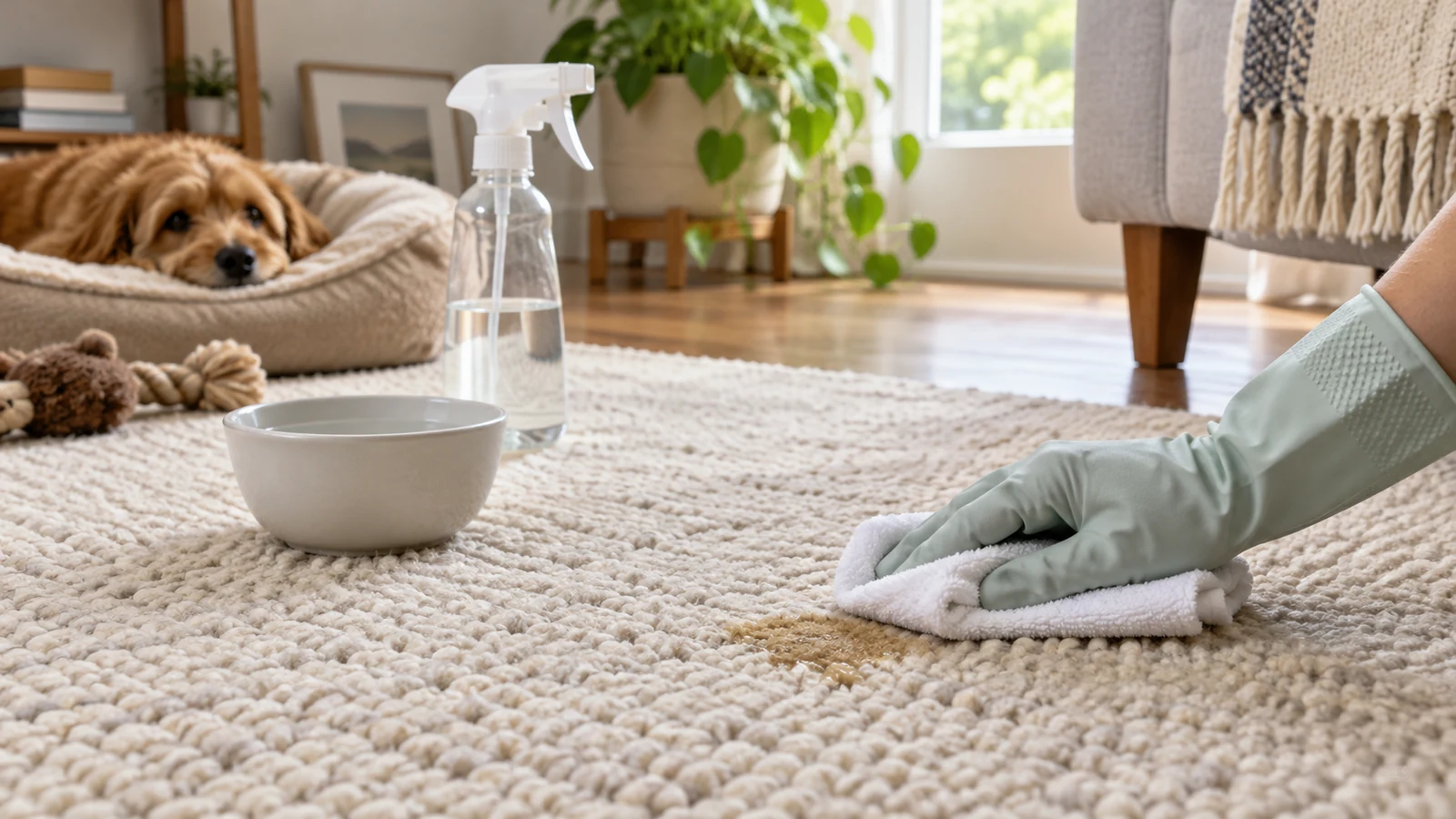
To learn how to remove pet stains from a wool rug, start by limiting spread rather than reaching for the strongest cleaner. Lift solid material or blot active liquid with clean white absorbent material, identify the rug and its care instructions, and inspect the back, pad, and floor. A product belongs on the stain only when its label and the rug guidance both permit the method.
Wool rugs are not one uniform category. A machine-made wool rug, a hand-knotted rug, a tufted rug with adhesive backing, and a wool-viscose blend may respond very differently to moisture, agitation, heat, and cleaning chemistry. If dye transfers, the rug changes shape or texture, liquid has saturated the foundation, or the construction is valuable or uncertain, stop adding products and contact a qualified rug-care professional.
Table of Contents
Quick Answer
For a fresh pet accident on a confirmed wool rug, keep pets and people away, lift solids without pressing them into the pile, and press clean white towels into liquid until little transfers. Do not rub. Check the underside and any separate pad so the visible spot does not hide a larger wet boundary.
Next, find the care label, product page, receipt, or manufacturer instructions. Confirm the wool percentage, construction, backing, dye restrictions, approved products, and drying method. Use a cleaner only if its label specifically permits wool or the rug manufacturer confirms compatibility. Complete an inconspicuous test and let that test dry before judging color and texture.
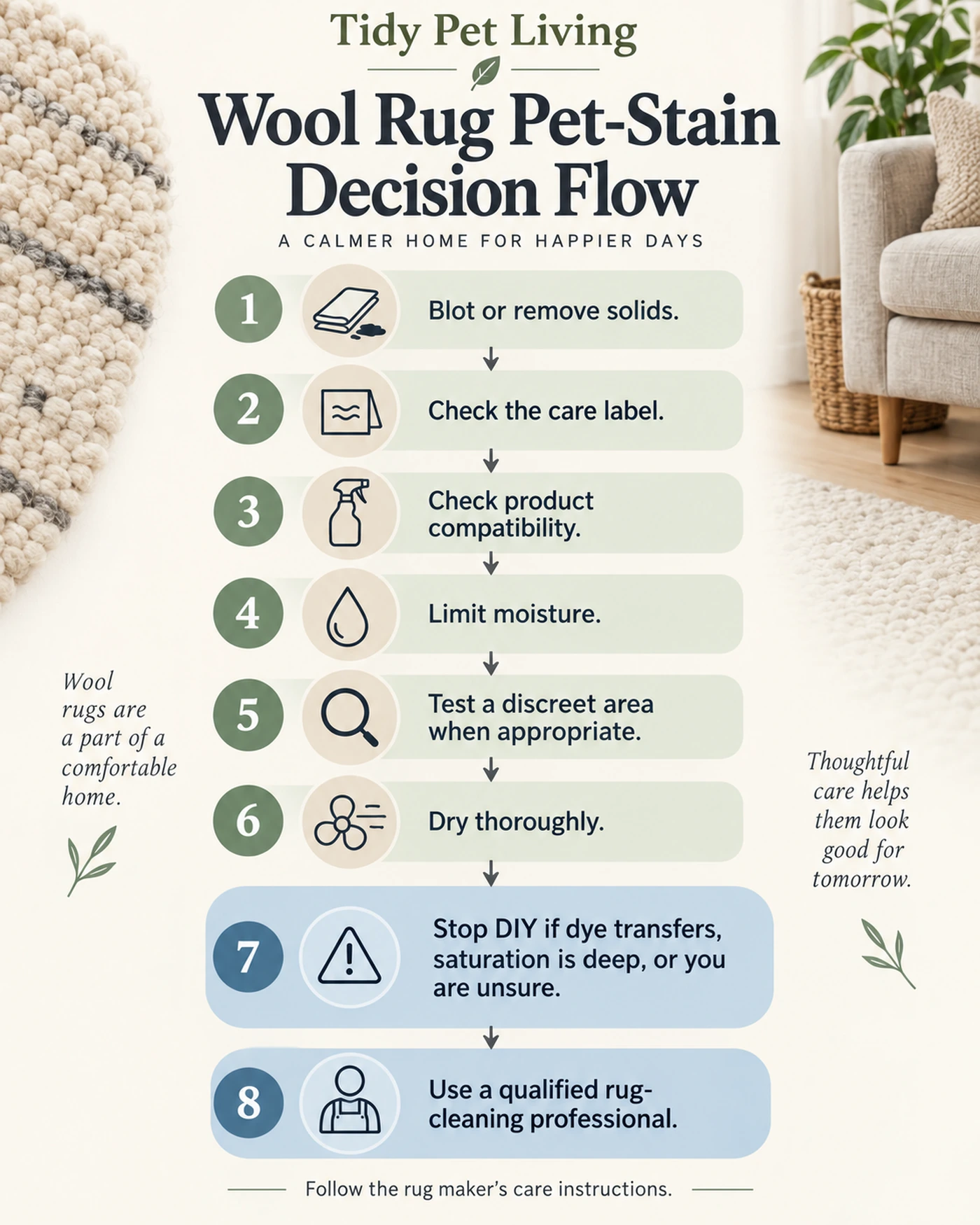
Use this sequence:
- Contain the area and remove solid material.
- Blot active liquid without rubbing or spreading it.
- Confirm the rug is wool and identify its construction.
- Inspect the back, pad, and floor.
- Review both the rug instructions and the proposed cleaner label.
- Test a small hidden area and assess it after drying.
- Apply the smallest permitted amount using the labeled method.
- Remove residue or rinse only when the instructions require it.
- Dry the rug and every affected layer completely.
- Reassess color, texture, shape, odor, and hidden layers before repeating anything.
Do not improvise a vinegar, peroxide, baking-soda, bleach, ammonia, detergent, steam, or enzyme recipe. Some wool rugs and some wool-approved products permit carefully controlled treatment, while other constructions or labels prohibit it. The exact rug and product directions decide.
What to Do First
The first job is containment. Move pets and foot traffic away from the area, prepare a waste bag and clean white towels, and protect yourself appropriately for the type of mess. If there is solid material, lift it with a spoon, dull edge, or disposable material. Work upward instead of pushing into the pile.
For liquid, place a white towel over the wet area and press. Move to a dry part of the towel and repeat until transfer slows. White material makes dye movement and soil transfer easier to see. Rubbing can enlarge the boundary, distort the pile, and move residue deeper.
Lift a removable rug only when its size, weight, furniture, and wet condition make that practical. A wet rug can be much heavier than expected. If lifting would drag contamination across the room, damage the rug, or create a handling injury, contain the top and arrange appropriate help.
When the rug can be lifted safely, check the underside. Compare the wet or discolored boundary with the visible face. Inspect any separate pad and the floor. If the rug sits over finished wood and liquid reached it, use the separate guide to pet urine smell on hardwood floors rather than applying wool-rug cleaner to the floor.
| Situation | First action | Main risk |
|---|---|---|
| Fresh urine or another active liquid | Blot repeatedly with clean white absorbent material and inspect below | Spread into foundation, pad, or floor |
| Vomit or feces with solid material | Lift solids first, then blot remaining moisture | Grinding residue into pile or foundation |
| Dried mark with no active moisture | Identify construction and prior products before adding liquid | Mobilizing dye or enlarging a tide line |
| Odor with little visible staining | Map the odor and inspect back, pad, and floor | Treating the wrong boundary or missing deep contamination |
| Unknown earlier cleaner | Stop product layering and document what is known | Incompatible residue or misleading test result |
Why Wool Rugs Need Different Treatment
Wool is a protein fiber, but fiber identity is only one part of the decision. The rug may contain cotton warps, jute foundation, latex adhesive, synthetic backing, decorative fringe, multiple dyes, or a second sensitive fiber such as viscose. A treatment compatible with the wool face can still harm another component.
Construction changes how liquid moves. A flatweave may allow a spill to reach the underside quickly. A dense pile can hide the true boundary. Hand-tufted rugs often depend on backing and adhesive that should not be treated as loose woven wool. Hand-knotted, antique, or specialty-dyed rugs can have value and color-stability concerns that lower the DIY limit.
The WoolSafe cleaning guidance emphasizes prompt attention, blotting rather than rubbing, small amounts, edge-to-center work, compatibility testing, and avoiding over-wetting. It also distinguishes fresh urine from old urine: the current WoolSafe treatment guide directs old urine stains toward professional treatment rather than presenting them as a routine home spot-cleaning job.
This does not mean wool cannot be cleaned. It means the method must match the whole rug. Generic phrases such as “carpet safe,” “natural,” “color safe,” or “pet formula” do not prove compatibility with wool, its dye system, or its construction.
If you are not certain the rug is wool, return to the broader area-rug pet stain guide. That page owns cross-material identification and explains the different boundaries for synthetic, cotton, viscose, plant-fiber, washable, and mixed rugs. This page begins after wool is confirmed or strongly documented.
Blot, Remove Solids, and Limit Moisture
Blotting is a controlled transfer process. Press down, lift, move to clean material, and repeat. Work from the outer edge toward the center when the stain boundary is visible. Do not scrub back and forth, twist the pile, or use a stiff brush simply because the mark is stubborn.
Use moisture only when the rug guidance and selected method allow it. More liquid is not automatically more effective. It can enlarge the affected area, carry contamination into the foundation, mobilize dye, soften adhesive, wet the pad and floor, and make complete drying harder in a small home.
A spray bottle can also create false precision. Fine mist still adds liquid, and spraying from above does not show whether the product reaches residue evenly or remains recoverable. Follow the exact application format on the approved label. If the directions call for applying product to a cloth rather than directly to the rug, do that.
Do not judge the final result while the wool is wet. Wet fibers can look darker, feel different, and carry strong cleaner or damp-wool odor. The meaningful check occurs after the rug, foundation, pad, and floor have returned to their normal dry state.
For a dried stain, document the color, texture, odor boundary, and earlier treatment before adding moisture. A pale area may be fiber or dye damage rather than removable residue. A dark ring may indicate migration. Repeatedly wetting damage will not restore lost dye or repair a changed foundation.
Check the Rug Label and Colorfastness
Start with the care label, purchase record, manufacturer product page, or direct manufacturer support. Record:
- face-fiber percentage and any blend;
- hand-knotted, hand-tufted, hooked, flatweave, or machine-made construction;
- backing, foundation, adhesive, and fringe information;
- spot-cleaning, washing, extraction, or professional-cleaning instructions;
- approved or prohibited products;
- drying position and heat restrictions;
- warranty conditions.
Do not infer the method from appearance. A wool-looking rug may contain viscose. A wool pile may sit over cotton or jute. A washable wool product may have model-specific machine and drying rules, while a different wool rug is spot-clean-only or professional-clean-only.
If treatment is permitted, test it in an inconspicuous area. Use the proposed product, quantity, contact time, recovery or rinse step, and drying method. Check the white test cloth for dye. After the test dries, compare color, pile direction, texture, stiffness, sheen, backing, and shape with untreated material.
A successful hidden test reduces uncertainty; it does not guarantee that a large, old, or deeply saturated stain will behave the same way. The stain itself may already have changed dye or fiber, and its depth may require more liquid than the test. Stop if the proposed job exceeds what the test actually demonstrates.
Choosing a Cleaner for a Wool Rug
Choose by exact permission rather than brand familiarity. WoolSafe maintains a list of approved carpet-care products and explains that its mark identifies products evaluated for wool and other suitable textile flooring. A WoolSafe mark is useful evidence, but the exact product directions, the rug instructions, and the stain condition still control how it may be used.
Manufacturer guidance can be narrower. Some wool-rug makers recommend immediate blotting and a small amount of a specified mild treatment. Others recommend professional cleaning for stains. Follow the instruction for the exact rug rather than copying a method from a different brand or construction.
Read the complete cleaner label. Confirm:
- wool or the exact rug is an allowed surface;
- the product covers the relevant soil, such as urine, vomit, or feces residue;
- whether it is applied to a cloth or the surface;
- required quantity, dilution, and contact time;
- blotting, rinsing, extraction, or residue-removal instructions;
- ventilation and access precautions;
- the dry-state endpoint;
- prohibited materials and combinations.
Do not mix or layer cleaners. An earlier detergent, deodorizer, disinfectant, oxidizer, solvent, powder, or fragrance may remain even after the surface feels dry. The chemical and steam boundaries in what not to use on pet urine smell apply when product history is uncertain.
| Cleaner or method | Wool consideration | When to avoid or stop |
|---|---|---|
| Exact manufacturer-approved spot method | Strongest match when it covers the rug and stain | Instructions are missing, conflict, or exclude the stain condition |
| WoolSafe-approved pet-stain product | Useful evidence of wool compatibility when the exact label also fits | Product is not approved for the construction, soil, or required application |
| Generic carpet or pet-stain spray | “Carpet safe” does not establish wool compatibility | Wool is absent from the allowed surfaces or specialty fibers are excluded |
| Enzyme cleaner | Conditional; exact formula and label must permit wool | Compatibility is assumed from another product, review, or general enzyme claim |
| Portable extractor or wet-cleaning machine | Requires rug, formula, machine, backing, and drying approval | Handmade, unstable, deep, unknown, or no-extraction construction; dye or shape changes |
| Professional wool-rug cleaning | Appropriate for old, deep, valuable, unstable, or uncertain cases | Provider cannot explain wool-rug training, testing, process, or controlled drying |
Can You Use an Enzyme Cleaner on Wool?
Only when the exact enzyme cleaner label permits wool or the rug manufacturer confirms compatibility, and the complete application can be followed. “Enzyme cleaner” is a product class, not one chemistry or one set of surface permissions.
Avoid both universal claims. It is inaccurate to say every enzyme cleaner is suitable for wool. It is also too broad to say every enzyme cleaner damages wool. WoolSafe lists certain approved pet-stain and odor products, including some formulas that use enzymatic action, while other consumer products explicitly exclude wool or specialty fibers.
Check the exact SKU and current label. Confirm whether the product is intended for fresh urine, old odor, vomit, feces residue, or a broader organic stain. Confirm the application amount, dwell time, blotting or recovery step, rinse direction, and drying conditions. Do not borrow directions from another bottle with a similar brand name.
If both enzyme chemistry and machine extraction remain possible after the material checks, the enzyme cleaner versus carpet cleaner guide explains their different jobs. It does not grant permission for either method on a particular wool rug.
Stop when the product requires saturation that the construction cannot tolerate, the affected depth cannot be reached evenly, residue cannot be removed as directed, or the rug cannot be dried in the approved position. A product can be compatible in principle and still be impractical for a large or deeply contaminated rug in an apartment.
Stain and Odor Need Different Decisions
A visible stain and an odor may overlap, but they are not identical outcomes. A color change can remain after accessible residue is removed because urine, earlier chemistry, or repeated wetting changed the dye or fiber. Odor can remain when contamination is below the visible face, inside the foundation, in a pad, or on the floor.
Do not keep wetting the visible mark merely because odor remains. Recheck the underside, pad, and floor after full drying. Note whether odor is strongest at the face, back, edge, or pad. A returning smell can indicate a larger or deeper boundary, but it does not identify a specific chemical remedy.
Fragrance is not proof of removal. Judge the area after the treatment scent has dissipated and every component is dry. If odor returns under humid conditions or after the rug is relaid, use the diagnostic framework for why pet odor keeps coming back after cleaning instead of repeating the same surface application.
For old urine, broad saturation, or foundation odor, professional rug washing or another specialist process may be necessary. That is an assessment, not a guarantee. Existing dye damage or fiber change may be irreversible even when contamination and odor can be improved.
Check the Backing, Pad, and Floor
The stain visible from above is often the smallest part of the evidence. Turn back a manageable edge or lift the rug when safe. Look for a larger damp boundary, dye transfer, tide lines, loosened tufts, softened adhesive, backing separation, or odor concentrated underneath.
Treat a separate rug pad as its own item. Felt, foam, rubber, latex, and composite pads have different cleaning and drying limits. A wool rug being cleanable does not make the pad cleanable. Replacement may be more reliable when the pad is deeply contaminated and its instructions do not provide a complete cleaning and drying method.
Inspect the floor before relaying the rug. Blot active moisture using a method compatible with the floor. Do not apply wool-rug cleaner to hardwood, laminate, vinyl, stone, grout, or another surface unless both sets of instructions permit it. Leave the floor exposed until its normal dry condition is restored.
Document damage in a rental before invasive work or disposal. Do not pull apart a rug, remove installed flooring, or alter a furnished item without the necessary permission.
How to Dry a Wool Rug Without Creating a Second Problem
Drying is part of the treatment. Follow the exact approved position: some rugs must dry flat, while a specifically washable model may have different directions. Do not hang a heavy wet rug from an unsuitable railing or narrow line; the weight can distort the shape, stress the construction, or create unsafe runoff.
Use reasonable air movement and humidity control without adding unapproved heat. A fan or dehumidifier can support drying when the rug instructions and household conditions allow it, but neither proves the foundation is dry. Keep pets, children, and foot traffic away from the treatment and equipment.
There is no universal overnight or 24-hour rule. Rug size, pile density, foundation, treatment amount, humidity, air movement, and drying position all affect the result. Before relaying the rug, check:
- face and underside have returned to their normal dry feel;
- no dye transfers to clean white material;
- no new tide line, stiffness, fuzzing, or texture change appears;
- the rug remains flat and its edges, fringe, and backing are stable;
- the pad and floor are separately dry and clean;
- treatment scent no longer obscures the odor assessment.
Do not speed drying with a steam cleaner, hot appliance, hair dryer, heated floor, or direct heat unless the exact rug instructions authorize that process. Do not place furniture on the area or reassemble a cover-and-pad system before every component meets its own dry-state requirement.
When DIY Cleaning Should Stop
The goal of a home response is not to prove that every stain can be removed. It is to limit damage and recognize when the rug needs a more controlled process.
Stop adding moisture or products when:
- dye transfers to the towel or test cloth;
- color, sheen, pile direction, texture, or shape changes;
- the rug develops a tide line, buckling, curling, stiffness, fuzzing, or odor from the backing;
- liquid reached a broad part of the foundation or pad;
- the stain is old, repeated, or larger underneath than on the face;
- earlier products are unknown or may conflict;
- the rug is handmade, antique, valuable, specialty-dyed, or of uncertain construction;
- the care label requires professional cleaning;
- the apartment cannot provide a protected, approved drying position;
- odor remains after the permitted process and complete drying;
- the floor underneath is damaged or contamination may have entered seams.
| DIY situation | Continue only when | Professional handoff trigger |
|---|---|---|
| Small fresh spot on documented colorfast wool rug | Label permits localized treatment and hidden test dries unchanged | Dye transfer, spreading boundary, or foundation wetness |
| Dried surface mark | Rug maker provides a method and no prior-product conflict exists | Old urine, changed dye/fiber, or unknown earlier chemistry |
| Odor after one permitted treatment | All layers can be inspected and are fully dry | Odor returns from backing, pad, or an inaccessible layer |
| Washable wool model | Exact model, washer, pretreatment, load, and drying rules can be followed | Rug does not fit, pad is not washable, or shape/color changes |
| Handmade or valuable rug | Immediate containment only, when appropriate | Any cleaning beyond containment without specialist assessment |
| Wool blend | Every component tolerates the method | Viscose, silk, jute, unstable dye, or unknown blend controls the limit |
When to Call a Professional Rug Cleaner
Choose a provider with specific wool-rug and fine-fiber experience rather than relying on a generic carpet package. WoolSafe recommends trained service providers for difficult wool cases, and some rug manufacturers specify professional cleaning for stains or overall cleaning.
Ask the provider:
- how the rug fiber, dye, foundation, and construction will be identified;
- how colorfastness and prior products will be assessed;
- whether treatment occurs in the home or in a controlled rug-cleaning facility;
- how urine depth, odor, backing, fringe, and pad will be handled;
- what moisture-recovery and drying controls will be used;
- what outcomes are realistic when dye or fiber is already damaged;
- how the floor and transport path will be protected.
Provide the stain history, approximate date, pet mess type, treatments already used, drying conditions, and photos of the face and back. Do not ask for or accept a guaranteed restoration outcome when the condition has not been inspected.
Professional help is especially appropriate for old urine, repeated accidents, extensive odor, unstable dye, hand-knotted or antique rugs, deep foundation contamination, deteriorating backing, and rugs too large to handle and dry in the available space.
Common Mistakes With Wool-Rug Pet Stains
- Scrubbing because blotting appears slow.
- Treating a wool rug like synthetic installed carpet.
- Assuming a pet-stain label automatically includes wool.
- Assuming every enzyme cleaner is suitable or unsuitable.
- Adding vinegar, peroxide, baking soda, bleach, ammonia, or detergent without exact permission.
- Mixing a stain remover with disinfectant or another cleaner.
- Saturating from above without inspecting the underside.
- Using a portable extractor because it mentions area rugs generally.
- Repeating wet treatment before the prior attempt is fully dry.
- Relaying the rug over a damp pad or floor.
- Treating fragrance as proof that odor is gone.
- Continuing after dye, pile, shape, backing, or texture changes.
Frequently Asked Questions
Can I use an enzyme cleaner on a wool rug?
Only when the exact cleaner label permits wool or the rug manufacturer confirms compatibility, and you can follow the complete application and drying process. Do not transfer permission from another product or from a generic carpet claim.
Is vinegar suitable for pet urine on wool?
Do not assume it is. Follow the exact rug manufacturer’s care instructions or a qualified wool-care process. Acidity alone does not establish compatibility with the dye, foundation, backing, earlier residue, or stain condition.
Can hydrogen peroxide remove a pet stain from wool?
Oxidizers can change color and fiber appearance. Use peroxide only if the exact rug guidance or qualified professional process permits it. An online dilution recipe is not evidence for a particular rug.
Can I steam-clean a wool rug after a pet accident?
Only if the exact rug and machine instructions permit that process. Heat, moisture, agitation, foundation construction, dye stability, and drying capacity all matter. Many wool-rug care pages direct consumers toward controlled spot cleaning or professional cleaning instead.
How do I know whether urine reached the rug foundation?
Inspect the back when the rug can be lifted safely. A larger wet or discolored area, odor concentrated underneath, tide lines, changed backing, or repeated odor after complete drying suggests the visible face is not the whole boundary. Surface inspection cannot measure depth with certainty.
Should I replace the rug pad?
Replace it when contamination cannot be removed and the pad cannot be dried under its instructions, or when it remains odorous, damaged, sticky, crumbling, or structurally changed. Do not assume the rug-cleaning method applies to the pad.
What if the stain is gone but odor remains?
Wait until all components are fully dry, then inspect the back, pad, floor, and surrounding area. Persistent odor may come from a deeper or wider boundary. Repeatedly wetting the visible area can worsen moisture and dye risks.
Is a washable wool rug always safe to machine wash after urine?
No. “Washable” must be confirmed for the exact model, size, contaminant, pretreatment, washer capacity, cycle, and drying method. A separate pad may not be washable, and a large wet rug may not move freely in the available machine.
Can a wool rug be guaranteed to return to its original appearance?
No general article or cleaner can promise that. Urine, dye instability, earlier chemistry, age, construction, and repeated saturation may create permanent changes. A qualified inspection can define realistic options but should not replace evidence with a guarantee.
Final Takeaway
How to remove pet stains from a wool rug depends on the exact wool construction, care instructions, stain condition, and affected depth. Contain the mess, blot rather than rub, inspect the back, pad, and floor, and use only a product and method that both the rug guidance and cleaner label permit.
Keep moisture controlled, judge the result after complete drying, and stop when dye, pile, shape, backing, foundation, or odor signals a deeper problem. For old urine, repeated saturation, valuable or handmade rugs, unstable color, uncertain construction, or inadequate drying space, a qualified wool-rug professional is the appropriate next step.
Sources
- WoolSafe: The Cleaning and Maintenance of Wool Carpets
- WoolSafe: Stain Wizard
- WoolSafe: Cleaning and Maintenance of Fine Fibres
- WoolSafe: Consumer Carpet Care Products
- International Wool Textile Organisation: Wool Carpet Care Guide
- IICRC: Carpet Topics—Animal Stains and Odors
- Revival: How to Care for Your Wool Rug
- Carl Hansen & Søn: Rugs—Maintenance and Care