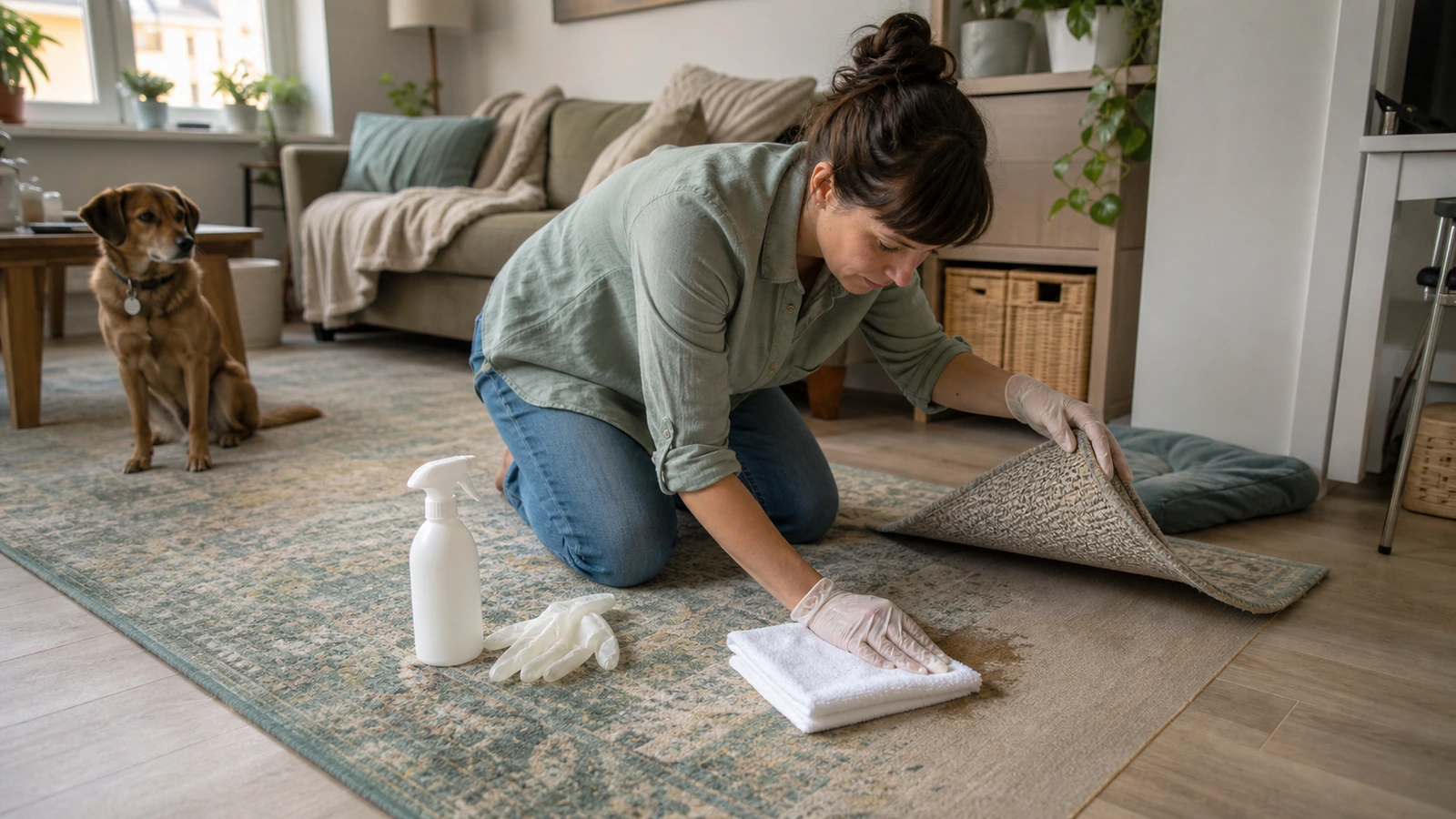
A pet accident on an area rug is not automatically a carpet-cleaning job. The visible pile is only the first layer. Liquid may have reached the backing, a separate rug pad, and the floor underneath, while the safest cleaning method may change with wool, cotton, synthetic yarn, viscose, plant fiber, dye, adhesive, or a removable-cover system.
That is why learning how to clean pet stains from an area rug starts with identification, not a bottle of cleaner. A method that works on a colorfast polypropylene rug may distort a cotton flatweave, discolor viscose, weaken a plant-fiber rug, separate a backing, or leave moisture trapped over laminate or wood.
This guide uses a material-and-layer decision system. It covers urine, vomit, feces, muddy paws, food residue, and unknown sticky stains without pretending they all require the same chemistry. It also separates fresh active mess from dried residue, controls moisture, and explains when an apartment is not a suitable place for another DIY attempt.
The sequence is an editorial framework supported by current rug-care, cleaning-product, flooring, public-health, and moisture guidance. Exact care labels and manufacturer directions always take priority over a general article.
Quick Answer
For a fresh pet stain, keep pets and people away, lift solids or blot active liquid without rubbing, then inspect the rug face, backing, separate pad, and floor. Identify the fiber, construction, and care label before applying a product.
Use this order:
- Identify the exact rug and its care instructions.
- Classify the fiber, weave, backing, pad, and washable components.
- Identify the stain type and whether it is fresh, dried, or recurring.
- Remove solids or contain and blot active liquid first.
- Lift the rug when safe and inspect the backing, pad, and floor.
- Choose only a method allowed by both the rug instructions and the cleaner or machine instructions.
- Control moisture and prevent the treatment from spreading into clean material.
- Dry the rug face, backing, pad, and floor under their own care rules.
- Recheck the stain, odor, color, texture, shape, backing, and floor after drying.
- Repeat only when permitted, or choose the appropriate professional, property-management, or replacement handoff.
Do not default to an enzyme cleaner, portable extractor, washing machine, vinegar recipe, or full-rug soaking. “Pet stain,” “synthetic,” and “machine washable” are not complete cleaning instructions.
The governing logic is:
CARE LABEL / RUG IDENTITY → FIBER + CONSTRUCTION → STAIN TYPE → FRESH OR DRIED → CHECK BACKING / PAD / FLOOR → REMOVE SOLIDS / CONTAIN LIQUID → CHOOSE COMPATIBLE METHOD → CONTROL MOISTURE → DRY BOTH SIDES COMPLETELY → RECHECK STAIN + ODOR + STRUCTURE → REPEAT / PROFESSIONAL / REPLACE / FLOOR HANDOFF
Table of Contents
Identify the Rug Before You Clean It
Start with the care label, receipt, product page, or manufacturer support. Record the face fiber, construction, backing, wash and drying instructions, cleaner restrictions, and whether the rug is handmade, vintage, or detachable.
Do not rely on appearance. A silky rug may be viscose; a wool-looking rug may be a blend; and a synthetic face may hide moisture-sensitive jute, latex, rubber, or adhesive. A washable cover may sit on a non-washable pad.
If the label is missing, inspect the underside, weave, fringe, backing, pad, and signs of hand construction. Unknown identity lowers the DIY ceiling; it does not justify the method marketed for the widest range of carpets.
Test any permitted product inconspicuously and let the test dry fully. Check a white cloth for dye and inspect for color, texture, pile, ring, backing, adhesive, or shape changes. A wet-only test is incomplete.
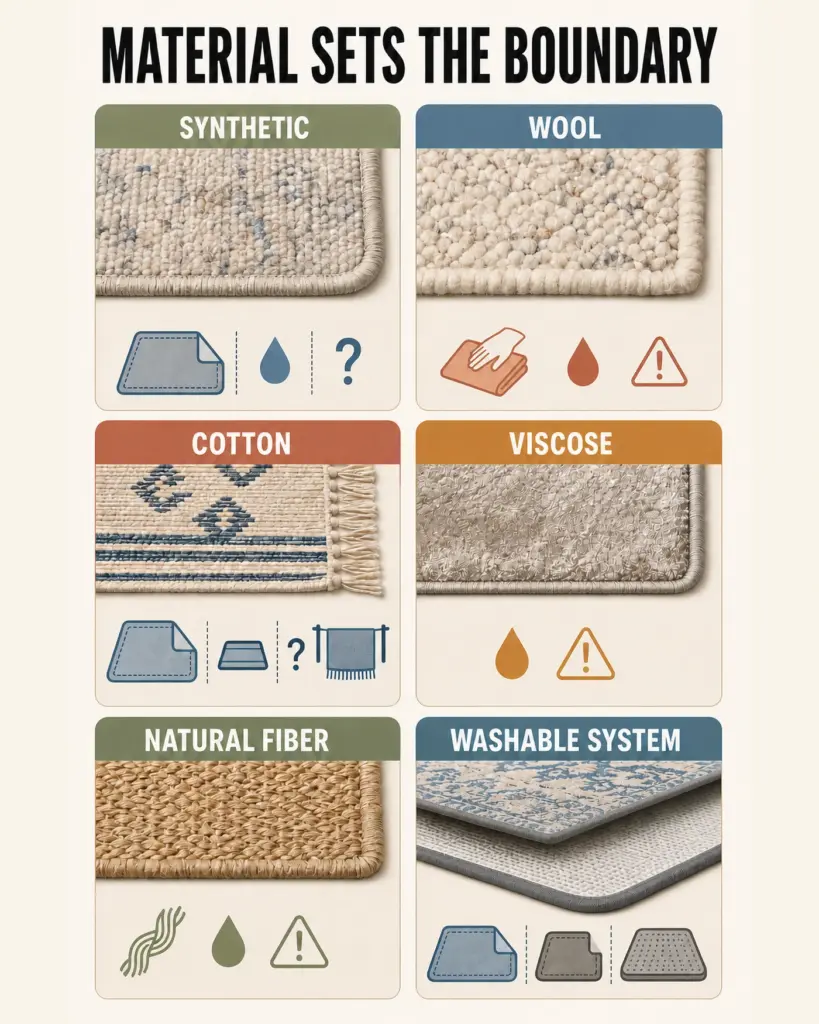
| Rug Material / Construction | Routine Pet-Stain Boundary | Moisture / Method Boundary | Major Risk | Stop Condition |
|---|---|---|---|---|
| Polyester | Prompt blotting and compatible localized treatment may be possible | Follow the exact label; backing and dye still control moisture and extraction | Oily residue, matting, rings, backing saturation | Color, texture, or backing changes during the dry test |
| Nylon | Often tolerates controlled spot cleaning | Do not assume every nylon rug permits extraction or saturation | Dye transfer, residue, over-wetting, backing damage | Care instructions conflict with the proposed cleaner or machine |
| Polypropylene / olefin | Face fiber may tolerate moisture better than delicate fibers | Construction, indoor placement, backing, and floor remain limiting factors | Oily soil, trapped moisture, adhesive or floor interaction | Liquid has spread beyond a controllable area or backing is unstable |
| Wool | Blot promptly; use wool-compatible, label-approved treatment | Low, controlled moisture; colorfastness and pile response must be checked | Dye bleed, felting, shrinkage, distortion | Valuable rug, unstable dye, unknown foundation, or repeated urine saturation |
| Cotton | Some rugs permit washing or localized treatment | Exact wash, load, and drying instructions decide; cotton can still shrink or bleed | Shrinkage, dye migration, warping, slow drying | Rug cannot move freely in the approved washer or dry as directed |
| Viscose / rayon | Immediate absorption is safer than experimental wet treatment | Moisture and wet agitation may permanently change appearance and texture | Yellowing, dye bleed, stiffness, pile distortion | Label is unclear, stain is deep, or any wet test changes the fiber |
| Jute / sisal / plant fiber | Blot active liquid promptly and limit spread | Saturation, steam, and wet shampoo are commonly prohibited | Browning, tide marks, swelling, weakening, distortion | More than a small controlled response is required |
| Mixed fiber | Identify every disclosed component | Use the boundary of the least tolerant fiber, backing, or dye system | One method protects the face but damages another component | Composition or construction remains uncertain |
| Machine-washable one-piece rug | Remove solids or blot liquid before following the wash label | Washer capacity, free movement, pretreatment, cycle, and drying are model-specific | Overload, dye loss, backing damage, incomplete drying | Rug does not fit or the contamination conflicts with shared-laundry use |
| Removable cover + pad system | Treat cover, pad, and floor as separate items | Cover washability does not make the pad machine washable | Missed pad contamination, trapped floor moisture, incorrect reassembly | Pad instructions are unavailable or components cannot dry separately |
| Latex / rubber / TPR / EVA backing | Inspect after every liquid accident | Do not infer washability from the face fiber | Crumbling, separation, odor retention, floor discoloration | Backing is sticky, cracked, separating, or incompatible with the floor |
| Vintage / handmade / specialty dye | Contain the stain and document the rug | Professional identification usually precedes deeper treatment | Unstable dye, fringe or foundation damage, loss of value | Unknown dye or structure, existing damage, or deep contamination |
Fresh, Dried, and Recurring Stains Need Different First Moves
“Dry before wet” is useful for loose mud, grit, food crumbs, and other dry debris. It is not a universal rule for active urine, vomit, feces, or another spreading liquid.
For fresh liquid, contain and absorb first with clean white material, pressing rather than scrubbing and replacing it as it becomes wet. Limit outward spread. Put a protective barrier below a removable rug only if it will not trap liquid.
Lift solids with a spoon or blunt edge without pressing them deeper. Bag waste, wash hands, and keep the pet away. For illness, ongoing diarrhea or vomiting, or a higher-risk household member, seek condition-specific veterinary or healthcare guidance.
For dried stains, identify the rug and inspect its layers before adding liquid. A dry mark may be residue, dye damage, distortion, or evidence below; moisture can mobilize residue or enlarge a ring.
If odor returns after drying, check whether treatment reached the backing, pad, or floor; whether the rug was re-laid too soon; and whether another accident or cross-contamination occurred. Odor cannot identify the affected layer, and fragrance cannot answer the question.
| Pet Stain Type / State | First Action | Chemistry Boundary | Backing / Pad Check | Escalation |
|---|---|---|---|---|
| Fresh urine | Keep pets away; blot active liquid without rubbing | Use a cleaner only when both labels permit it; do not mix products | Inspect immediately because the visible spot may be smaller than the wet underside | Large saturation, unstable dye, valuable rug, soaked pad, or vulnerable floor |
| Dried urine / recurring odor | Identify the rug, affected area, and prior treatments before re-wetting | Enzyme treatment is conditional, not automatic; follow exact repeat directions | Check for residue, odor, rings, or dampness below after the proper dry state | Repeated label-directed treatment fails or odor remains in structure or floor |
| Vomit | Lift solids, then absorb remaining liquid | Account for pigment, food, and acidic residue; use only compatible treatment | Check whether liquid crossed the backing | Illness-related contamination, dye change, deep penetration, or delicate rug |
| Feces | Lift solids, bag waste, then clean visible residue | Disinfect only when justified and when an appropriate product is permitted for the surface | Inspect backing and pad without spreading contamination | Diarrhea, large contamination, high-risk household, or non-cleanable material |
| Muddy paws | For ordinary loose mud, allow drying when appropriate and remove dry soil first | Treat the remaining mark only with a compatible method | Check below only if the mud was wet enough to penetrate | Abrasion, embedded grit, dye change, or broad wet soil load |
| Food residue | Lift food and absorb liquid or grease promptly | Cleaner must fit both the food soil and rug; raw food requires stronger contamination caution | Inspect the feeding-side edge, backing, pad, and floor for seepage | Raw-food spread, oily ring, damaged dye, or inaccessible backing |
| Unknown sticky stain | Stop traffic and collect what can be identified without smearing | Do not layer random solvents, detergents, enzymes, oxidizers, or disinfectants | Inspect for depth and previous product residue | Unknown chemistry, strong reaction, color change, odor, or valuable construction |
Check How Far the Stain Traveled
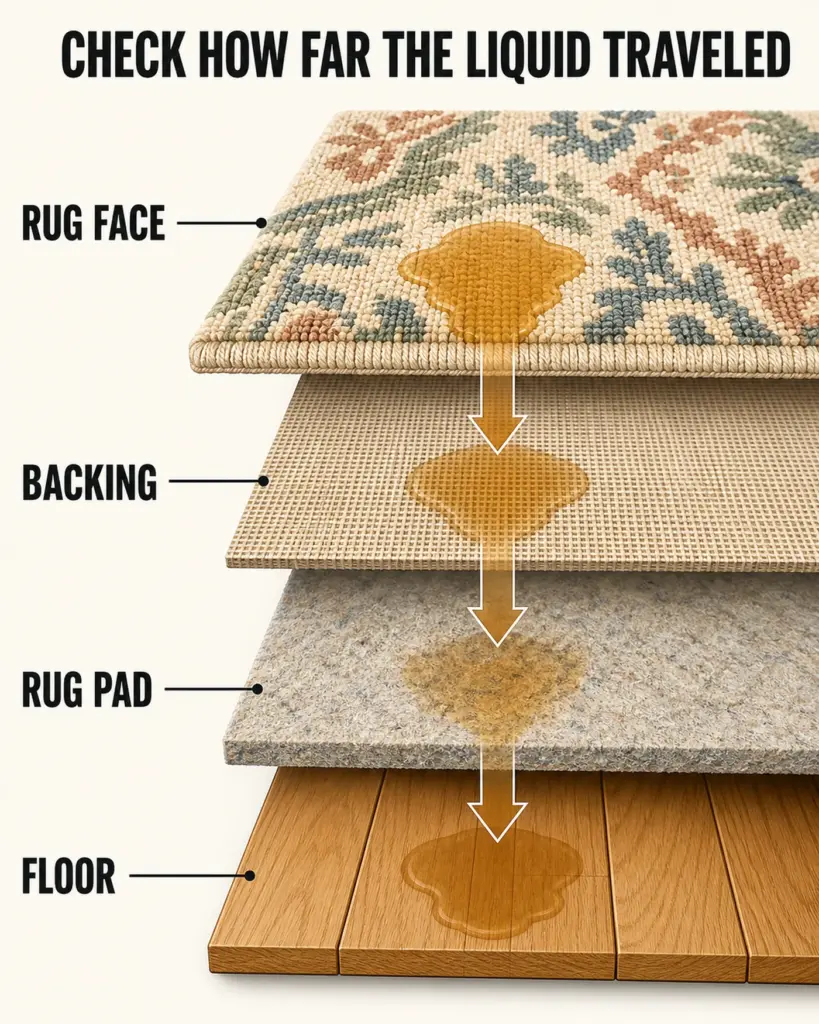
Because an area rug is movable, its hidden layers can be inspected. Lift carefully: a wet rug can spread liquid, strain its structure, or drag contamination across the floor.
Begin at the nearest edge and lift only enough to inspect. Get help for a large, heavy, or wet rug. Do not sharply fold it, drag it across wood, or carry it dripping through shared space.
Rug Face
The face shows where the accident was noticed, not necessarily its full spread. Pile direction, pattern, and color can conceal the boundary.
Backing
Look for a larger wet area, discoloration, odor, adhesive change, deteriorated latex or rubber, loose tufts, delamination, or a tide line. Top-only treatment may miss the source.
Rug Pad
Separate the pad when permitted. Felt, foam, rubber, latex, and composite pads have their own limits. Rug washability says nothing about the pad. Replace a contaminated pad if it cannot be cleaned and dried as directed.
Floor Underneath
Inspect for wetness, residue, discoloration, swollen edges, open seams, finish change, or odor. Blot liquid and follow the floor instructions; rug cleaner does not automatically belong on the floor.
If the area rug sits over wall-to-wall carpet, the lower surface is no longer a simple hard-floor check. A cat-urine accident in installed carpet belongs in the cat urine smell in apartment carpet guide, while concern about installed cushion or deeper material requires its own assessment.
Choose a Compatible Cleaning Method
A method is compatible only when the rug, product, and machine instructions agree. Any no-water, dry-clean-only, no-extraction, no-enzyme, no-machine-washing, or professional-cleaning restriction controls.
Use the smallest controlled response that reaches the affected material without creating a broader moisture problem. A label-approved urine treatment may need to reach residue depth, but soaking an assembly that cannot be protected and dried is not controlled cleaning.
Do not mix cleaners. Previous detergents, disinfectants, powders, oxidizers, solvents, or shampoos may leave residue or conflict with the next product. Disclose earlier products to the manufacturer. See what not to use on pet urine smell for chemical and steam cautions.
Cleaning removes soil and residue; disinfection is a separate, condition-specific job. Many rugs cannot tolerate a disinfectant or its required wet contact time. Never claim disinfection unless the product’s surface, contact-time, rinse, drying, and safety directions were met.
Synthetic Area Rugs
Polyester, nylon, and polypropylene may be more forgiving than viscose or plant fiber, but inspect the weave, backing, dye, binding, adhesive, pad, and floor.
For approved spot treatment, remove solids or blot liquid, test the product, confine application, and recover or rinse only as directed. Glued backing, foam, fringe, mixed yarn, or unstable print can lower the moisture limit.
Some synthetic rugs permit extraction, but only when all instructions and the drying space agree. Move an approved rug away from vulnerable wood or laminate rather than spraying through it.
Wool Rugs
For wool, blot with clean white material, avoid scrubbing, and complete a dry-state dye test. Use treatment approved for the exact rug; “safe for carpet” is insufficient.
Moisture, heat, agitation, incompatible alkalinity, oxidizers, and prolonged wetness can affect wool, dye, foundation, or shape. Old urine, repeated saturation, foundation odor, unstable dye, valuable handwork, or unknown backing favors a qualified rug cleaner.
Professional cleaning becomes appropriate when the apartment cannot safely identify, treat, and dry the complete construction.
Cotton Rugs
Cotton is washable only when the exact label says so. It can become heavy, shrink, bleed, wrinkle, or dry unevenly; a cotton face does not make its backing washable.
If washing is permitted, remove solids or blot liquid, observe pretreatment limits, leave room for movement, and follow the specified cycle and drying method. Do not force a bulky wet rug into a small machine.
Viscose, Rayon, and Art-Silk Rugs
Moisture and agitation can make viscose or rayon swell, flatten, harden, yellow, bleed, or reflect light differently after drying.
Absorb liquid without rubbing. If the label does not authorize a method, stop after containment and contact the manufacturer or a viscose-rug professional. “Plant-derived” and “art silk” are not DIY permissions.
Jute, Sisal, and Other Natural Plant Fibers
Jute, sisal, seagrass, and related fibers may absorb liquid, swell, develop tide marks, distort, or weaken. Many manufacturers prohibit steam, wet shampoo, and saturation.
Blot promptly and lift solids without rubbing. Check instructions before any product: “natural,” “pet friendly,” or “carpet safe” may still mean too much moisture. Broad penetration favors professional cleaning or replacement over repeated damp treatment.
Washable Rugs and Removable-Cover Systems
“Washable” answers only part of the problem. Confirm whether the whole rug, only the cover, or neither component may be washed after the specific contaminant and pretreatment.
For one-piece rugs, confirm machine type, capacity, free movement, detergent, cycle, drying, and wet weight. If the rug cannot move freely or dry as directed, machine washing is unavailable despite a washer symbol.
For removable-cover systems, separate as directed and inspect both components plus the floor. A washable cover may sit on a spot-clean-only pad; do not copy one brand’s rules to another.
In shared laundry, remove waste first, never transport a dripping rug, and do not assume a normal cycle disinfects. Follow rug, appliance, and building rules; use an approved larger machine or professional service when needed.
The Enzyme-Cleaner Boundary
Enzyme cleaners are conditional options for urine or other organic residue. The rug must permit the exact product, which must reach the residue and be timed, removed, rinsed, extracted, blotted, or dried exactly as labeled.
Never borrow another brand’s contact time or extend installed-carpet approval to wool, viscose, jute, vintage rugs, all dyes, or all backings. “Color safe” does not replace care instructions and a dry-state test.
If the rug is compatible and an enzyme product is justified, the enzyme cleaner versus carpet cleaner guide explains the difference between chemistry that acts on residue and a machine that removes liquid and soil. Product selection belongs in the separate enzyme-cleaner research guide rather than in this surface-execution article.
The Portable-Extractor Boundary
An extractor applies liquid and recovers some of it. It cannot make a rug compatible, guarantee urine removal, or eliminate drying for the backing, pad, floor, hose, tool, and tanks.
Confirm the rug, machine, formula, protected cleaning location, test result, and drying plan before extraction.
Do not extract silk, viscose, jute, sisal, handmade, vintage, specialty-dye, unstable, or dry-clean-only rugs unless exact instructions allow it. An unknown rug remains unknown even if the machine mentions area rugs.
Stop for dye-colored recovery water, pile change, softened backing, buckling, uncontrolled spread, or inadequate drying capacity.
Dry the Rug, Backing, Pad, and Floor
Drying is part of cleaning. A dry-feeling pile may hide a damp backing, pad, or floor; early reassembly can trap moisture, residue, and odor.
Use the approved drying position: some rugs must lie flat, some permit a dryer setting, and some may hang only when their construction and weight allow. Avoid weak railings or rods and runoff into shared or neighboring space.
Safe airflow or dehumidification may help but cannot override instructions or prove hidden layers dry. Outdoor drying depends on weather, humidity, pollution, security, and building rules.
There is no universal overnight, 24-hour, or 48-hour drying time. Fiber, construction, treatment volume, humidity, airflow, and position matter. General guidance to dry wet materials quickly is not a rug-specific deadline.
Before re-laying, check:
- The face and underside feel and look consistent with the rug’s normal dry state.
- No dye is transferring and no tide line is developing.
- The rug has not shrunk, buckled, curled, stiffened, or separated.
- The pad has reached its own required dry state or has been replaced.
- The floor is dry, clean, undamaged, and compatible with the pad or backing.
- The treatment odor has dissipated as expected under the product directions.
- Pets cannot access residual product or a damp assembly.
Judge stain and odor only after the full assembly is dry. Mid-dry re-wetting obscures whether drying or treatment failed.
Protect the Floor Under the Rug
When liquid reaches the floor, lift, inspect, contain, dry, and choose a handoff. Rug cleanup does not replace floor-specific care.
Hardwood and Engineered Wood
Blot promptly and use only compatible floor care. Check seams, finish, color, and shape. Do not put rug cleaner or enzymes on wood unless both instructions permit it. Report possible seam or subfloor entry as the lease requires.
Laminate
Remove standing moisture promptly without wet-mopping. Swollen edges, changed joints, warping, or prolonged liquid beneath the pad requires a flooring or property-management handoff.
Vinyl and LVP
Wipe promptly with a compatible method and inspect seams. Check whether latex or rubber in the pad can discolor vinyl. “Waterproof” does not authorize trapped contamination or incompatible cleaner.
Tile, Grout, and Natural Stone
Tile, grout, sealant, and stone differ. Acidic or abrasive urine remedies can harm natural stone. Follow supplier guidance and escalate deep grout staining, loose tile, seal damage, or suspected penetration.
| Apartment Scenario | Immediate Action | Drying Plan | Floor Check | Handoff |
|---|---|---|---|---|
| Small synthetic rug over sealed hardwood; fresh urine | Blot, lift safely, inspect all layers, and use only compatible treatment | Dry rug and pad separately in approved positions with protected airflow | Blot wood promptly; inspect finish and seams | Flooring help if darkening, seam entry, or finish change appears |
| Wool rug in a studio; dried odor | Identify construction and prior products before adding moisture | Use only a controlled approved treatment with space to dry flat | Inspect for old residue beneath the rug and pad | Qualified rug cleaner for unstable dye, deep odor, or inadequate drying space |
| Washable cover system over LVP | Separate cover and pad as directed; remove waste before washing | Wash only the permitted component; dry cover and pad under separate rules | Inspect seams and backing-related discoloration | Manufacturer support if pad treatment or reassembly is unclear |
| Large cotton rug; no in-unit washer or balcony | Contain the spot and confirm the wash label | Use an approved large machine or service; control transport and runoff | Keep floor exposed until dry and clean | Laundromat only if machine and building rules fit; otherwise professional service |
| Viscose rug over laminate; vomit | Lift solids and absorb liquid without rubbing | Avoid experimental wet cleaning; maintain safe controlled staging | Blot laminate and inspect edges immediately | Rug professional plus flooring handoff if liquid reached joints |
| Jute runner near entry; repeated pet accidents | Blot the current accident and stop saturation attempts | Limited apartment drying does not make repeated wet treatment safe | Inspect for trapped moisture and discoloration | Professional assessment or replacement; veterinarian if accidents are new or frequent |
Common Area-Rug Pet-Stain Mistakes
- Treating it like installed carpet: Lift when safe and inspect the backing, pad, and floor.
- Starting with the strongest cleaner: Strength is not material compatibility.
- Using enzymes for every organic mark: Urine, vomit, feces, food, and unknown residue differ; compatible chemistry can still be incompatible with the rug.
- Scrubbing: This can spread residue, drive in solids, distort pile, fuzz wool, and damage viscose or plant fiber.
- Saturating from above: Extra liquid may enlarge the wet area and soak the pad or floor without evenly reaching residue.
- Extracting without checks: Rug, dye, backing, machine, formula, and drying plan must all agree.
- Washing immediately: First remove solids or contain liquid; confirm which component fits the approved machine and drying method.
- Cleaning only the face: Hidden residue can return as odor or moisture.
- Re-laying too soon: A dry pile does not prove the backing, pad, and floor are dry.
- Masking odor: Fragrance does not remove residue and can obscure the recheck.
- Combining products: Mixing or unapproved layering adds chemical, residue, dye, and performance risks.
When DIY Should Stop
Stop when the rug, contamination, floor, or apartment exceeds a controlled home process.
Stop and seek appropriate help for:
- Dye bleeding, color transfer, shrinkage, rippling, curling, pile distortion, or hardening.
- Backing separation, loose tufts, softened adhesive, or deteriorating latex or rubber.
- A valuable, vintage, handmade, silk, viscose, specialty-dye, or unidentified rug needing more than containment.
- Broad pad saturation, repeated deep saturation, or odor that persists after approved treatment and complete drying.
- Persistent dampness or no safe space, position, airflow, or isolation for drying.
- Visible mold-like growth; avoid disturbing it and seek qualified moisture or remediation guidance.
- Damaged wood finish, open seams, laminate swelling, vinyl discoloration, loose tile, grout damage, or suspected subfloor involvement.
- Biological contamination too large to handle without spreading, or unknown/reacting chemical residue.
Choose a professional experienced with the exact rug, not a generic carpet package. Disclose its construction, stain, prior products, affected layers, and dye or backing response. Ask about testing, cleaning, recovery, drying, and final checks.
Replacement is reasonable when a component cannot be cleaned and dried as directed, structural damage is advancing, repeated saturation reached its foundation, or treatment exceeds its value. A handmade rug may merit restoration while a deteriorating pad may merit prompt replacement; decide by component.
For new or frequent accidents, or changes in urination, stool, appetite, mobility, pain, vomiting, or behavior, contact a veterinarian. Cleaning cannot diagnose recurrence.
Recheck After Everything Is Dry
Recheck only after every layer is dry. Use neutral light from multiple directions; viscose and directional pile can change appearance with viewing angle.
Check for:
- Residue, tide lines, dye transfer, or color change.
- Changed texture, pile, fringe, edge, shape, backing, or adhesive.
- Pad odor, staining, compression, or dampness.
- Floor discoloration, swollen joints, finish change, or residue.
- Odor that persisted versus odor that returned after drying.
Repeat only when both instructions allow it and no damage occurred. Never compensate by increasing concentration, contact time, product combinations, or water.
If odor returns, diagnose before cleaning again. Record products, drying, inspected layers, and changes so the manufacturer, rug cleaner, flooring professional, veterinarian, or property manager can choose the next step.
Final Takeaway
The safest way to approach how to clean pet stains from an area rug is to stop treating the rug as one surface. Identify its fiber and construction, classify the stain, contain fresh liquid or lift solids, and inspect the rug face, backing, pad, and floor before choosing a method.
Enzyme cleaners, extractors, and washing machines are conditional tools—not default answers. Moisture control and complete component-by-component drying are part of the cleaning job. When dye, structure, repeated saturation, persistent dampness, recurring odor, valuable construction, or floor damage exceeds the apartment’s capacity, stop and use the correct professional or replacement handoff.
Sources
- Carpet and Rug Institute: Pet Urine and Carpet
- WoolSafe: Cleaning and Maintenance of Wool Carpets and Rugs
- WoolSafe: Stain Wizard
- Ruckstuhl: Cleaning and Care of Sisal and Viscose Rugs
- Carl Hansen & Søn: Wool and Jute Rug Care
- Ruggable: Care and Pad-Cleaning Support
- CDC: Hygiene Practices Around Animals
- CDC: When and How to Clean and Disinfect Your Home
- EPA: Mold Course—Dry Quickly
- Shaw Floors: Hardwood Care
- Shaw Floors: Laminate Care
- Shaw Floors: Vinyl Care
- Natural Stone Institute: Care and Cleaning of Natural Stone
- BISSELL: How to Spot Clean Carpet and Rugs