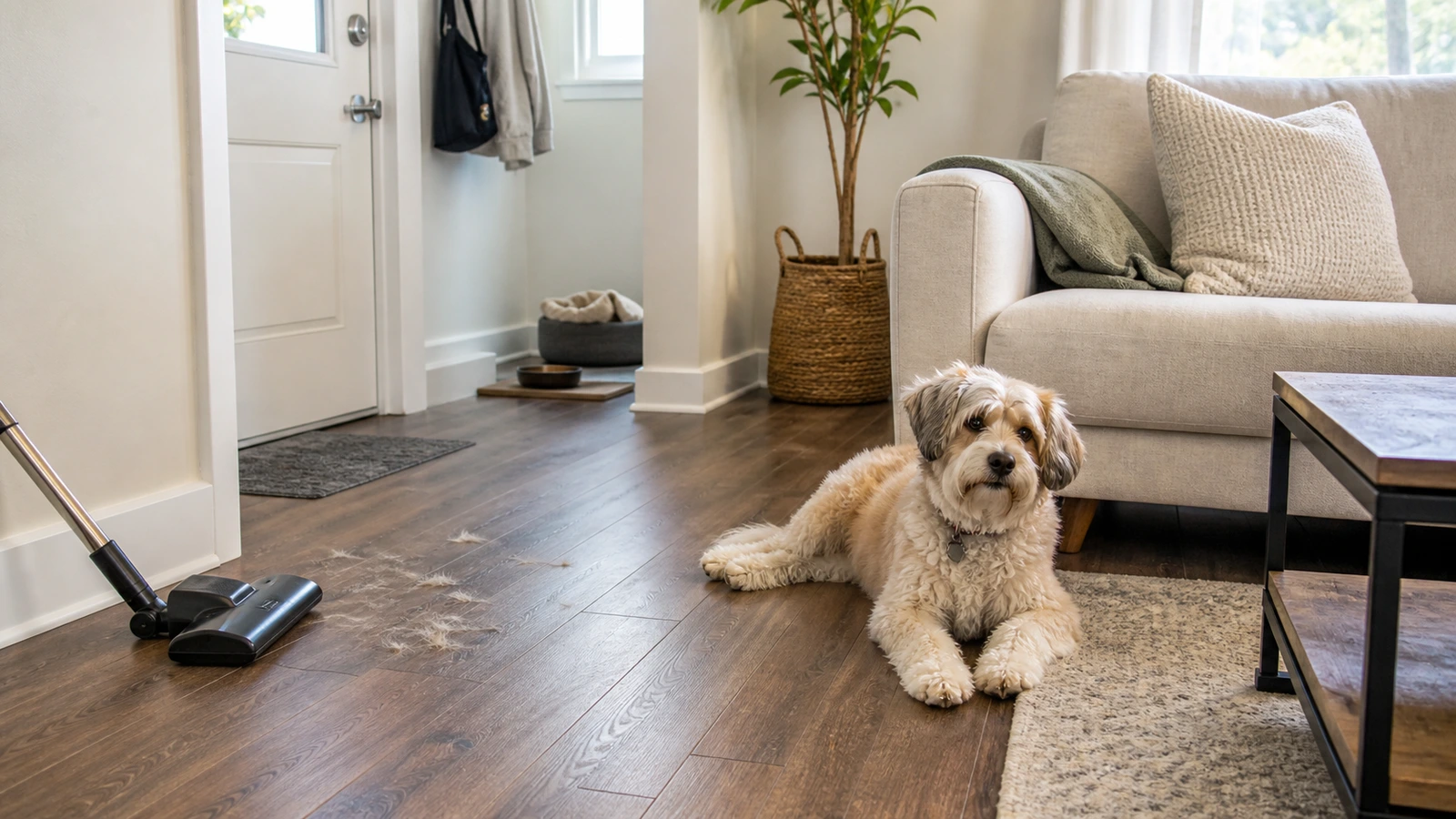
Guests are almost at the door, the sofa has a visible layer of pet hair, litter has reached the hallway, and something near the feeding area smells off. This is not the moment to begin a deep clean. The goal of quick cleaning before guests is to create the largest safe improvement in what people will see, smell, touch, and walk through—without starting a wet or complicated task that cannot be finished.
In a small apartment, one choice can affect the entire room. Wet-mopping may block the only path, while removing a sofa cover may leave no clean seat. The best use of 15 minutes is not “clean faster.” It is “choose fewer, higher-impact tasks and stop at the right boundary.”
The sequence in this guide is an editorial prioritization framework based on source control, guest contact, visible impact, re-transfer risk, drying, and safety. The minute blocks are not a scientifically validated schedule; apartments will complete tasks at different speeds. Current CDC, EPA, FDA, product-label, and surface-care guidance supports the safety boundaries—not a claim that a sofa must be cleaned in a particular minute.
Quick Answer
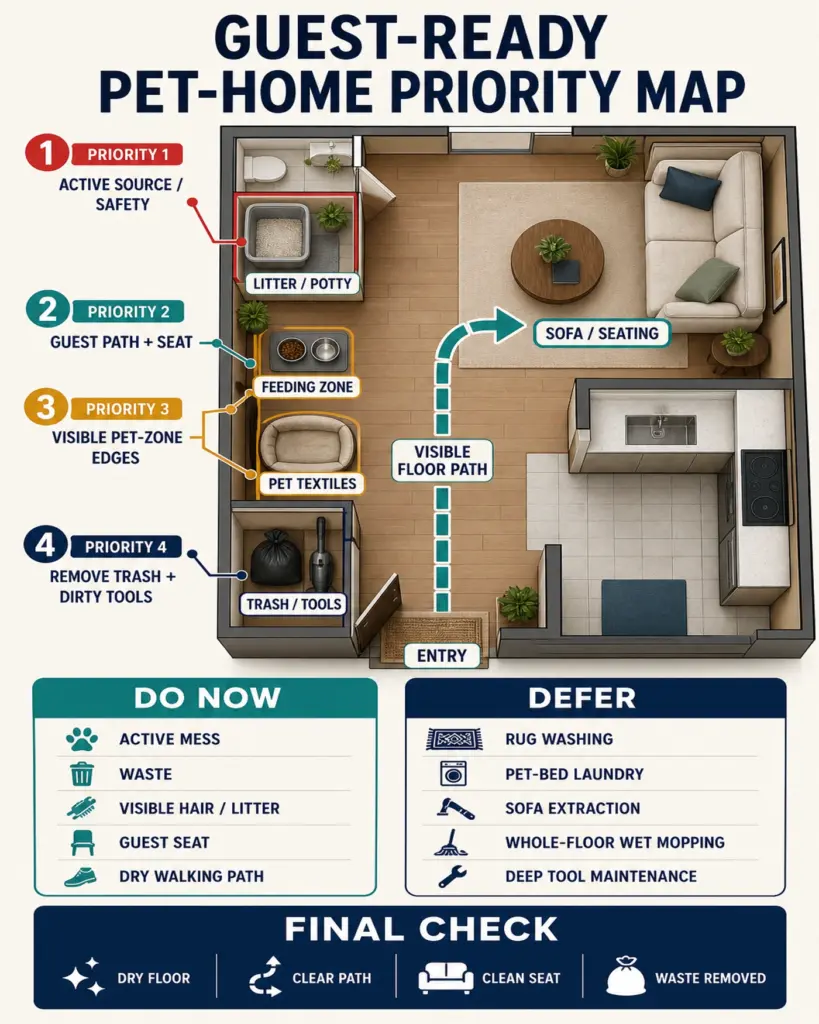
In 15 minutes, do not try to clean the whole apartment. Use this priority order:
- Stop for any active mess or safety problem.
- Remove pet waste, food waste, and the strongest obvious odor source.
- Clear the entry and the path guests will walk.
- Reset the exact sofa or chairs guests will use.
- Pick up visible pet hair, litter, grit, crumbs, and other dry debris.
- Clean only the visible edges of the litter, potty, and feeding zones.
- Remove trash and dirty cleaning-tool sources from the occupied area.
- Ventilate only when outdoor air and building conditions make it appropriate.
- Finish with a dry-floor, clear-path, clean-seat walkthrough.
Do not start anything that cannot be clean, dry, put away, and safely reset before guests arrive. Washing a rug, laundering pet bedding, extracting a sofa, or wet-mopping the entire apartment may technically be cleaning, but it is a poor 15-minute decision when it leaves wet surfaces, blocked paths, exposed equipment, or no usable replacement textile.
The governing logic is:
SAFETY OVERRIDE → STOP SPREADING → REMOVE ACTIVE SOURCE / WASTE → HIT GUEST PATH → RESET SEATING / TEXTILES → CLEAN PET-ZONE EDGES → REMOVE TRASH / TOOL SOURCES → VENTILATE IF APPROPRIATE → FINAL DRY WALKTHROUGH → DEFER / HANDOFF
When time is short, VISIBLE + SMELLABLE + TOUCHABLE receives priority over hidden, low-impact detail.
Table of Contents
Before You Start the Timer
Pause for a fast safety scan. You are not looking for every dusty corner. You are checking whether an urgent condition makes the guest-ready timer irrelevant.
Stop ordinary cleaning if you find fresh urine, feces, vomit, standing water, a raw pet food spill, broken glass, smoke, a burning or electrical odor, gas odor, sewage odor, or an unknown chemical spill. The immediate sequence becomes STOP → CONTAIN → ISOLATE → HAND OFF. Keep pets and people away, prevent spreading if you can do so safely, and follow the correct emergency, building-management, product-label, or professional procedure. Do not keep rushing through an aesthetic checklist while contamination or a hazard remains active.
This article does not teach those full cleanup procedures. If the event cannot be made safe within the available time, the 15-minute reset ends. Guests may need to be delayed, redirected, or met elsewhere.
If there is no safety override, collect only the few tools already suitable for your surfaces: perhaps a trash bag, dry cloth, compatible vacuum or dry pickup tool, and one label-approved spot-cleaning item if genuinely necessary. Do not spend the first five minutes assembling a chemistry lab. Read and follow labels, never mix products, and keep pets away from treated areas for as long as the label directs. “Pet-safe” should not be assumed from a scent, a natural-looking package, or an internet shortcut.
Finally, choose the actual guest zone: where people will enter, walk, sit, place a drink, and use a sink or toilet. Private bedrooms, closets, hidden storage, and detailed appliance cleaning do not earn time unless they contain an active source.
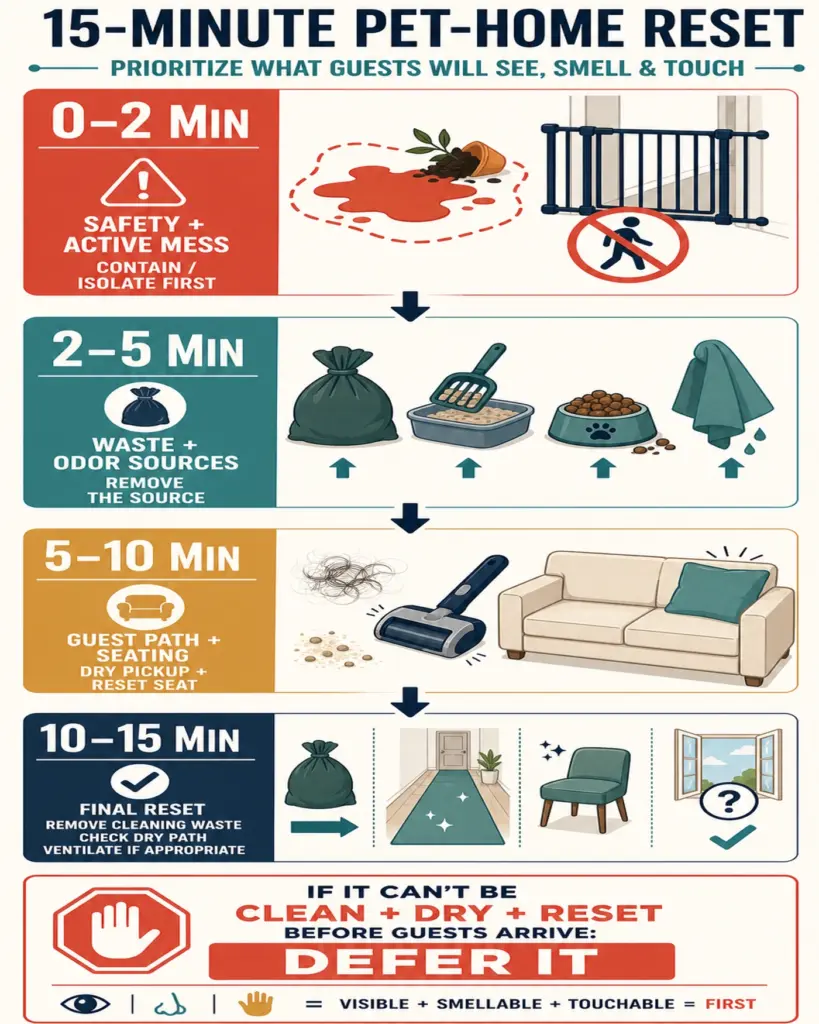
The 15-Minute Quick Cleaning Before Guests Plan
Use the blocks as capacity limits, not a stopwatch competition. If one priority consumes the entire block, move forward only when it is safe to do so. Skip lower-impact tasks instead of compressing a label contact time, leaving a wet surface, or abandoning a contaminated tool.
0–2 Minutes: Safety and Active-Source Triage
Walk the guest path once. Look down at the floor, check the pet toilet and feeding zone, and notice any strong localized smell. If you find an active liquid or biological mess, contain that first. Loose dry debris can wait; a spreading liquid cannot.
Remove immediate trip or cut hazards from the path only when they can be handled safely. Broken glass, an electrical smell, smoke, gas, sewage, and unknown chemicals are not speed-cleaning tasks. Isolate the area and use the correct emergency or property-management handoff.
If the scan is clear, open the pathway. Move a pet gate, leash, toy, cleaning cord, or bowl only if doing so does not disrupt the pet’s essential setup. Do not relocate a litter box or indoor potty merely because it is unattractive.
2–5 Minutes: Waste and Localized Odor Sources
Remove what continues to produce odor. Scoop or collect visible pet waste, secure the bag, and move it to the proper disposal point. Remove stale wet food, empty food packaging, dirty paper towels, and obvious food waste. If a small trash can holds litter waste or pet food residue, empty it rather than spraying fragrance above it.
Check for one wet or odorous textile in the main room: a pet towel, throw, washable pad, or blanket. Remove it from guest seating and isolate it in a suitable ventilated staging place. Do not seal a damp textile inside a closed hamper or closet. If a clean spare throw already exists, place it on the guest seat; do not begin a laundry cycle just to manufacture a replacement.
This is source removal, not odor diagnosis. If you cannot identify the smell after checking waste, food, damp textiles, and active mess, stop chasing it with random products.
5–10 Minutes: Guest Path and Seating
Use dry pickup for loose pet hair, tracked litter, grit, crumbs, and dry debris. Start at the entry and follow the route to the seating area. Focus on what is visibly concentrated: edge clumps, a litter trail, the center walkway, and the floor directly in front of the sofa. You do not need to vacuum under every piece of furniture.
Then reset the exact seat a guest will use. Remove surface hair with a method compatible with the upholstery, clear crumbs, lift off an obviously dirty throw, and straighten cushions. Check the seat with your hand and clothing in mind: will a guest sit in hair, touch a damp spot, or pick up debris on a sleeve?
Do not wet-extract, soak, or heavily spray the sofa. Upholstery that cannot dry before arrival is not guest-ready. If embedded hair or a deeper stain needs a longer material-specific process, defer it and provide another clean seat if possible.
10–15 Minutes: Final Source Removal and Visual Reset
Give the visible edges of the pet zones a short pass. Collect dry litter or potty debris that escaped into the walkway. Remove crumbs near the feeding mat, lift a visibly wet mat if needed, dry the exposed floor interface, and return stable bowls to a usable position. Do not turn this into a full bowl, fountain, litter-box, or floor-cleaning procedure.
Next, remove the secondary sources created by cleaning: tie off the waste bag, move dirty paper towels or cloths out of the living area, and empty a vacuum bin or dirty-water tank only if the equipment maker permits it and the step can be completed cleanly. Long washing, filter care, hose cleaning, or component drying waits until after the visit.
Use the final minute to stand at the door and follow the guest’s view. Is the path clear? Is the floor dry? Is the seat usable? Is trash hidden by proper removal rather than pushed into a cabinet? Are cords, vacuums, buckets, and wet tools out of the walking route? Stop when the ownership loop is closed.
| Minute Block | Priority | Do Now | Skip / Defer |
|---|---|---|---|
| 0–2 | Safety and active-source triage | Scan for liquid, biological mess, glass, smoke, gas, sewage, chemicals, and blocked paths; contain or isolate first | Aesthetic cleaning while a hazard or active contamination remains |
| 2–5 | Waste and localized odor sources | Remove pet waste, stale food, obvious trash, and one wet or odorous textile | Odor diagnosis, fragrance masking, full litter or feeding-zone cleaning |
| 5–10 | Guest path and seating | Dry-pick up visible hair, litter, grit, and crumbs; reset the exact guest seat | Whole-home vacuuming, upholstery extraction, embedded-hair treatment |
| 10–15 | Final source removal and visual reset | Check pet-zone edges, remove cleaning waste, conditionally ventilate, and confirm a dry clear path | Tool deep maintenance, whole-floor mopping, any task that cannot finish and dry |
Why the Guest Path and Seating Carry More Weight
A guest experiences an apartment through a narrow route: entry, visible floor, seating, and perhaps the kitchen edge or bathroom. Hair under a closed bed has less immediate effect than hair on the chair, litter underfoot, or a waste bag beside the door.
Small homes intensify that route. A studio’s pet bed may be visible from the sofa. A litter box may sit near the living room because there is no utility room. The feeding mat may border the kitchen walkway, and the sofa may be both the pet’s resting place and the only guest seating. Prioritizing the path is not pretending hidden mess does not exist. It is choosing what can produce the greatest safe change before arrival.
The path also controls re-transfer. Cleaning the sofa before collecting floor hair can allow shoes, paws, tools, or a moving blanket to put debris back on the seat. A compact route—entry, floor path, seating, pet-zone edge, trash exit—reduces repeated work.
Reset the Guest-Visible Pet Zones
Entryway
The entry creates the first view and often carries outdoor grit, paw debris, leashes, waste bags, and pet towels. Clear enough space for guests to enter without stepping over equipment. Collect the visible dry debris and remove any damp towel that smells. Do not build a temporary pile that narrows the walkway or blocks the door.
In an apartment building, remember the shared corridor. Do not shake a hairy mat, dusty blanket, or litter-tracking rug into a hallway, balcony, or neighboring space. If there is no appropriate outdoor shaking area, fold the item debris-side inward and stage it for later cleaning.
Sofa and Seating
Guest seating is a high-impact touch and clothing-transfer point. Concentrate on the actual cushion, arm, and nearby throw a guest will contact. Remove loose surface hair and crumbs with a care-compatible method. Replace an obviously dirty throw only when a clean, dry spare is already available.
Straightening cushions is useful after the seat is clean; it is not a substitute for removing hair or a damp textile. Do not mist the sofa with perfume, saturate it with cleaner, or begin extraction. If the only seat is wet or contaminated, block access and offer a different clean chair rather than declaring it dry because the surface feels less damp.
Visible Floor Path
Target the line from the entrance to seating and any guest-facing bathroom or kitchen area. Pick up obvious hair clumps, litter, grit, crumbs, and dry dirt. Normally, loose dry material comes up before a local damp wipe because adding liquid can spread grit or create muddy residue.
That is not an absolute rule. A fresh liquid or biological mess is contained first. For an ordinary visible mark, use only a method compatible with the exact floor and only if it can dry before foot traffic. Do not wet-mop the entire apartment because guests are coming. Wet flooring in the only walking path creates a new problem, and excess moisture may conflict with the flooring maker’s instructions.
Litter or Potty Zone
Remove waste, secure it, and collect tracked dry litter or debris that reached the guest path. If an obvious compatible hard surface needs a small wipe, follow the surface and product directions and leave it dry. Keep the pet’s access route functional.
Do not move a litter box, pee-pad holder, indoor dog toilet, or other established setup solely to improve appearance. Relocation can confuse access and shifts the problem rather than resolving it. Do not add heavily scented litter, powders, sprays, or improvised deodorizer as a last-minute mask.
Feeding Area
Remove stale food, food cans, crumbs, and an obvious spill. If the feeding mat is wet underneath, lift it and dry the visible floor interface. Return bowls only when the immediate area is stable and usable. A raw pet food spill is not a cosmetic wipe: it triggers the active-mess and contamination boundary and may require more time than the guest reset allows.
Keep cleaning products away from food and water. Do not spray around filled bowls. Detailed cleaning of bowls, slow feeders, fountains, removable parts, and mats belongs after the visit unless contamination requires immediate handling.
Pet Textiles
A blanket on the guest sofa, damp paw towel by the door, or pet bed visible from the main room can affect both appearance and odor. Remove a visibly dirty or wet item, fold dry hair-covered material inward, and stage laundry-bound textiles without sealing damp fabric in a closed container.
Do not begin washing a pet bed, rug, or bulky blanket. A full wash and dry cycle will not fit the boundary, and removing the only protective layer may expose a dirtier surface. Use a clean spare only when it already exists.
| Guest-Visible Zone | Quick Action | Why It Matters | Do-Not-Do Shortcut |
|---|---|---|---|
| Entry | Clear the path; collect dry debris; remove damp pet towel | First view and shared walking point | Shake hair or litter into a shared corridor |
| Visible floor path | Dry-pick up hair, litter, grit, and crumbs; spot-wipe only if compatible and dryable | Guests walk through it and can transfer debris | Wet-mop the whole apartment |
| Sofa / seating | Remove loose hair and crumbs; lift dirty throw; straighten clean cushions | Direct clothing and hand contact | Spray fragrance, soak, or extract the sofa |
| Litter / potty | Remove waste; bag it; collect tracked dry debris | Localized odor and visible tracking | Relocate the setup or add fragrance masking |
| Feeding zone | Remove stale food and crumbs; address obvious spill; dry under a wet mat | Often borders kitchen or dining space | Spray near bowls or start deep component cleaning |
| Pet textiles | Remove wet or visibly dirty item; use an existing clean spare | Large visible surface and possible odor source | Start laundry without a dry replacement |
| Trash / tools | Remove waste and isolate dirty cloths or pads; empty equipment only if quick and approved | Cleaning residue can become the final odor source | Hide trash or wet tools in a cabinet or closet |
Trash and Cleaning Tools Are Part of the Odor Check
The apartment can still smell unclean after the visible source is gone if the litter bag, food waste, dirty paper towels, used cloth, wet mop pad, vacuum bin, or dirty-water tank remains in the living area. Finish with REMOVE / EMPTY / ISOLATE.
Remove tied waste through the building’s proper route; do not leave it beside the apartment door or in a shared corridor. Empty a vacuum bin or dirty tank only when it can be done without releasing dust, spilling liquid, or violating the manual. If the tool requires washing, filter removal, hose flushing, or extended drying, isolate it appropriately and defer full maintenance.
Never push wet tools into a closed closet. That hides the visual clutter while preserving moisture and odor. Keep cords, buckets, vacuums, and bags out of the guest path so the reset does not create a trip hazard.
Ventilation and the Air-Purifier Boundary
Source control comes first. Removing waste, dirty food, a wet textile, and contaminated cleanup material generally matters more than trying to move scented air around the room.
Open windows only when outdoor air is suitable, smoke or pollution is not a problem, weather allows, and the building permits it. Consider adjacent apartments and shared corridors; do not push odor or debris toward neighbors. A kitchen or bathroom exhaust fan may help when it actually exhausts outdoors and is appropriate for the source. There is no universal “open the window for 10 minutes” promise.
An air purifier can remain in normal use as a supplement, but it does not remove a litter waste bag, clean a wet feeding mat, dry a sofa, or solve an unidentified source. Do not use an ozone generator in an occupied pet home. Do not diffuse essential oils or spray perfume as a shortcut. Changing the smell is not the same as removing its cause.
What Not to Do in the Last 15 Minutes
Some tasks feel productive because they are dramatic. They are poor choices when they create moisture, exposure, clutter, or unfinished work.
- Do not spray fragrance everywhere. It can combine with pet, food, waste, or damp-textile odor while making the original source harder to judge.
- Do not wet-mop the entire apartment. A small home may have no alternate walking route, and the floor may not dry before arrival. Handle an active spill as required; otherwise limit work to dry pickup and a compatible local response.
- Do not start washing rugs. Washer fit, wet weight, drying, backing, pad care, and floor exposure cannot be resolved in a rushed final block.
- Do not wash pet bedding. A bulky bed or insert may need care-label checks, a full cycle, and complete drying. Removing it may also leave no clean resting place for the pet.
- Do not start laundry without a clean, dry replacement. A sofa throw in the washer does not help if the exposed cushion is hairier or the wash will remain wet through the visit.
- Do not wet-clean guest seating. Soaking, steaming, or extracting the sofa can leave moisture below the surface even when the face fabric feels less wet.
- Do not run carpet extraction for ordinary presentation. Extraction adds wet equipment, dirty water, surface compatibility, drying, and tool-reset demands. An active spill is a separate containment decision, not permission for a rushed whole-rug job.
- Do not move the litter or potty setup for appearance. The pet still needs reliable access, and moving the station can transfer debris or create a new accident risk.
- Do not hide wet tools in a closet. The room may look clearer while damp cloths, pads, hoses, or tanks become a secondary odor source.
- Do not hide trash inside a cabinet. Waste continues producing odor. Bag and remove it through the appropriate disposal route.
- Do not mix cleaners. Follow the label for one appropriate product. Speed does not reduce chemical risk or required contact, rinse, ventilation, and pet-access instructions.
- Do not use ozone. Ozone generators should not be used in occupied spaces and are not a safe guest-ready odor shortcut.
- Do not fill the guest path with equipment. A vacuum, cord, bucket, open bag, drying rack, or displaced pet station can undo the clear route you are trying to create.
The common thread is unfinished ownership. If a task cannot complete the full loop—use, clean, dry, reset, and put away—it belongs after the visit.
Apartment Scenarios
Apartment layout changes the best first move. In a studio, nearly everything is visible and one wet task can block the room. In a one-bedroom, you may be able to close a private door, but the entry, sofa, and kitchen path still carry most of the visit. Mixed-pet homes need source triage rather than assuming all odor or debris comes from one animal.
| Apartment Scenario | First Priority | Second Priority | Defer | Handoff |
|---|---|---|---|---|
| Studio + cat; litter near living room | Remove litter waste and secure the bag | Collect tracked litter from the entry-to-sofa path | Full box wash or relocation | Broader odor-source guide if smell remains unexplained |
| One-bedroom + dog; damp entry | Remove wet towel and clear paw-debris path | Dry-pick up sofa hair and reset the guest seat | Bedding wash and whole-floor mopping | Weekly schedule after the visit |
| Cat + dog; feeding area near kitchen | Remove stale food, waste, and any active spill | Dry the mat-floor interface and clear the shared path | Bowl, fountain, mat, or floor deep cleaning | Product labels and full feeding-zone routine |
| Heavy shedding; no outdoor shaking area | Clean the exact guest seat | Dry-pick up visible path clumps; fold hairy textiles inward | Whole-home hair removal | Pet-hair control system |
| Strong localized odor | Remove the obvious waste, food, or wet textile source | Remove cleanup trash and conditionally ventilate | Random product testing or fragrance masking | Odor-source guide or appropriate professional help |
| Pet uses the only guest sofa | Remove loose hair, crumbs, and dirty throw | Provide an existing clean dry cover or alternate chair | Wet extraction and embedded-hair treatment | Furniture care label or upholstery professional |
What to Defer Until After Guests Leave
Write deferred work down, then stop thinking about it during the visit. Handoffs include washing rugs or bedding, deep-cleaning upholstery, extracting carpet, cleaning under furniture, maintaining equipment, replacing filters, deep-cleaning feeding components, and completing full bathroom or floor routines.
Defer any wet task without enough drying space. This does not apply to active hazards or contamination, which require the appropriate immediate response. It applies to important but non-urgent work such as embedded hair, deeper odor investigation, maintenance, or hidden dirt.
If the Odor Still Remains
If obvious waste, stale food, damp textiles, litter residue, trash, and cleanup materials are gone but the smell remains unexplained, stop adding products. Use the pet odor source guide later to separate likely sources instead of treating the whole room at random.
If hair returns almost immediately after the guest path and seating are cleaned, the source may be continuing transfer from bedding, clothing, floors, or pet resting zones. The apartment pet-hair control guide covers that broader system.
If odor returns, record whether it was localized or room-wide, whether it changed after the apartment dried, and which source-removal steps were completed. That information will make later diagnosis more useful.
After the Visit: Fix the Underlying System
The 15-minute reset is an exception workflow, not a maintenance schedule. After guests leave, finish tool care, wash or dry staged textiles, complete deferred surface work, and return pet zones to normal use. If last-minute resets happen often, use the weekly cleaning schedule for apartments with pets to move recurring work out of the emergency window.
Notice what consumed the most time. If you could not find a trash bag, the supply setup needs attention. If the guest seat always holds hair, the furniture method or protective textile needs a separate solution. If a wet mat repeatedly affects the kitchen path, the feeding-zone routine needs follow-up. The urgent page identifies friction; it does not own every repair.
Final Takeaway
Effective quick cleaning before guests is not a miniature deep clean. It is a controlled decision: handle hazards first, remove the strongest active sources, clear the guest path, reset the seat, address visible pet-zone edges, remove cleaning waste, ventilate only when appropriate, and stop with the apartment dry and usable.
You do not need to make a pet home look pet-free. You need to avoid creating a second problem while making the shared space noticeably cleaner for the people and animals who will use it.
Sources
- CDC: When and How to Clean and Disinfect Your Home
- CDC: About Cleaning and Disinfecting Pet Supplies
- EPA: Improving Indoor Air Quality
- EPA: Read the Label First—Protect Your Pets
- EPA: Ozone Generators That Are Sold as Air Cleaners
- FDA: Raw Pet Food Diets Can Be Dangerous to You and Your Pet
- Shaw Floors: Luxury Vinyl Care
- American Cleaning Institute: Living Room 15-Minute Clean-Up Routine