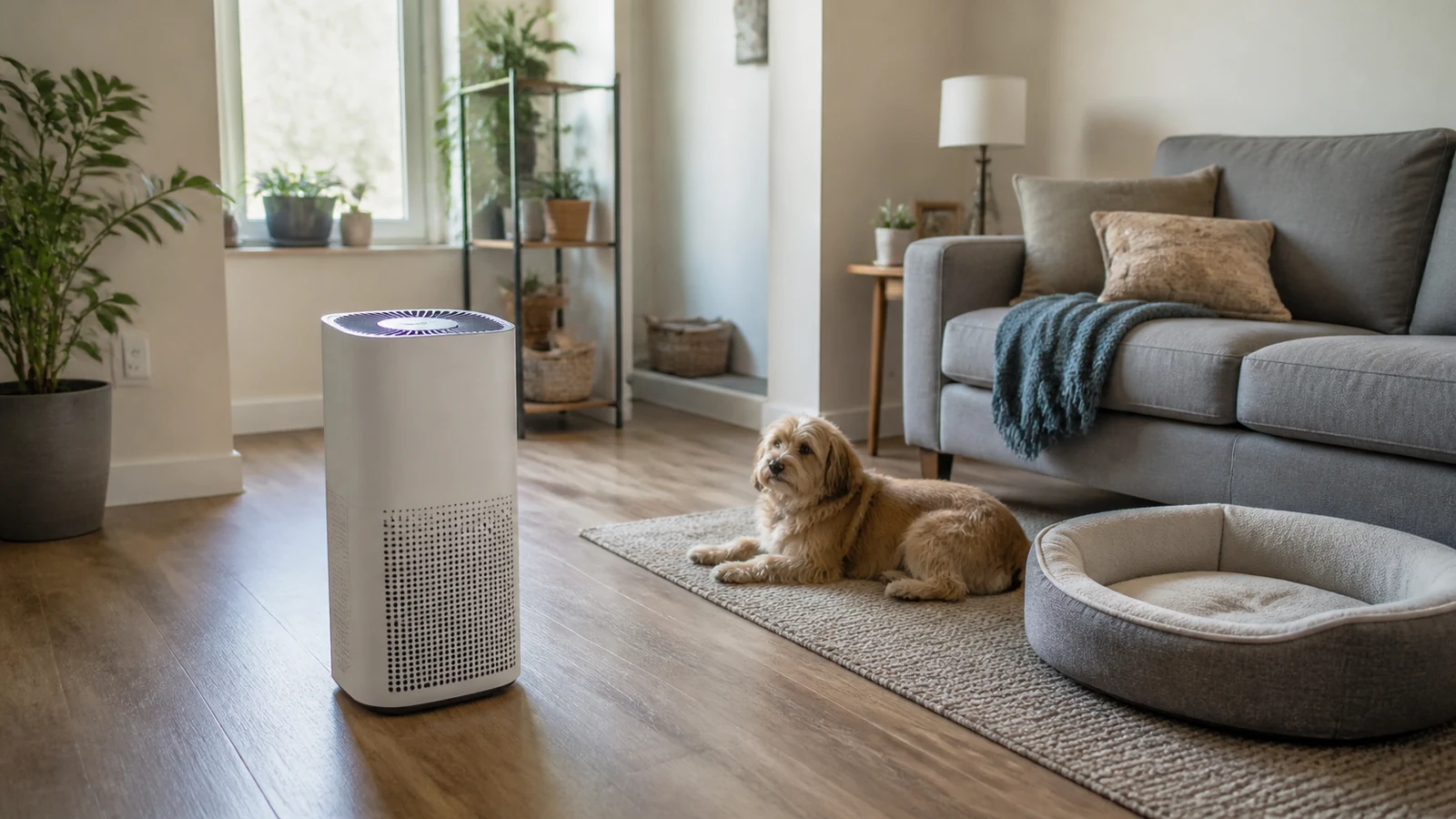
Deciding where to place an air purifier requires more than finding an empty outlet. The right position depends on the room, the pet-related source, the intake and exhaust design, and the exact manual. A 360-degree intake needs a different setup from a front intake, and a floor model should not be balanced on a shelf just because elevation sounds better.
Start with the room that has the main airborne problem and where people or pets spend meaningful time. Then give the unit open space to draw in room air and return filtered air without a sofa, curtain, wall, table, or pet bed interrupting that path. Keep it on a stable surface, away from water and heat, and somewhere you can tolerate the noise and reach the filters.
Placement is only one part of the solution. A portable purifier can supplement source control and ventilation, but it cannot scoop a litter box, wash a dog bed, remove urine from carpet, vacuum hair from a sofa, or repair a moisture problem. The EPA Guide to Air Cleaners in the Home describes filtration as a supplement to reducing pollutant sources and ventilating with clean outdoor air. Follow that order, and follow your exact model manual before any general placement advice.
Table of Contents
Quick Answer
Place the purifier in the room with the pet problem you most want to address, not automatically in the hallway or the geometric center of the apartment. A living-room unit may be the best starting point for a dog bed and sofa; a bedroom unit may make more sense when the pet sleeps there; and a purifier serving a litter-box room should be near that source zone without sitting directly in the dust and scatter path.
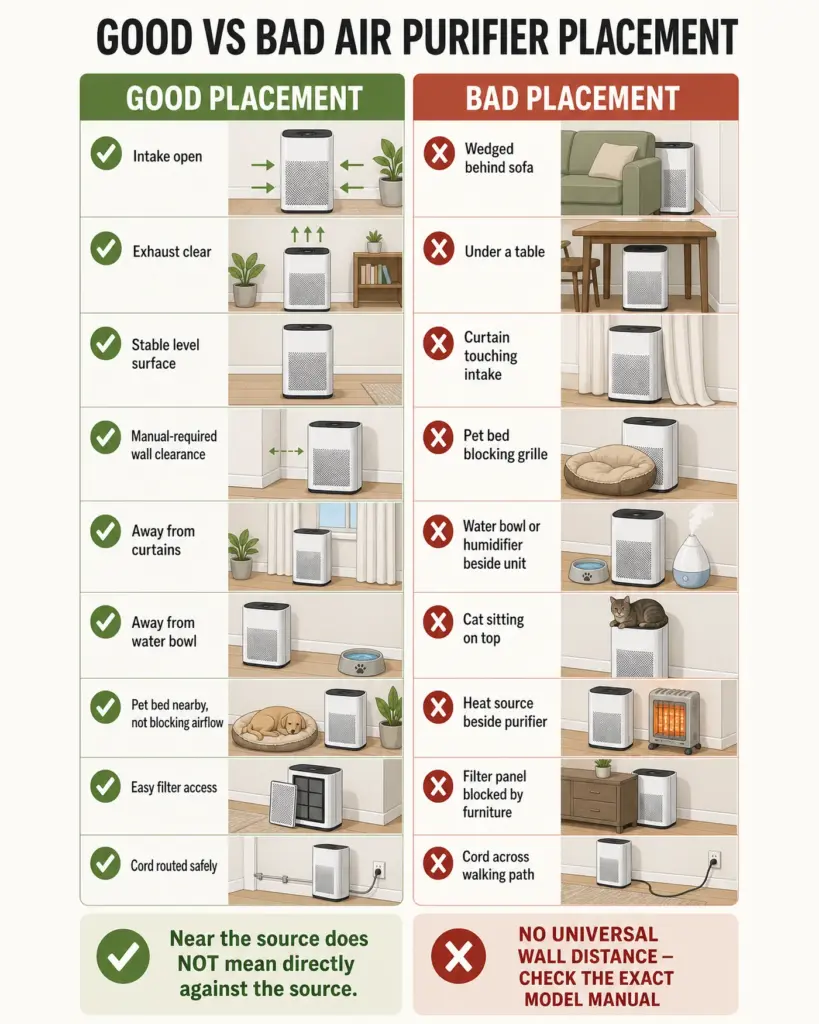
Keep every intake and exhaust open. Do not wedge the unit behind furniture, press it against a curtain, cover it with bedding, or trap a top exhaust under a table. Use the clearance in the exact manual because different models require very different amounts of space. Keep the purifier away from water bowls, humidifiers, splashes, heat sources, and unstable surfaces. Make sure cords are not a chewing or tripping hazard.
If you have one purifier and several closed rooms, choose a priority room based on the main source, time occupied, room size, and noise tolerance. Hallway convenience does not make one unit equivalent to a correctly sized purifier inside each room. After several days of comparable use, check whether airflow remains open, odor sources are controlled, the prefilter is loading quickly, noise is tolerable, pets leave the unit alone, and filter access remains practical. Reposition only after identifying the specific problem you are trying to correct.
| Problem | Best Starting Zone | Avoid | Why |
|---|---|---|---|
| Pet dander or fine particles | The occupied room where the pet spends substantial time, with open circulation around the unit | A hidden corner, closed closet, or space behind furniture | Airborne particles must travel through the purifier’s intake to be captured |
| Light pet odor | In the same room as the controlled source, near but not touching the source zone | Treating placement as a substitute for washing, scooping, or urine removal | Filtration may support the room only after the active source is addressed |
| Litter box area | The same room, outside the immediate litter-dust, scatter, and splash path | Directly beside the box or where a cat can block the intake | Proximity can help serve the zone, but excessive dust, debris, and access problems can impair use |
| Pet bed or sofa | Near the active resting zone with clearance around the intake and exhaust | Blankets, cushions, or the bed touching the unit | A localized source is useful only if fabric does not obstruct airflow |
| Bedroom with a pet | Inside the bedroom, sized for that room and positioned for comfortable continuous use | Direct airflow at the sleeper or a location that is too noisy to tolerate | A purifier works only when it can run at a useful speed without disrupting sleep |
| Open-plan studio | An open location that can circulate through the connected living and sleeping area | Sizing only for the few feet around a litter box or pet bed | The connected volume, furniture layout, and competing sources all affect the service area |
| Multi-room apartment | The highest-priority occupied room, or separate units for separate closed rooms | Assuming a hallway unit will clean equally through closed doors | Walls and closed doors restrict air exchange between rooms |
Use a Placement Decision System, Not One Magic Spot
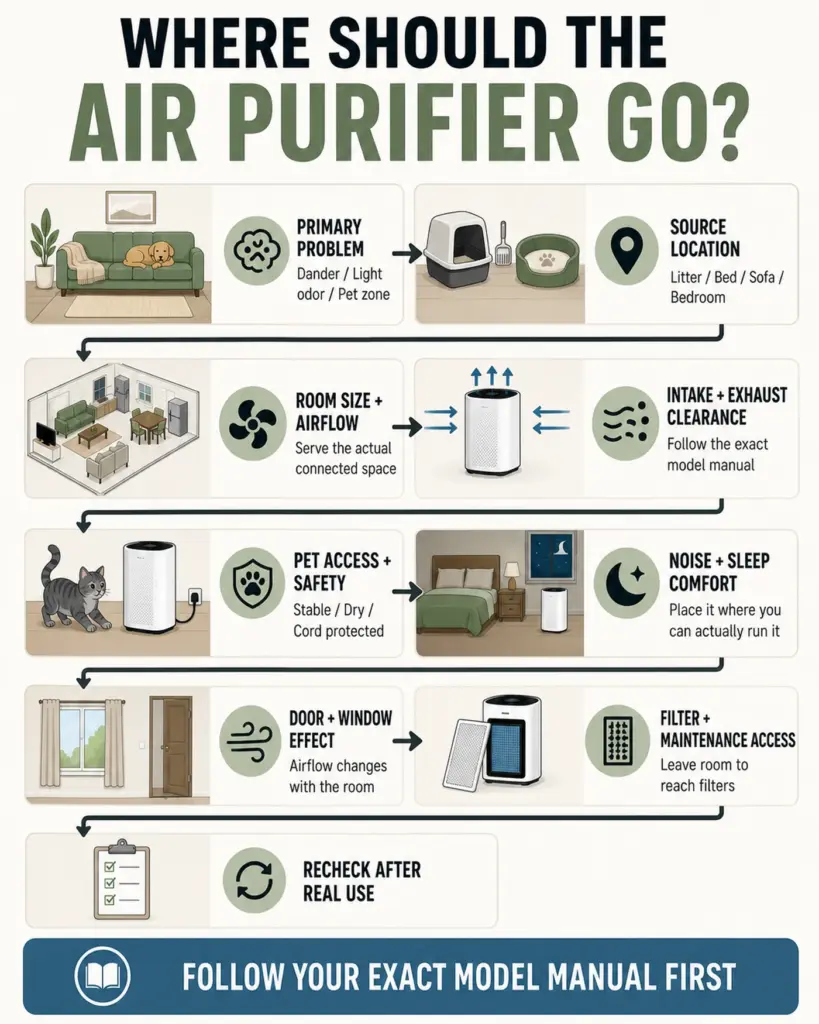
A good starting position answers a sequence of practical questions. First, identify the primary problem. Is the goal to reduce airborne dander in the room where everyone relaxes, support light odor control after the litter box is cleaned, or serve the bedroom where a pet sleeps? A purifier cannot be equally close to every source in an apartment, so define the job before choosing the spot.
Second, map the source. A cat tree, litter box, dog bed, sofa, entry mat, and sleeping area create different traffic and airflow patterns. “Near the source” should mean in the same functional zone with clear airflow, not pressed directly against a dusty or wet object. If the source is an active urine spot, dirty fabric, food waste, or an overdue litter box, stop and clean it first.
Third, match the unit to the room. The Association of Home Appliance Manufacturers explains that Clean Air Delivery Rate, or CADR, helps match a portable room air cleaner to the intended room size. Its air-cleaner selection guidance emphasizes room size as a primary consideration. In an open studio, measure the connected area the unit is expected to serve. In a closed bedroom, use that bedroom’s dimensions. Higher ceilings increase room volume, so a floor-area claim based on a typical ceiling may not describe your apartment accurately.
Fourth, inspect the machine. Locate every intake, the clean-air outlet, the sensor, the power cord, and the filter-access panel. A round unit may pull air through a 360-degree intake near its base and exhaust upward. A rectangular unit may pull from the front or rear. That design determines which wall, sofa, or curtain matters most.
How Far Should an Air Purifier Be From the Wall?
There is no universal wall-clearance number for air purifiers. The correct distance is the one specified for your exact model and orientation. Manufacturer examples show why a single rule would be misleading:
- The Levoit Core 300S manual instructs users to place the purifier on a flat, stable surface and allow at least 15 inches of clearance on all sides.
- The Levoit Vital 200S manual emphasizes at least 15 inches of clearance in front of the unit, reflecting its front-intake layout.
- The Winix 5500-2 manual calls for 12 to 18 inches from walls for maximum airflow.
- Blueair’s general air purifier placement guidance advises keeping a purifier at least 4 inches from potential obstacles.
- The Honeywell HHT270 manual specifies a much larger distance: at least 3 feet from a wall for best airflow.
- Rabbit Air’s placement guidance says clearance depends on inlet and outlet locations and gives a general range of 1 to 2 feet from an intake for many configurations.
These numbers are examples of variation, not options to average together. They apply to different models with different housings and airflow paths. Do not borrow the smallest number because it fits your furniture, and do not apply the largest number to every purifier as a universal safety rule. Follow your exact model manual first.
If the manual permits a unit near a wall, confirm that the relevant intake remains open and the outlet is not throwing cleaned air straight into a tight pocket behind furniture. Leave room for the power cord without crushing it and for the filter panel to open. A purifier that technically fits may still be impractical if every filter change requires dragging a cabinet across the floor. That maintenance access matters over time, so review the air purifier filter replacement cost guide when planning for ongoing ownership.
Match Placement to the Intake and Exhaust Design
| Design | Placement Implication |
|---|---|
| 360° intake | Keep all intake sides open according to the manual; do not press the base into a wall, curtain, or pet bed |
| Rear intake | Protect the rear clearance and do not hide the unit with its back against furniture unless the manual explicitly permits that setup |
| Front intake | Keep the entire front path open; some models can sit closer to a wall behind them, but only when the manual allows it |
| Side intake | Check which sides draw air and keep those sides clear of walls, baskets, curtains, and bedding |
| Top exhaust | Leave the area above the unit open; do not put objects on top or trap it under a table, shelf, or low cabinet |
Blocked intake reduces the amount of room air that can reach the filter. Blocked exhaust restricts distribution and may send cleaned air into a small recirculation pocket rather than the occupied part of the room. The exact outcome varies with the unit and room, so there is no honest universal percentage for how much performance a blockage costs.
Should an Air Purifier Be on the Floor or Elevated?
Some purifiers are designed as floor units, some are specifically designed for tabletops, and some manuals allow either stable surface. The EPA notes this distinction rather than recommending one universal height. There is no reliable model-independent rule that every purifier works best 3 to 5 feet above the floor.
Use the surface required or permitted by the manual. A large floor unit is usually more stable on a hard, level floor and may be difficult to secure safely on furniture. A compact tabletop unit may be appropriate on a sturdy nightstand or shelf if its intake, outlet, cord, and required clearances remain open. Never place a unit on a narrow surface where a cat can knock it down or vibration can move it toward an edge.
Elevation also changes pet access. A higher position may protect an intake from a dog bed, but it may invite a cat to sit on the unit or make the cord easier to pull. A floor position may be stable yet vulnerable to litter scatter, water splashes, toys, robot vacuums, or a dog leaning against it. Choose the position that fits the purifier’s design and remains safe in your actual household.
Can an Air Purifier Sit Near a Wall or in a Corner?
A purifier can sit near a wall when the model’s required clearance is maintained and every intake and outlet remains open. A front-intake, top-exhaust model may tolerate a wall differently from a cylindrical unit that draws air around its entire base. Check the manual diagram rather than judging by appearance.
Corner placement is not automatically forbidden, but two nearby walls create more opportunities to block side or rear intakes and to limit distribution. Pull the unit out far enough to satisfy every relevant clearance. Check for curtains that move toward the intake when the fan is running. Make sure a sofa arm, bed skirt, storage basket, or cable bundle cannot shift into the openings.
Should You Put an Air Purifier Near a Window or Door?
Windows and doors change both ventilation and the purifier’s workload. Opening a window can bring in cleaner outdoor air when weather, outdoor air quality, building rules, and safety allow. It can also introduce pollen, smoke, traffic particles, humidity, or strong drafts. An open window does not make a purifier useless, but it changes the conditions under which the unit is operating.
Do not treat filtration as a replacement for appropriate ventilation. EPA ventilation and filtration guidance presents outdoor-air ventilation and portable filtration as complementary tools. Ventilate when conditions are suitable, then use the purifier according to the room and problem. If outdoor air is polluted, keeping the window closed while the purifier serves the room may be the better temporary choice.
A position directly in a strong cross-draft can cause room air to bypass the intake or continually deliver new outdoor particles near the unit. Move the purifier away from the direct path if the draft disrupts circulation or creates uncomfortable airflow. Near an interior door, consider whether the door is usually open or closed. A purifier inside a closed bedroom serves that room more predictably than a hallway unit trying to reach it through a closed door.
Where to Place an Air Purifier Near a Litter Box
Start in the same room as the litter box, close enough to serve that source zone but not directly beside the box. The purifier should not sit where digging and pouring litter create a concentrated dust plume into the intake. Keep it outside the normal scatter path and away from any place that may be splashed during box cleaning or accidents.
Leave enough open space for the cat to enter, turn, dig, and leave without brushing the purifier or blocking its intake. Do not narrow the litter-box approach into a passage that makes the cat squeeze past a fan, cord, or unfamiliar noise. If the purifier’s presence changes how the cat uses the box, move it farther away and reassess.
Most importantly, clean the litter box on schedule. Remove waste, maintain the box and surrounding floor, and address urine outside the box. A purifier may support control of airborne particles or light residual odor when equipped appropriately, but it cannot neutralize waste that remains in the room.
Where to Place an Air Purifier Near a Pet Bed or Sofa
Placing the unit near a pet’s main resting zone can make sense because that area repeatedly releases dander and light debris into the room. “Near” still requires clearance. Leave a buffer so a dog cannot push the bed against the intake and a loose blanket cannot be pulled toward the grille. Keep sofa skirts, throws, and curtains away from both intake and exhaust.
Position the purifier where air can circulate between the pet zone and the occupied room rather than hiding it behind the sofa. If the unit exhausts forward, do not aim a strong draft directly at a sleeping pet or person. If it exhausts upward, keep shelves and table undersides clear.
An air purifier captures only particles that become airborne and reach the intake. It does not remove hair already embedded in upholstery, bedding, carpet, or cushions. Use the pet hair control guide for the vacuuming, fabric, laundry, and routine-cleaning side of the problem.
Where to Place an Air Purifier in a Bedroom With Pets
Size the purifier for the bedroom rather than for the entire apartment. Put it inside the room where it can draw from open room air, meet the manual’s wall clearance, and avoid being hidden behind the bed, dresser, or curtains. If the pet sleeps on one side of the room, that area may be a useful starting zone, but the pet bed must not touch the intake.
Noise is a placement factor, not merely a product specification. A unit may deliver more airflow at a higher fan speed, but that benefit disappears if the location makes the sound irritating enough that you turn it off. Test the fan speed you can realistically use overnight. Sleep Mode can improve comfort, although a very low setting also moves less air than a higher setting. Choose a purifier and position that support consistent operation rather than chasing the quietest possible setting at any cost.
Check the clean-air direction. A top exhaust may be comfortable near a wall if the manual allows it, while a forward exhaust can create an unpleasant draft when aimed at a pillow. Redirect or reposition the unit rather than relying on a universal distance from the bed. Display lights also matter; use a display-off feature if available or move the unit so the controls do not shine directly at the sleeper without blocking the vents.
Air Purifier Placement in a Studio Apartment
Treat an open studio as one connected service area unless substantial partitions create separate airflow zones. Use the full connected floor area and ceiling height when evaluating whether the purifier is large enough. A unit advertised for a small bedroom may not provide the same air-change rate across a combined living room, sleeping area, kitchen edge, and pet zone.
Start by identifying the dominant problem and occupied zone. If the litter box is near the bathroom but people and pets spend most of the day near the sofa, placing the purifier inches from the box may leave the sleeping and living side poorly served. A more open position between the source zone and occupied zone may be the better compromise, provided it does not create a cord or tipping hazard.
Do not hide the purifier behind a sofa to preserve the studio’s appearance. Small apartments encourage furniture to touch every wall, so check the real intake and exhaust paths carefully. Keep the unit away from cooking heat, grease, sink splashes, humidifier mist, and curtains. If kitchen ventilation is available and appropriate, use it for cooking pollutants rather than expecting the purifier to handle every source.
Can One Air Purifier Clean Multiple Rooms?
Portable air purifiers are generally room or zone devices. Their CADR and suggested room size describe performance in a defined space, not equal cleaning through a collection of closed rooms. Air must travel from each room to the purifier and return, and closed doors sharply limit that exchange.
If you own one purifier, choose the priority room using four factors: the strongest airborne source after source control, the room occupied for the most time, the room size the purifier can realistically serve, and the noise level you can tolerate there. A bedroom may be the priority overnight, while a living room may matter more during the day. Moving a purifier can be practical if the model is portable and has a safe setup in both locations, but repeated moving should not lead to blocked clearances, damaged cords, or long periods when the unit is not running.
For separate closed rooms that all need continuous filtration, multiple correctly sized units are the more direct solution. This is a room-use conclusion, not a recommendation to buy more equipment automatically. First verify that source control, ventilation, room sizing, and current placement are not the real limitations.
Pet-Safe Placement Details That Matter
Use a firm, level surface that can support the purifier without wobbling. Place tall or lightweight units outside the path of running pets, play, doors, and robot vacuums. Do not balance a purifier on a narrow stool or unstable stack to achieve an arbitrary height.
Route the cord along a low-traffic path without pinching it under furniture or placing it where people trip. If a pet chews cords, use an appropriate physical management solution and choose a location the pet cannot access. Do not improvise a cover that blocks ventilation or traps heat.
Keep water bowls, fountains, litter-cleaning water, humidifiers, and wet towels away from the unit. Moisture can create electrical and filter problems, and some particle sensors may react to nearby mist. Maintain separation from radiators, heaters, cooking appliances, and strong direct sunlight when the manual warns against those conditions.
Watch how pets change the setup. A cat may sit on a warm, flat top and block the outlet. A dog may repeatedly push a bed, toy basket, or blanket against a low intake. Long curtains can move when the fan starts. Inspect the operating purifier at pet level instead of assuming the clearance remains the same throughout the day.
Placement Cannot Fix an Active Odor Source
An air purifier is supplemental control. It does not replace scooping and washing a litter box, laundering a pet-bed cover, cleaning the bed insert when possible, removing urine from compatible surfaces, cleaning food residue, vacuuming hair and dander, or ventilating when outdoor conditions make ventilation appropriate.
If an odor returns quickly after the purifier is moved, identify the source rather than moving the unit again. Check pet bedding, upholstery, carpet edges, accident areas, trash, food storage, bowls, damp towels, and the litter-box floor. Persistent urine or moisture odor requires cleanup at the contaminated material, not a stronger fan setting.
The pet odor source-control guide can help separate airborne support from the cleaning task that actually owns the problem. Complete the source-control step first, then use placement to help the purifier serve the room more effectively.
How to Test Whether the Placement Is Working
- Start with a manual-compliant position. Confirm the correct surface, required clearance, open intake and exhaust, room size, cord route, water and heat separation, pet access, and filter-removal path. Record the room, fan setting, typical door and window state, and the problem you are evaluating.
- Run the purifier under comparable daily conditions for several days. Keep source-control routines reasonably consistent. A day with an overdue litter box and open windows is not comparable to a day after cleaning with the room closed. Consistency makes the placement test more useful.
- Observe practical outcomes. Check whether furniture or fabric moves into the vents, light odor persists after the source is cleaned, the prefilter loads unusually fast, noise causes someone to lower or stop the unit, pets interfere with it, and filters remain easy to access.
- Change one variable at a time. Move the unit away from a blockage, serve the correct room, adjust its orientation, or choose a more sustainable fan setting. Then repeat under similar conditions before making another change.
Do not treat a purifier’s particle sensor as proof that odor has been removed. Many sensors respond to airborne particles and may not measure the gases responsible for smells. A stable display can be one observation, but it is not a guarantee of odor control, allergen elimination, or correct placement.
| Apartment Scenario | Best Starting Zone | Avoid | Recheck |
|---|---|---|---|
| Studio + Cat + Litter Box | An open position serving the litter-box room and occupied studio area, outside the immediate dust path | Directly beside the box, behind furniture, or near a splash zone | Litter dust loading, cat access, residual odor after scooping, and coverage of the sleeping side |
| One-Bedroom + Dog + Sofa/Pet Bed | The living-room resting zone with the intake and exhaust clear | Dog bed, throws, or sofa side blocking the unit | Whether the dog shifts bedding, whether noise limits use, and whether settled hair still needs more frequent cleaning |
| Bedroom Where Pet Sleeps | Inside the bedroom, sized for the room and positioned for comfortable overnight use | Direct airflow at the sleeper, a blocked bedside gap, or an exposed chewing cord | Sleep tolerance, display light, pet interference, wall clearance, and overnight fan setting |
| Open Living Room + Kitchen | An open living-zone position sized for the connected area | Heat, grease, sink splashes, or assuming the purifier replaces kitchen exhaust | Cooking periods, window and door state, full connected area, and filter loading |
| Multi-Pet Small Apartment | The room with the highest combined source and occupied time after cleaning | Trying to sit equally close to every pet zone or allowing several beds to crowd the intake | Faster prefilter loading, shifting beds and blankets, noise, and whether a second room remains underserved |
| Apartment With One Purifier Only | The priority room selected by source, occupied time, room size, and noise tolerance | Default hallway placement with closed doors | Whether the chosen room is truly the main need and whether moving the unit interrupts consistent operation |
Common Air Purifier Placement Mistakes
Avoid these recurring errors:
- Behind a sofa: Furniture can block the intake, trap the exhaust, and leave the purifier circulating only a small pocket of air.
- Inside an entertainment unit: A cubby restricts side, rear, or top airflow and may leave too little operating clearance.
- Under a table: A top exhaust can blow into the tabletop while bags, chairs, and storage crowd side intakes.
- Touching a curtain: Fabric can move toward the intake when the fan starts, so check clearance while the unit is running.
- Beside a water bowl or humidifier: Splashes and mist do not belong near an electrical purifier, and mist may confuse some particle sensors.
- Beside a heat source: Radiators, heaters, cooking equipment, and direct heat may violate the manual and alter room airflow.
- Blocked by a pet bed: A dog can move a bed or blanket after you position the unit. Recheck during normal use.
- Using one brand’s clearance as a universal rule: Manufacturer examples range from a few inches to several feet and may apply to different sides of the unit.
- Assuming a hallway covers every room: Closed doors and limited exchange prevent equal service to separate rooms.
- Ignoring the odor source: Placement cannot repair contaminated carpet, dirty litter, damp bedding, food waste, or an unwashed bed.
- Choosing a location that discourages use: Noise, direct drafts, bright controls, or a bad cord path may cause someone to switch the purifier off.
- Leaving no maintenance space: Keep enough access to remove, clean, and replace filters without shifting heavy furniture.
A Final Placement Checklist
Confirm that the purifier serves the correct room, is appropriately sized, sits on a manual-approved stable surface, and has open intake, exhaust, sensor, cord, and filter access. Keep curtains, furniture, bedding, water, humidifiers, and heat away. Clean the source, ventilate when appropriate, and test one placement change at a time. The best position is the safest manual-compliant spot that keeps airflow open and remains practical around your pets.
Sources
- EPA Guide to Air Cleaners in the Home
- EPA Ventilation and Filtration Strategies
- AHAM Tips for Choosing the Ideal Portable Room Air Cleaner
- Levoit Core 300S User Manual
- Levoit Vital 200S User Manual
- Winix 5500-2 User Manual
- Blueair Air Purifier Placement Guidance
- Honeywell HHT270 Portable Tabletop Air Purifier Manual
- Rabbit Air Placement Guidance