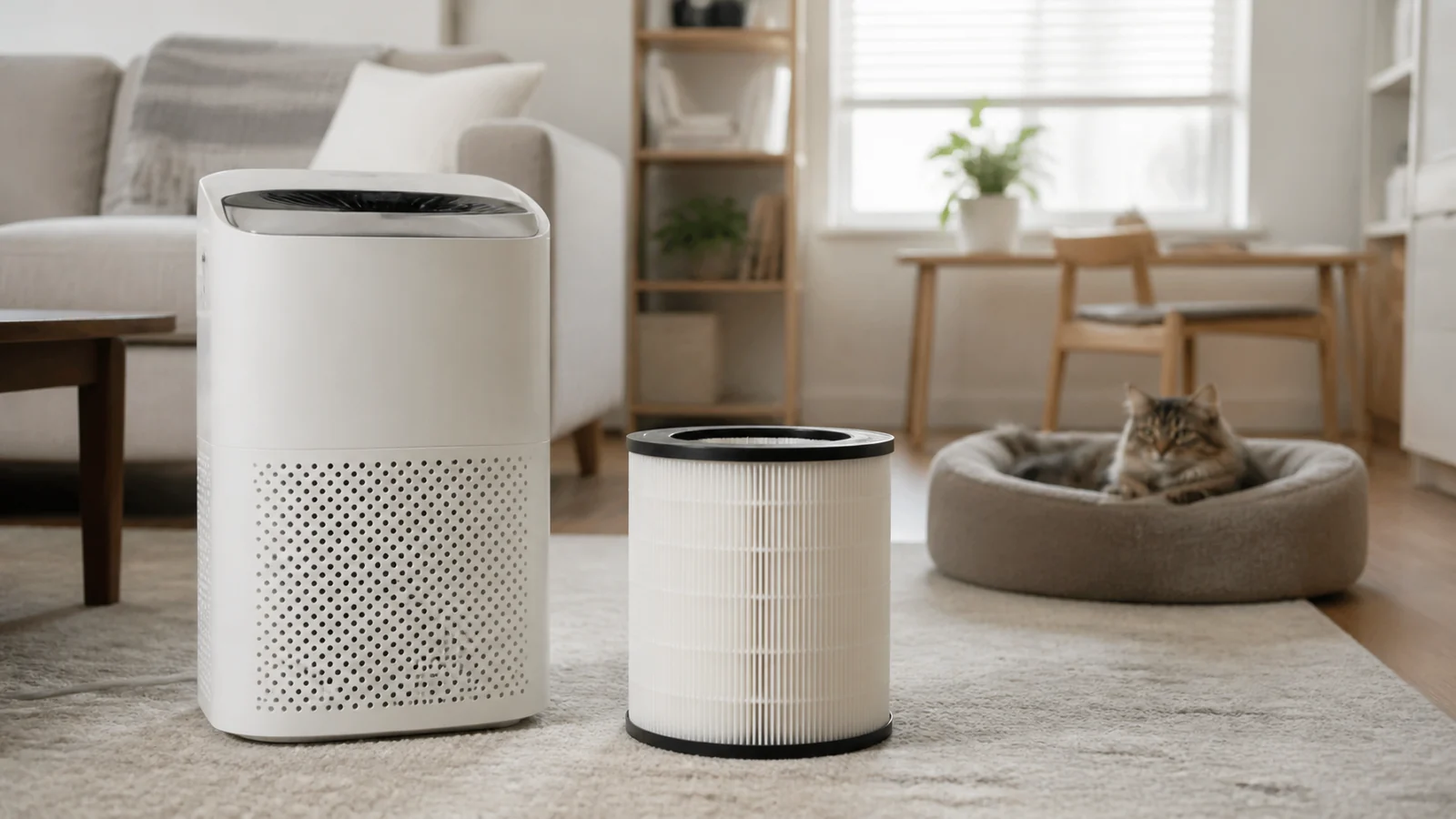
The purchase price is only the first number on an air purifier receipt. In a pet home, filter design, replacement frequency, hair, dander, litter dust, odors, runtime, and the number of purifiers can all change what you spend.
This guide compares air purifier filter replacement cost across seven familiar purifier families. It is an ownership-cost comparison, not a new ranking of the purifiers. If you still need to choose a purifier, start with our research-based air purifier comparison. The goal here is to show which consumables each machine requires, how the manufacturer describes filter life, and how those facts translate into a realistic annual estimate.
Tidy Pet Living did not hands-on test filter lifespan. Prices in this article are current official U.S. manufacturer prices checked August 24, 2026. Promotional prices can change, and a filter shown as available today may be unavailable later. Annual cost figures are calculations based on manufacturer intervals, not guarantees. Pet load, household dust, litter, runtime, odor load, smoke, cooking, and the surrounding environment can move the real replacement date earlier or later.
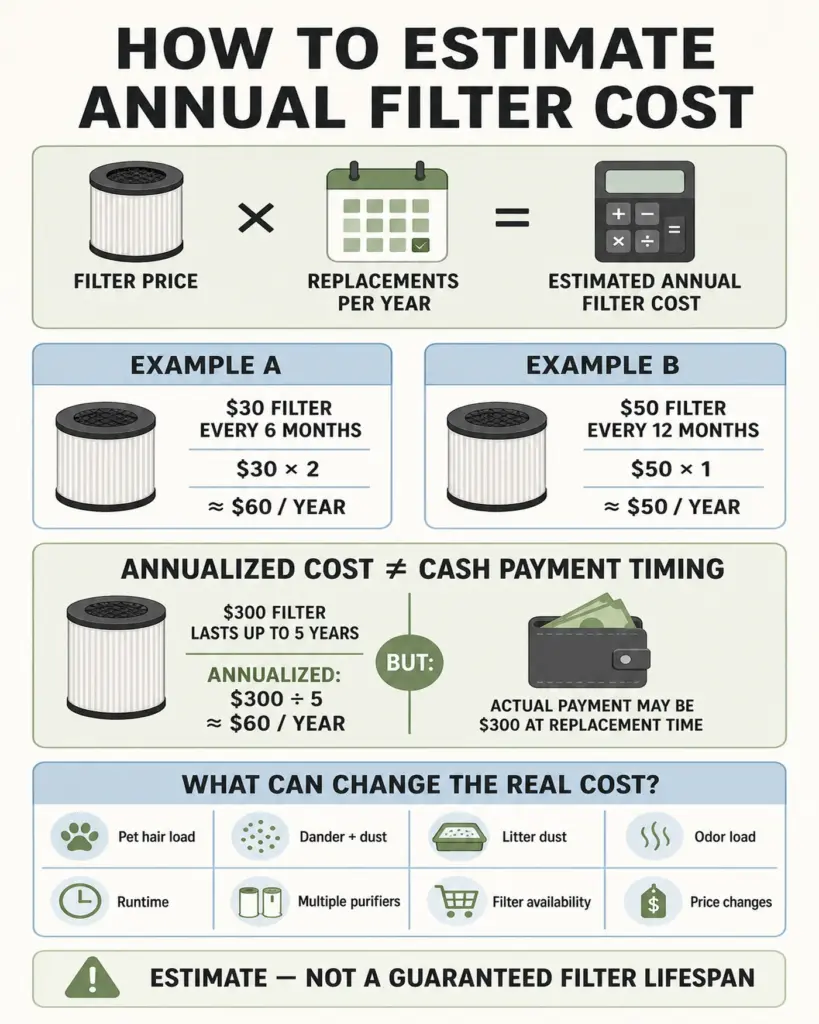
Table of Contents
Quick Answer
For the seven examples in this guide, estimated annual filter cost ranges from about $45 at the low end of a conventional recurring-filter estimate to about $140 at the regular listed price of a bundled annual kit. A multi-year filter can produce a lower annualized figure, but it may require a much larger payment when replacement finally arrives. The Austin Air HealthMate illustrates that difference: a $315 filter lasting five years equals about $63 per year when annualized, but the owner does not literally pay $63 every year.
An inexpensive purifier is not automatically inexpensive to maintain. A $30 cartridge replaced every six months costs about $60 per year, while a more expensive cartridge may last longer. The reverse is also true: a long service interval does not make the eventual replacement payment small. Look at both replacement frequency and cash-flow timing.
Pets add several different loads. Large visible hair often reaches the intake or prefilter first. Fine dander and household dust place more burden on the particle-filter stages. Odor-related gases challenge the carbon stage. Cleaning an approved reusable prefilter can control large-debris buildup, but it does not make the main filter permanent.
For budgeting, identify the exact filter, check its current official price, read the manufacturer interval, and calculate a range. Then consider runtime, pet and litter zones, odor conditions, unit count, and current availability.
Air Purifier Filter Replacement Cost: Seven Ownership Examples
| Purifier | Replacement Filter | Official Price Checked Aug. 24, 2026 | Manufacturer Interval | Estimated Annual Filter Cost | Prefilter Care | Main Cost Caveat |
|---|---|---|---|---|---|---|
| Levoit Vital 200S-P | Vital 200S Replacement Filter | $49.99 | 6–12 months | About $50–$100 | Washable prefilter | Standard filter was shown as sold out during the final check; environment may shorten the interval |
| Winix 5500-2 | Filter H, 116130 | $59.49 promotional; $84.99 regular | About 12 months | About $59 promotional; about $85 regular | Cleanable fine-mesh prefilter; AOC carbon maintenance applies | Sale price is temporary; purifier appears to be an older or legacy family |
| Levoit Core 300-P | Core 300-P-RF Original Filter | $29.99 | 6–8 months | About $45–$60 | Follow exact cleaning instructions; do not assume it is washable | Shorter interval produces two purchases per year |
| Blueair Blue Pure 311i Max | F3MAX Particle + Carbon Filter | $44.99 | 6–9 months | About $60–$90 | Cleanable fabric prefilter | Do not confuse the 311i Max filter with the newer 311i+ Max filter |
| Honeywell HPA300 | HRF-ARVP300 Filter A/R Combo Pack | $89.95 promotional; $139.95 regular | HEPA about 12 months; carbon prefilter about 3 months | About $90 promotional; about $140 regular | Replace Filter A; do not wash it | Annual kit economics depend heavily on a temporary sale price |
| Rabbit Air A3 | A3 Filter Replacement Kit | $115.95 | Up to 12 months at 24/7; about 2 years at 12 hours/day | About $58–$116 | Washable prefilter; inspect per current instructions | Actual interval depends strongly on daily runtime |
| Austin Air HealthMate | HealthMate Filter, standard HM400 size | $315 | Up to about 5 years under normal residential conditions | About $63 annualized | Vacuum exterior intake surfaces | $315 is a lumpy replacement payment, not a $63 annual bill |
The annual estimates use the manufacturer intervals as planning inputs. They do not predict the exact day a filter in a particular pet home will need replacement.
How the Annual Filter Cost Math Works
For a conventional cartridge, start with this formula:
Filter price × expected replacements per year = estimated annual filter cost
If the manufacturer gives a range, calculate both ends. A $49.99 filter with a 6–12 month interval produces this estimate:
- Long end: $49.99 × 12/12 = $49.99 per year
- Short end: $49.99 × 12/6 = $99.98 per year
- Practical rounded estimate: about $50–$100 per year
The service period remains a real-world variable. Heavy litter dust, smoke, cooking odors, several shedding pets, or continuous operation may not match a lightly used home. Do not automatically use the longest published interval.
Promotional pricing adds uncertainty. Use today’s sale price for a present purchase and the regular listed price as a more conservative future reference.
Seven Filter-Cost Profiles
Levoit Vital 200S-P
Filter identity: The official standard replacement is the Vital 200S Replacement Filter for the Vital 200S-P series. It combines a washable prefilter, main particle filter, and activated carbon layer in one replacement assembly.
Current official price: $49.99, checked August 24, 2026. The standard filter page displayed the product as sold out during the final check, so availability deserves attention even though the official price and compatibility remained visible.
Manufacturer interval: Levoit describes a 6–12 month service range and notes that usage and environment can justify earlier or later replacement. A higher-pollution environment may require more frequent changes.
Estimated annual cost: $49.99 × 12/12 to $49.99 × 12/6 equals $49.99–$99.98, rounded to about $50–$100 per year. A three-year recurring-filter estimate is about $150–$300.
Prefilter / maintenance: The washable prefilter catches hair, dust, and other large particles before they reach deeper media. Clean and dry it according to the current instructions; cleaning the prefilter does not renew the main or carbon layers.
Pet-home caveat: A high-shedding pet may make prefilter care more frequent, while dander, litter dust, and odors create different loads deeper in the assembly. There is no supported universal percentage by which pets shorten this filter’s life.
Ownership-cost takeaway: The wide 6–12 month interval matters as much as the $49.99 price. Budgeting only for one annual filter could understate cost if your environment produces a six-month cycle. Current stock status is also part of ownership risk.
Winix 5500-2
Filter identity: The official replacement is Filter H, SKU 116130. It is a one-year set containing the True HEPA filter and washable AOC carbon filter for the 5500-2 and AM80.
Current official price: The product page showed a promotional price of $59.49 against a regular listed price of $84.99 on August 24, 2026. The sale price should not be treated as permanent.
Manufacturer interval: Winix recommends replacing both the True HEPA and AOC carbon filters about once every 12 months for optimal performance.
Estimated annual cost: At today’s promotion, $59.49 × 1 is about $59 per year. At the regular listed price, $84.99 × 1 is about $85 per year. A three-year illustration would be about $178 if the current sale somehow persisted, versus about $255 at regular list price; neither predicts future prices.
Prefilter / maintenance: The fine-mesh prefilter can be cleaned. The AOC carbon stage has manufacturer maintenance guidance, but washing can affect performance depending on contamination and prior cleaning. The True HEPA filter should not be washed and reused.
Pet-home caveat: Hair and larger debris can accumulate at the front layers, while odor conditions affect the carbon stage. Cleaning approved components does not cancel the annual replacement guidance for the complete set.
Ownership-cost takeaway: The 5500-2 appears to be an older or legacy purifier family in the current catalog context, but official Filter H support remains active. That is not the same as proven discontinuation. Filter availability can outlast sales of the purifier itself, yet an owner should still monitor supply and price.
Levoit Core 300-P
Filter identity: The current original replacement is the Core 300-P-RF Original Filter, an integrated prefilter, main filter, and activated carbon filter designed for the Core 300-P family.
Current official price: $29.99, checked August 24, 2026.
Manufacturer interval: Levoit recommends replacement every 6–8 months.
Estimated annual cost: At eight months, $29.99 × 12/8 is $44.99. At six months, $29.99 × 12/6 is $59.98. The rounded estimate is about $45–$60 per year, or about $135–$180 over three years if price and interval stay similar.
Prefilter / maintenance: The prefilter catches hair, dust, and large particles, but owners should follow the exact Core 300-P cleaning instructions rather than automatically washing it. “Prefilter” does not mean “washable” across every brand or model.
Pet-home caveat: A small cartridge price can look inexpensive in isolation, but the shorter 6–8 month interval creates 1.5–2 replacement equivalents per year. Large hair at the outer layer and fine dander in the particle media are different maintenance problems.
Ownership-cost takeaway: This example shows why cartridge price alone is incomplete. The $29.99 shelf price becomes an estimated $45–$60 annual burden once replacement frequency is included.
Blueair Blue Pure 311i Max
Filter identity: The standard example is the F3MAX Particle + Carbon replacement filter for the Blue Pure 311i Max. Blueair also sells specialized options, but those higher-priced variants are not used in this calculation.
Current official price: $44.99 for a one-time purchase, checked August 24, 2026. Subscription pricing is excluded because it depends on enrollment and recurring-purchase terms.
Manufacturer interval: The manual places replacement between 6 and 9 months depending on usage and air-quality conditions.
Estimated annual cost: $44.99 × 12/9 is about $59.99, while $44.99 × 12/6 is $89.98. That produces an estimate of about $60–$90 per year and about $180–$270 over three years.
Prefilter / maintenance: The exterior fabric prefilter is cleanable and washable according to its instructions. It can intercept hair and visible dust before the main cartridge. Replacement fabric covers are sold, but they are not assumed to be a required annual consumable.
Pet-home caveat: Blueair’s RealTrack logic considers fan speed, usage time, and pollution levels. Even so, the filter indicator remains an estimate rather than a direct laboratory measurement of remaining carbon or particle capacity.
Ownership-cost takeaway: Model identity matters. The Blue Pure 311i Max uses F3MAX, while the newer 311i+ Max uses a differently identified filter. A similar product name is not sufficient evidence of compatibility.
Honeywell HPA300
Filter identity: The HRF-ARVP300 Filter A/R Combo Pack contains three HEPA R filters and four precut carbon Filter A prefilters, representing about one year of normal consumables for the HPA300 family.
Current official price: $89.95 promotional, with a regular listed price of $139.95, checked August 24, 2026. The promotion is not a permanent baseline.
Manufacturer interval: Honeywell calls for HEPA replacement approximately every 12 months and carbon prefilter replacement approximately every three months, with actual conditions able to shorten or extend the guideline.
Estimated annual cost: One current annual kit × $89.95 is about $90 for a promotional-year estimate. One kit at the regular $139.95 list price is about $140. A three-year sale-price illustration is about $270, while three years at regular list price is about $420. Future sale prices are unknown.
Prefilter / maintenance: Filter A is a replaceable carbon prefilter, not a washable mesh. Honeywell says the HEPA and prefilter should not be washed or cleaned for reuse. This separate quarterly consumable is already included in the annual kit used for the comparison.
Pet-home caveat: A carbon prefilter can collect large particles and reduce some odors, but replacing it does not eliminate the need to identify and clean the actual odor source. For a broader source-control approach, use the pet odor in apartments guide.
Ownership-cost takeaway: Bundling makes the yearly requirement easier to see, but the apparent value changes dramatically between sale and regular pricing. Budget from the kit contents and replacement schedule, not from the HEPA price alone.
Rabbit Air A3
Filter identity: The A3 Filter Replacement Kit for SPA-1000N includes the medium filter, activated-carbon charcoal filter, BioGS HEPA filter, and one customized filter. The washable prefilter is separate and reusable.
Current official price: $115.95, checked August 24, 2026.
Manufacturer interval: Rabbit Air describes up to 12 months at 24/7 operation and approximately two years at 12 hours per day under its stated assumptions.
Estimated annual cost: At 12 hours per day, $115.95 ÷ 2 is $57.98 per year. At 24/7 operation, $115.95 × 1 is $115.95 per year. The planning range is therefore about $58–$116 per year, or about $174–$348 over three years on an annualized basis.
Prefilter / maintenance: The prefilter is washable. Rabbit Air’s official pages vary in wording, with one calling for monthly cleaning and its care page describing every three months or as needed. Regular inspection under the current instructions is more defensible than pretending one interval fits every pet home.
Pet-home caveat: Runtime is the dominant assumption in the published cost range. A purifier shared by living and sleeping zones may run longer than one used for a limited daily period. Pet hair can also change prefilter cleaning frequency without automatically proving that the main kit has reached replacement time.
Ownership-cost takeaway: The $115.95 payment is relatively large, but daily runtime can spread it over one or two years. An annualized comparison should always disclose that operating assumption.
Austin Air HealthMate
Filter identity: The standard HealthMate replacement filter, identified by the HM400 standard-size label, includes large- and medium-particle prefiltration, a large activated carbon and zeolite bed, and HEPA media in one filter assembly.
Current official price: $315, checked August 24, 2026.
Manufacturer interval: Austin Air describes filter life of up to approximately five years under normal residential conditions. Heavier contamination, pet load, smoke, or other pollution may shorten that period. “Up to five years” is not a five-year guarantee for every home.
Estimated annual cost: $315 ÷ 5 equals an annualized ownership equivalent of about $63 per year if the filter genuinely lasts five years.
Prefilter / maintenance: Austin Air recommends periodically vacuuming the exterior intake surfaces. The internal filter assembly follows its replacement schedule rather than a routine washable-main-filter program.
Pet-home caveat: Owners should pay attention to unpleasant odor coming from the unit or a meaningful drop in airflow, alongside the official guidance. Visible hair on the exterior intake is a maintenance signal, not automatic proof that the complete $315 assembly is exhausted.
Ownership-cost takeaway: Austin Air does not cost $63 every year. The $63 figure is only an annualized comparison. Actual cash outlay is lumpy: a new filter that really lasts five years may require no replacement purchase during years 1–3, followed by a $315 payment later. If it needs replacement earlier, both the annualized cost and cash timing change.
Why Prefilter Maintenance Matters More in Pet Homes
Pet hair is visible, but it should not be used as shorthand for every contaminant a purifier handles. Large hair commonly collects on an intake grille, fabric cover, or prefilter. Fine dander and dust can travel farther into the particle-filter stages. Odor-related gases interact with carbon media. Each load has a different cost implication.
A clogged outer layer can restrict airflow. Cleaning an approved reusable prefilter is worthwhile maintenance and helps distinguish surface debris from a deeper filter problem. For the larger pet hair control system, settled hair still needs vacuuming and surface cleaning.
The cleaning method must be model-specific:
- The Vital 200S-P has a washable prefilter.
- The Core 300-P prefilter should be maintained according to its exact instructions rather than automatically washed.
- The Winix fine-mesh prefilter can be cleaned, and its AOC carbon stage has separate manufacturer guidance.
- Blueair’s fabric prefilter is cleanable and washable according to its care directions.
- Honeywell Filter A is replaceable and not washable.
- Rabbit Air’s prefilter is washable, but official wording on maintenance frequency varies, making regular inspection important.
- Austin Air calls for vacuuming the exterior intake surfaces while the internal assembly remains on its replacement schedule.
Even excellent prefilter care cannot restore used particle media or reverse carbon saturation. Treat it as protection and maintenance, not a promise that the main filter will last indefinitely.
Why Odor Control Can Change Filter Economics
Filter systems package carbon in different ways. A combined particle-and-carbon cartridge makes replacement simple, but both functions are purchased together. A separate carbon prefilter may require more frequent, lower-cost replacement than the HEPA component. A washable carbon stage may reduce routine replacement of that stage, although washing does not guarantee original performance forever. A large carbon and zeolite bed may last much longer but create a high lump-sum replacement price.
For ownership cost, the important question is not which mechanism is theoretically best. It is what must be replaced together, what can be maintained, and how often the manufacturer expects the consumable to change.
Odor performance may decline before a particle filter looks dramatically dirty, especially under a strong gas or odor load. There is no universal carbon-saturation timeline that applies to cooking, litter boxes, wet-dog odor, smoke, and every other home. A filter replacement also cannot eliminate an odor source that remains in carpet, upholstery, litter, waste, moisture, or ventilation pathways.
Does the Filter Light Mean the Filter Is Full?
Not necessarily. A filter light is maintenance guidance, but its logic varies by model.
Some reminders are based largely on accumulated runtime. Honeywell’s HPA300 reminders use operating hours for the HEPA and prefilter checks. Rabbit Air’s A3 presents a cycle-style filter-life display and resets the replacement period when new filters are installed. These systems help with scheduling, but they do not prove that the media has reached a measured physical capacity.
Other systems use broader estimates. Levoit describes built-in filter-life algorithm logic and notes that its authentic-filter support affects the reminder function. Blueair’s RealTrack considers fan speed, usage time, and pollution levels. That is more tailored than a simple calendar, but it remains an estimate based on inputs and model logic.
The Winix 5500-2 manual provides a filter indicator and reset procedure, but that does not establish direct measurement of remaining HEPA or carbon capacity. Austin Air does not use a conventional remaining-capacity sensor for this decision; its guidance emphasizes service conditions and symptoms such as odor or reduced airflow.
Use the light with the manual interval, airflow, odor performance, prefilter condition, and home environment. Do not ignore a reminder, but do not describe it as laboratory proof that the filter is “full.” Reset it only after completing the maintenance or replacement specified for that model.
Official vs Third-Party Replacement Filters
An official filter usually provides the clearest identity, documented compatibility, known dimensions, and a replacement schedule written for the purifier. Some brands also connect authentic-filter use to recognition or filter-life algorithm behavior. That makes official products a useful baseline for both cost and expected operation.
Third-party filters may cost less or remain available when an official product is hard to find. They are not automatically bad, unsafe, or fake, but a “compatible” label alone does not verify equivalent fit, seal, performance, carbon quantity, airflow resistance, or service life.
Compare the exact model, dimensions, included stages, evidence, return policy, and relevant warranty terms. Do not assume equivalence or lower annual cost without evidence.
The Purchase Price Is Not the Ownership Cost
A low purifier price can be offset by frequent cartridges, a short replacement interval, proprietary filter kits, separate carbon consumables, or the need to operate multiple units. The Core 300-P example is straightforward: its $29.99 cartridge becomes about $45–$60 per year when a 6–8 month interval is applied.
A more expensive purifier can create a different tradeoff rather than an automatic saving. Rabbit Air’s $115.95 kit can be spread over roughly one or two years depending on runtime. Austin Air’s $315 filter may create a lower annualized figure over five years, but the replacement transaction remains large. Expensive machines are not inherently cheaper to own.
Three-year estimates help expose recurring cost:
- Vital 200S-P: about $150–$300
- Winix 5500-2: about $178 using today’s sale price or about $255 at current regular list price
- Core 300-P: about $135–$180
- Blue Pure 311i Max: about $180–$270
- Honeywell HPA300: about $270 using today’s sale price or about $420 at current regular list price
- Rabbit Air A3: about $174–$348 on an annualized basis
- Austin Air HealthMate: about $189 as a three-year annualized equivalent, not a three-year replacement cash cost
Sale-price projections are illustrations only. Winix and Honeywell may not offer today’s promotion at the next replacement date, much less for three consecutive years.
One-Year vs Three-Year Ownership Planning
| Cost Type | One-Year Question | Three-Year Question |
|---|---|---|
| Filter price | What does the correct filter cost today? | How might price changes affect later purchases? |
| Replacement frequency | How many replacements fit the stated interval this year? | Will the interval create three, four, or more purchases? |
| Promotional pricing | Can I buy at the current sale price now? | What happens if future purchases occur at regular price? |
| Prefilter consumables | Is the prefilter reusable or part of an annual kit? | Will separate prefilters add recurring cost? |
| Multiple purifiers | How many units need filters this year? | Does adding a bedroom unit multiply the recurring burden? |
| Availability risk | Is the exact official filter currently stocked? | Is the purifier becoming an older family with fewer supply options? |
| Cash-flow timing | What payment will actually occur this year? | Does a long-life filter create a large later payment? |
Annualized cost is useful for comparing unlike service intervals. Actual cash expenditure is useful for budgeting. They are not always the same.
Consider a new Austin Air filter that lasts the full five years. Its annualized equivalent is about $63, and its three-year annualized equivalent is about $189. Yet the replacement cash outlay during years 1–3 could be $0 because the $315 purchase occurs later. Conversely, if a replacement is already due in year one, the cash outlay could be $315 immediately. A budget should show both views instead of multiplying an annualized number and calling it actual spending.
For conventional recurring cartridges, the two views are usually closer, but timing still matters. A six-month cartridge may produce two payments in one year. An eight-month interval can create an uneven pattern across calendar years. Buying a spare during a sale shifts cash forward even when the installed filter is not ready to change.
What Changes the Cost in a Pet Apartment?
A small apartment is not automatically cheaper to filter. Layout and use patterns matter.
An open studio may allow one appropriately sized purifier to serve a shared living and sleeping zone. A divided apartment may tempt the owner to keep one unit in the living room and another in the bedroom. Two purifiers normally mean two filter schedules, and that can double a cartridge expense even when each room is small.
Moving one purifier between rooms avoids two consumable schedules but may reduce consistent operation where it is needed. The practical choice depends on occupancy, doors, and whether moving the unit is realistic.
High-shedding zones can load exterior surfaces and prefilters quickly. A litter area may add fine dust as well as odor load. A purifier running continuously in a shared bedroom and living space may reach a manufacturer usage threshold sooner than a unit used for a few hours. Cooking, outdoor pollution, smoke, renovation dust, and open windows can add loads unrelated to pets.
Storage matters too. Buying a spare filter can protect against temporary stock shortages, but a bulky cartridge consumes valuable closet space and moves cash spending earlier. Confirm that an old spare remains sealed and is the exact filter for the current model.
Finally, watch older-model support. The Winix 5500-2 is an older or legacy family in the current catalog context, while Filter H remains officially supported. That is useful, but it does not guarantee permanent availability. A filter ecosystem can stay active after purifier sales slow down, then become harder or more expensive to maintain later.
When Should You Actually Replace the Filter?
Use a model-specific decision sequence:
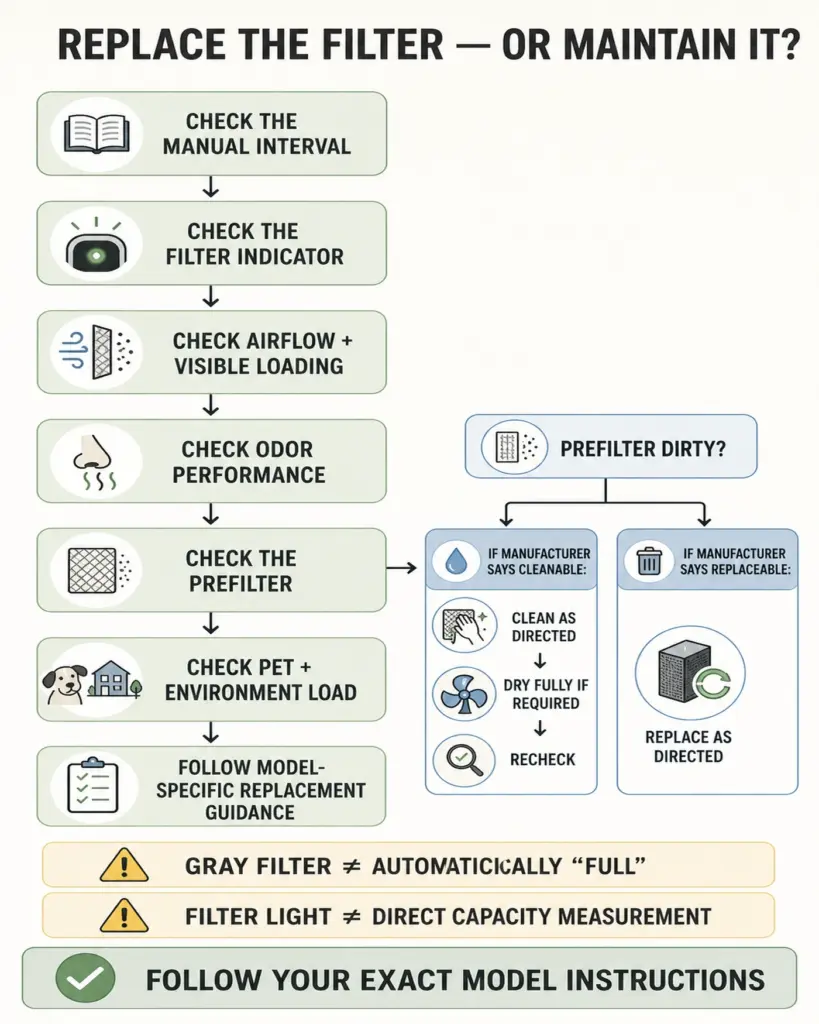
CHECK MANUAL INTERVAL → CHECK FILTER INDICATOR → CHECK AIRFLOW / VISIBLE LOADING → CHECK ODOR PERFORMANCE → CHECK PREFILTER → CHECK PET / ENVIRONMENT LOAD → REPLACE ACCORDING TO MODEL GUIDANCE
Start with the current manual or official support page. The published interval establishes the manufacturer’s planning boundary. Next, check the reminder and understand whether it is a timer, algorithmic estimate, or model-specific indicator.
Inspect airflow and visible loading without assuming that appearance tells the whole story. A gray particle filter may be doing its job and may not, by color alone, prove that replacement is due. A relatively clean-looking filter can still have odor performance concerns that are not visible. Check the prefilter separately because a layer of hair at the intake may be maintainable without replacing the complete cartridge.
Then consider what changed in the home: a shedding season, new pet, dusty litter, smoke event, renovation, longer runtime, or stronger odor burden. Follow the model’s replacement guidance when the interval, indicator, performance symptoms, and conditions point toward replacement. Do not ignore the manual simply because the filter looks acceptable, and do not replace solely because it has turned gray.
Bottom Line
The most useful air purifier filter budget starts with the exact filter, not the purifier’s purchase price. Record the official price and date, translate the manufacturer interval into a transparent annual range, identify what the prefilter requires, and separate recurring annualized cost from the cash payment that will actually occur.
For pet homes, routine prefilter attention can control hair and large debris, but dander, dust, odors, and environmental pollution still affect deeper stages. Filter lights offer guidance rather than perfect capacity measurements. Promotional prices improve today’s purchase but should not be treated as permanent three-year assumptions.
Before buying or keeping a purifier, ask whether you can identify, obtain, store, and afford its correct filter on your home’s likely schedule. That is the real ownership cost.
Sources
- Levoit Vital 200S-P Air Purifier Replacement Filter
- Levoit Core 300 Series Original Filter
- Winix Filter H — 116130
- Winix 5500-2 User Manual
- Blueair Blue Pure 311i Max F3MAX Replacement Filter
- Blueair Blue Pure 311i Max Product and Filter Information
- Honeywell HRF-ARVP300 Filter A/R Combo Pack
- Honeywell HPA300 User Manual
- Rabbit Air A3 Filter Replacement Kit
- Rabbit Air A3 Maintenance
- Austin Air HealthMate Filter
- Austin Air FAQ