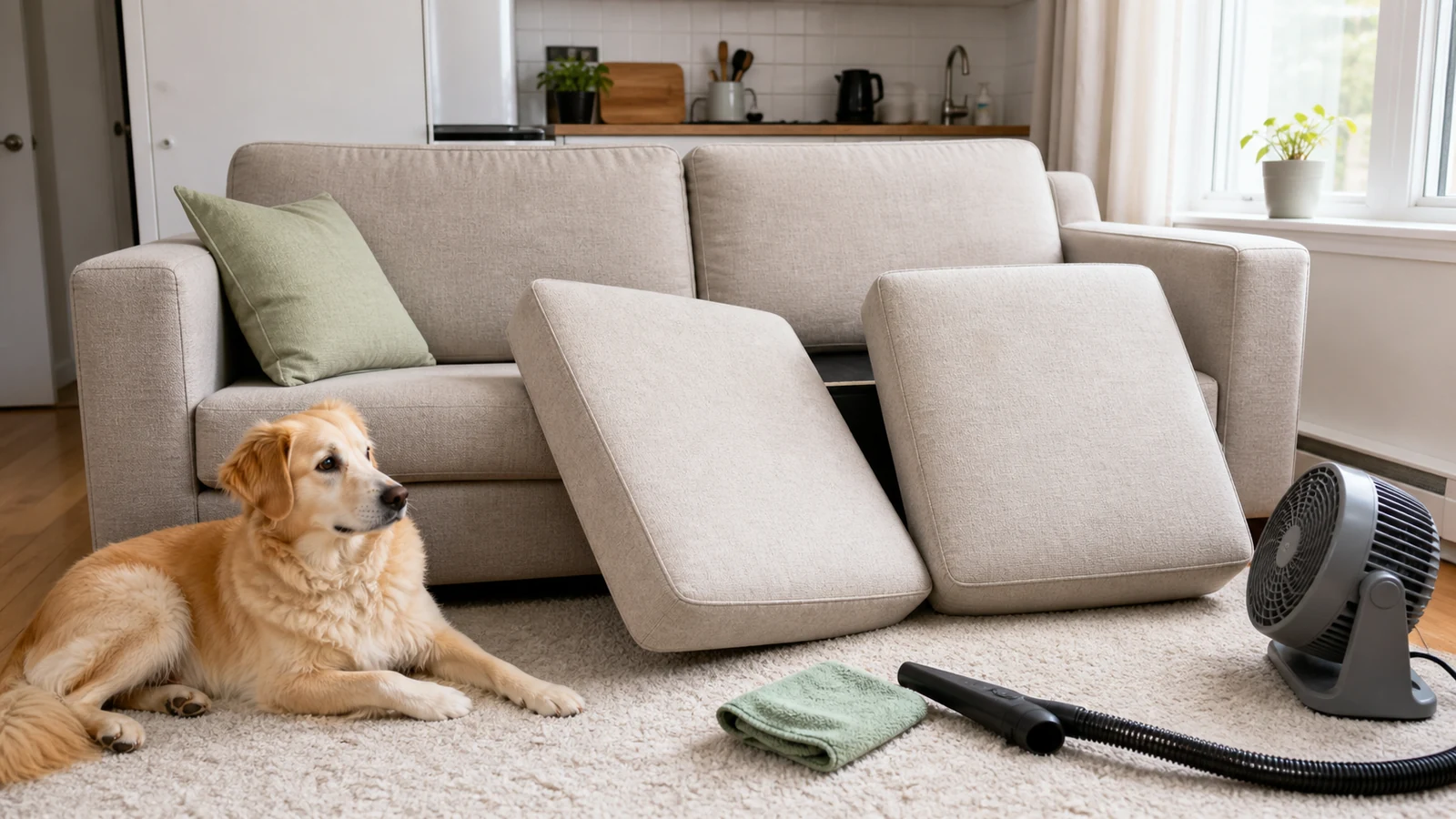
A couch can still smell like a pet after you vacuum it because the odor source may not be sitting loosely on the visible fabric. It may be held in body oils on the upholstery, inside a removable cover, in the batting around a cushion, in the foam, along a seam or zipper, beneath the cushions, or even in the frame or floor below.
If you are trying to learn how to get pet smell out of a couch, resist the urge to add another spray immediately. First determine what smells, how deep the source may be, and what the upholstery is designed to tolerate. A treatment that is reasonable for a water-cleanable fabric can damage solvent-only upholstery, velvet, wool-containing fabric, leather, or faux leather. A method that freshens the surface may also fail when a liquid accident has reached the cushion insert.
Quick Answer
To get pet smell out of a couch without creating a larger cleaning problem:
- Smell-check the cushions, seams, underside, frame, nearby throws, and floor to find the strongest zone.
- Find the upholstery care tag and the furniture manufacturer’s instructions.
- Remove loose hair, dander, crumbs, and other dry debris before applying anything wet.
- Decide whether the odor appears limited to the fabric surface or may have reached the cover, batting, foam, seams, or frame.
- Use only a cleaning category permitted by the care code and the exact product instructions.
- Apply the least moisture needed for the specific job. Do not assume that a W code permits soaking.
- Extract or blot removable moisture as the approved method directs.
- Create airflow and keep people and pets off the couch until every treated layer is completely dry.
- Recheck the odor when the couch is dry. If it returns, investigate depth, residue, or a nearby source before adding more cleaner.
Table of Contents
Match What You Notice to the First Decision
The following table is a screening tool, not a diagnosis. More than one condition can exist at the same time.
| What You Notice | Likely Level | First Decision | Main Risk |
|---|---|---|---|
| General pet smell where a pet rests | Often surface fabric, cover, or nearby throw | Remove dry debris and check the care code before surface cleaning | Masking oils and residue with fragrance |
| Visible hair or dander buildup | Usually surface and seams | Vacuum or brush dry material first | Wetting debris into the fabric |
| Wet-dog or damp-cloth smell | Cover, fabric, batting, or another damp item nearby | Find the moisture source and create airflow | Cleaning an already damp cushion and extending drying |
| A fresh, limited urine accident | Surface, cover, or possibly deeper layers | Blot, identify the affected depth, and check product and upholstery compatibility | Assuming the visible spot marks the full affected area |
| Odor from vomit, feces, or another organic accident | Surface or deeper if liquid migrated | Remove the source first, then follow material-specific care | Broad disinfectant use or unnecessary saturation |
| Strong cleaner or perfume smell with sticky fabric | Surface residue, possibly deeper if heavily sprayed | Stop adding products and identify what was already used | Chemical mixing, discoloration, or residue buildup |
| Odor that returns after complete drying | Possible missed area, deeper layer, residue, frame, or nearby material | Remap the source and inspect depth | Automatically assuming foam contamination or repeating the same treatment |
If the entire room smells but no part of the couch is clearly strongest, step back and use a broader apartment pet-odor source check.
Check the Upholstery Care Code Before You Add Moisture
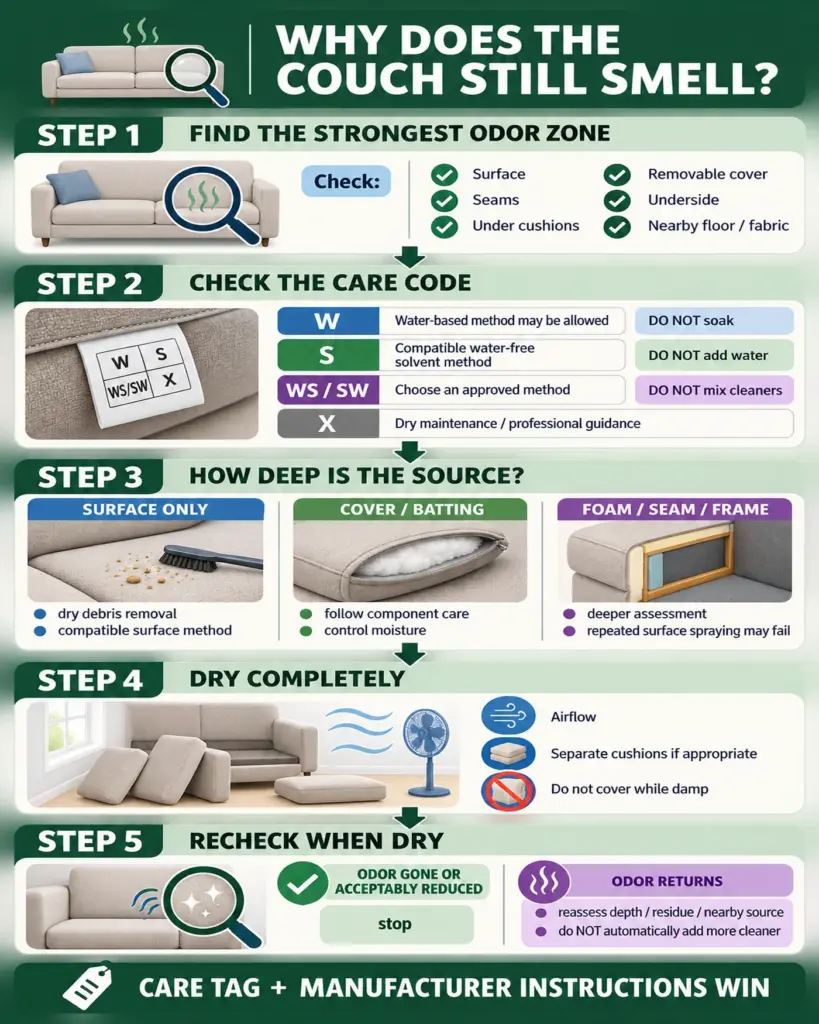
The care tag is often under a seat cushion or beneath the furniture. It may list a cleaning code such as W, S, W-S, S-W, or X. The code is a starting boundary, not a promise that every product within a broad category is suitable.
Furniture manufacturer guidance overrides generic online advice. Instructions for a removable cushion cover may also differ from instructions for the upholstered frame or the insert inside the cover. A zipper provides access for manufacturing or service; it does not automatically mean that a cover is machine washable.
La-Z-Boy’s fabric-care guidance illustrates why these distinctions matter. Its instructions call for determining the fabric and cleaning code, pretesting where directed, avoiding saturation, and treating leather separately from ordinary fabric upholstery.
W: Water-Based Methods May Be Allowed
A W code generally permits a compatible water-based upholstery shampoo or foam cleaner. It does not mean that you can soak the couch, use any household mixture, or run unrestricted water through the cushion.
S: Water-Free Solvent Methods
An S code generally points to a compatible water-free dry-cleaning solvent method. It does not mean that any solvent in a household cabinet is safe. Different solvents can affect dyes, finishes, adhesives, backing materials, and indoor air.
WS or SW: Choose an Allowed Category, Do Not Mix Categories
A WS or SW code may allow either an approved water-based upholstery method or an approved water-free solvent method. It does not authorize mixing products, alternating unknown chemistries, or assuming that every stain remover is compatible.
X: Dry Maintenance and Professional Guidance
An X code generally means routine liquid and solvent DIY cleaning is not appropriate. Vacuuming or light brushing may still be allowed. X does not mean the couch can never be cleaned; it means that generic wet spot treatment is outside the normal home-care boundary.
Spot Testing Has Limits
A hidden-area test can reveal an immediate color or texture problem, but it cannot prove that deep foam will dry correctly. Follow the manufacturer’s instructions, let the test dry, and do not transfer approval from one component to another.
Is the Smell on the Surface or Inside the Cushion?
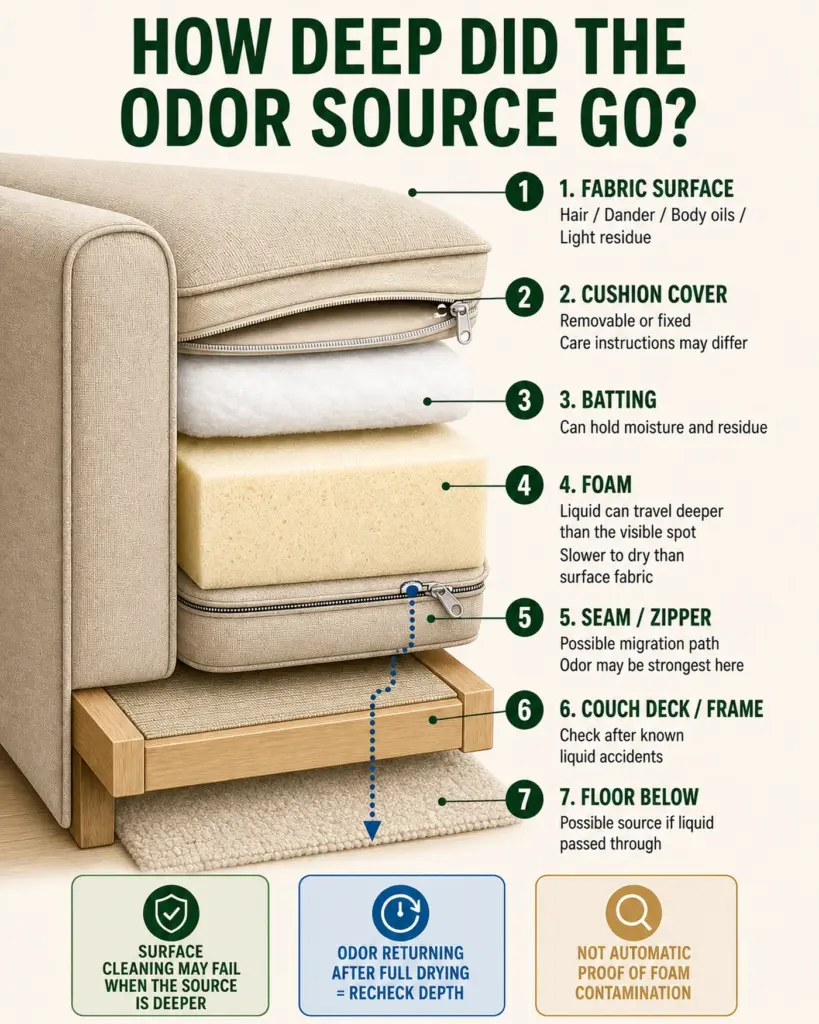
Think of a couch as a stack of materials rather than one surface:
Fabric surface → cushion cover → batting → foam → seam or zipper → frame → floor below
Dry hair and crumbs are usually visible or collect in seams. Body oils and saliva can remain on the contact surface or cover. A liquid accident can move through the fabric, follow stitching, collect near a zipper, enter batting and foam, reach the deck below the cushions, or travel to the floor.
Start with a dry inspection. Remove cushions if the furniture design permits it. Smell each component separately rather than standing in front of the whole couch. Compare the top, sides, seams, zipper area, underside, cushion deck, frame edges, nearby throw, and floor. Use good lighting to look for texture changes, residue, rings, or discoloration. Do not repeatedly press your face into a chemically treated area; ventilate and follow the product’s exposure precautions.
Possible signs of deeper involvement include:
- the odor is strongest at a seam, zipper, or underside;
- a laundered or cleaned cover smells neutral, but the assembled cushion does not;
- the foam or batting has a distinct odor when safely accessible;
- a known liquid accident reached the edge or underside;
- the smell improves while the surface is wet but returns after complete drying;
- several surface treatments produce only brief improvement; or
- the cushion stays damp longer than the surrounding fabric.
None of these signs proves that foam is the source. The actual problem could be retained product, a missed section, the cushion deck, the frame, a throw, or the floor. The purpose of the inspection is to narrow the next decision, not to make a diagnosis from one clue.
Choose the Workflow by Odor Type
General Pet Body or Coat Odor
A pet’s regular resting place can collect coat oils, saliva, outdoor dust, and small amounts of moisture. Begin by removing throws, blankets, and removable accessories. Check each item’s own care instructions and clean it separately when appropriate.
Vacuum the couch slowly with a suitable upholstery tool. Work across the main contact area, between cushions, along welting, and in crevices. If hair is embedded, use only a fabric-compatible dry tool that will not snag loops or disturb pile. Empty the vacuum away from the couch so captured debris does not return to the room.
After dry removal, reassess. A light odor may be largely associated with the removed throw or debris. If the upholstery itself still smells, use only the surface-cleaning category allowed by its code. Avoid spraying the entire couch merely because one seat is affected. Clean the actual contact zone and connected panel as the manufacturer directs, then dry it fully.
Hair, Dander, and Dry Debris
Hair itself is not always the primary odor source, but it can carry skin oils, saliva, dust, and outdoor debris. It also accumulates in seams where liquid cleaning is difficult to control. Removing it first improves your ability to locate the actual smell and prevents wet cleaner from turning dry debris into a paste.
Work from dry to damp: lift removable cushions, vacuum broad surfaces, detail seams, and check beneath the couch. Avoid aggressive scraping that can fuzz fabric or damage velvet pile. A lint tool that works on a tightly woven polyester may be too harsh for a loose weave.
If hair is spreading through floors, laundry, vents, and multiple furniture pieces, use the broader pet-hair control system for apartments. Keep this couch job focused on the affected upholstery rather than trying to solve the entire home’s shedding pattern with one cleaning session.
Wet Dog or Damp Fabric Smell
A damp smell makes moisture control the first priority. Identify whether the moisture is in the couch, a cover, a pet blanket, a towel, the pet’s coat, or a nearby rug. Do not add water-based cleaner to upholstery that is already damp merely because it smells stronger.
Remove wet accessories and dry them according to their own instructions. If the couch is damp from ordinary contact rather than a contaminated spill, airflow may be more appropriate than immediate washing. Stand removable cushions in a stable position if the manufacturer permits removal, leave space between them, and move air around multiple sides.
Avoid fragrance sprays. Judge the upholstery only after it is fully dry. If dampness persists or the material shows visible microbial growth, stop routine deodorizing and seek professional assessment.
Urine
Urine requires a depth decision before a product decision. A small fresh amount caught on a removable, washable cover is different from liquid that entered a seam, soaked the insert, reached the couch deck, or dripped to the floor.
Blot fresh liquid with an absorbent, color-safe material without grinding it deeper. Check the top, seam, zipper, underside, insert, and material below. Follow the couch manufacturer’s care limits and the exact cleaner label. An enzyme cleaner is not automatically compatible with every couch, and the application volume required by a urine product may conflict with a moisture-sensitive upholstery code or dense cushion that cannot dry adequately.
For chemical exclusions and common failure modes, use the detailed guide to what not to use on pet urine smell. If you need to understand the different jobs of an enzyme treatment and an extraction machine, the enzyme cleaner versus carpet cleaner explanation can clarify product classes, but the couch care code still controls what is appropriate here.
Do not reproduce a carpet procedure on a cushion merely because both are fabric-covered. If urine reached foam or the frame, professional cleaning or cushion replacement may be more rational than repeated surface treatment.
Vomit, Feces, and Other Organic Accidents
Remove solids or bulk material first using a method that does not spread it across the weave. Blot remaining liquid rather than scrubbing aggressively. Use the upholstery instructions to decide whether any wet treatment is allowed.
Do not assume the couch needs a disinfectant. Cleaning, sanitizing, and disinfecting are different tasks, and a product intended for a hard nonporous surface may not be labeled for absorbent upholstery. The EPA’s household cleaning guidance emphasizes label directions, surface compatibility, ventilation, and not mixing cleaning products. It also notes that many antimicrobial products are not intended for absorbent materials such as fabrics or upholstery.
Cleaner or Fragrance Residue
If the couch smells more like cleaner than the original pet odor, feels sticky or stiff, or develops rings, stop adding products. Write down what was used, where it was used, and whether the upholstery was dry between applications.
Residue can hold soil, alter texture, and make odor assessment difficult. A compatible rinse or extraction step may help on some water-cleanable upholstery, but only when both the furniture instructions and the machine or product guidance allow it. On S or X upholstery, adding water to chase residue can create a second problem.
Do not try to cancel one product with another cleaner. If the prior product is unknown, contact the furniture manufacturer, product manufacturer, or a professional before adding anything else.
Unknown or Returning Odor
When the source is uncertain, divide the couch into zones. Check one cushion at a time, then the deck, arms, back, frame edge, throws, and floor. Note whether the odor changes when a cushion is removed or turned. This is more useful than treating every surface equally.
Wait until previously treated material is completely dry. If the odor returns, consider a missed source, deeper contamination, retained residue, or a nearby material; do not assume the foam is responsible.
Fabric Type Alone Does Not Tell You How to Clean the Couch
Polyester upholstery may be durable, but one polyester couch can have different cleaning instructions from another. Microfiber can carry W, S, or W-S guidance depending on the specific product. Cotton and linen blends may respond differently because blend percentages, dyes, finishes, and dimensional stability vary. A removable cotton-blend cover may still be marked for spot cleaning rather than machine washing.
Performance fabric is not a universal cleaning category. La-Z-Boy’s performance-fabric list includes products with different codes, even among micro-denier and performance constructions. Treat “performance” as a marketing or construction description until you verify the exact care instructions.
Velvet requires attention to pile direction, pressure marks, and potential appearance changes. Fritz Hansen’s velvet guidance recommends suitable upholstery vacuuming and describes material-specific handling. Its product-specific steam guidance is not permission to steam every velvet couch.
Wool-containing upholstery often deserves extra caution because a generic household product may not be appropriate for wool, its dye, or its finish. Follow the furniture or textile manufacturer’s instructions rather than transferring advice from synthetic fabric.
Leather and faux leather belong outside the normal fabric-upholstery workflow. Genuine leather varies by finish and requires leather-specific care. Faux leather is a coated material with its own restrictions; it should not automatically receive fabric spray, enzyme saturation, or leather conditioner. skai’s faux-leather guidance recommends product-specific care and identifies categories such as solvents, chlorides, polishing agents, and aerosol sprays as unsuitable for its materials. Use the instructions for your exact furniture rather than treating that page as universal permission for all faux leather.
Why Drying Matters as Much as Cleaning
Visible fabric can feel dry while batting or foam underneath still holds moisture. Foam is thick, porous, and exposed to less moving air than the surface. Seams and piping can also slow evaporation. If cushions are reassembled or covered while damp, air movement becomes even more limited.
Over-wetting is especially difficult in an apartment without a patio, spare room, or space to separate cushions. Plan the drying setup before the couch is wet.
Use the least liquid appropriate to the approved method. Blot or extract excess moisture as directed. If using a compatible upholstery machine, make suction-only passes when the machine instructions recommend them. Do not keep spraying because the recovered water still looks cloudy; the furniture’s moisture limit matters more than making the tank look perfect.
Rug Doctor by BISSELL’s sofa guidance advises dry passes, complete drying before use, opening windows or using ceiling fans, and standing removable cushions upright when possible. Kärcher’s upholstery guidance likewise emphasizes checking water resistance, removing moisture, allowing ample drying time, and ventilating.
Do not use a hair dryer, space heater, or direct high heat to force the process. Concentrated heat can affect fibers, finishes, adhesives, leather, faux leather, and stains. Use ordinary airflow and the furniture manufacturer’s guidance instead.
The correct time to judge odor is when every treated layer is fully dry. Do not sit on the couch, replace covers, stack cushions tightly, or put a waterproof protector over damp upholstery. Keep pets away until the treated area is dry and the product label permits access. The ASPCA’s household cleaning guidance advises following labels and preventing pet access while treated areas air out or dry.
How to Dry a Couch When You Live in a Small Apartment
Plan a drying zone before you begin. Clear a stable section of floor and protect it if necessary. Keep doorways, exits, heaters, and walking paths open. If only one cushion is affected, clean one cushion rather than dismantling the entire room.
Position removable cushions so air can reach more than one side, provided they are stable and the manufacturer allows removal. Do not lean a wet cushion against painted walls, wood furniture, bedding, or another absorbent cushion. Rotate its position only if doing so will not distort the insert or transfer moisture.
Use a fan to move room air across—not just into—treated surfaces. Run HVAC in a normal, safe mode if it improves circulation. Open a window when outdoor conditions, security, building rules, and air quality make that sensible. In humid weather, an open window may not improve drying; use the driest practical indoor airflow available rather than assuming outside air is always better.
If the couch sits beside the bed or occupies most of a studio, reduce the treatment area to what you can dry safely. Do not wet every cushion at once if you have nowhere to separate them. Create a temporary pet-free zone with a closed door, gate, exercise pen, or supervised alternative resting place. Avoid covering the couch with plastic to block access because that also traps moisture.
For removable covers, read the sewn-in instructions before using shared laundry. Confirm whether washing, water temperature, spin, and machine drying are allowed. A zipper alone does not make a cover washable. Bring the cover back only when both it and the cushion insert are fully dry; assembling a dry-looking cover over damp foam defeats the drying plan.
Be especially conservative with furnished or landlord-owned furniture. Photograph the care tag and the affected area before treatment, save the product label, and document what happened. If the instructions are missing, the material is valuable, or the accident reached the insert or frame, contact the landlord or furniture provider before an irreversible treatment.
There is no universal drying time. A thin surface treatment and a saturated foam insert are not comparable. Temperature, humidity, airflow, cushion density, fabric, and application volume all matter. “Until fully dry” is the only reliable general endpoint.
Use Cleaning Products Without Creating a Chemical Problem
Cleaning products should be selected by purpose, surface compatibility, and label—not by the idea that more ingredients create more cleaning power.
Never mix bleach with ammonia, acids such as vinegar, or other cleaning products. More broadly, do not combine vinegar, peroxide, disinfectants, enzyme cleaners, solvents, or other treatments unless the exact manufacturer explicitly directs that combination for the exact products and surface. The EPA warns that mixing cleaning products can create toxic vapors and advises ventilation during and after use.
Do not use bleach as a general couch deodorizer. Do not treat vinegar as a universal upholstery cleaner. Do not add essential oils to create a “pet-safe” fragrance. Concentration, exposure route, formulation, and the animal involved all matter, and a pleasant scent does not remove the source.
Baking soda is sometimes used as a dry odor-adsorption technique, but it is not the central answer to couch odor. Consider it only if the furniture guidance permits a dry powder, the material will not be harmed, pets can be kept away during use, and you can remove the powder fully with an appropriate vacuum. Fine residue can remain in texture, seams, or filters, and applying powder before locating a liquid source can complicate cleanup.
Use one compatible product at a time. Read directions for dilution, application amount, dwell time, rinsing or extraction, ventilation, protective equipment, and pet access. If the label does not list upholstery or your material, do not assume that “pet odor” on the front of the bottle makes it suitable.
When Another Round of Cleaner Is Probably Not the Answer
Pause before repeating treatment when:
- odor returns after the couch is completely dry;
- accessible foam or batting smells directly;
- liquid reached a seam, zipper, underside, deck, or frame;
- the underside smells stronger than the top;
- a cushion remains damp;
- several cleaners have already been layered;
- the fabric feels sticky, stiff, rough, or unusually slick;
- color, pile, texture, coating, or finish has changed;
- the furniture belongs to a landlord or came with a furnished rental; or
- repeated accidents continue to reach the same area.
The next step depends on access and condition. A genuinely washable cover may be assessed and cleaned separately according to its label. An accessible cushion insert can be inspected without tearing, cutting, or altering the furniture. The furniture manufacturer may clarify component care or identify an approved service method.
A qualified upholstery cleaner can assess fiber, dye stability, construction, contamination depth, and drying feasibility. The IICRC upholstery odor tip sheet recommends trained professional help for urine-odor upholstery problems. Professional treatment is an escalation option, not a guarantee that every contaminated foam or frame can be restored.
Sometimes replacing one cushion insert is more rational than repeatedly saturating it. That does not automatically mean replacing the whole couch. Compare the affected component, furniture value, availability of replacement inserts, previous damage, professional-cleaning cost, and the likelihood of another accident.
For landlord-owned furniture, document the condition, incident, tag, products already used, and communication. Do not remove upholstery, cut foam, or arrange irreversible work without authorization.
Common Mistakes That Make Couch Odor Harder to Remove
Adding Cleaner Before Reading the Care Code
The first spray can create the first damage. Find the tag and product instructions before choosing water, solvent, powder, or a machine.
Over-Wetting a W-Code Couch
W permits an appropriate water-based category; it does not mean unrestricted saturation. Liquid can move beyond the fabric into batting, foam, seams, wood, metal, and flooring.
Mixing or Layering Products
A second product may react with the first or make residue harder to identify. Stop, record what was used, ventilate as directed, and seek manufacturer guidance when compatibility is uncertain.
Masking the Smell With Fragrance
A fragrance spray changes perception temporarily. It does not tell you whether body oils, damp fabric, urine, residue, or another source has been removed.
Cleaning the Center but Ignoring Seams and the Underside
Liquid follows gravity and construction paths. The visible center may look clean while a seam, zipper, cushion edge, deck, or floor holds the strongest odor.
Judging the Result While the Couch Is Wet
Wet fabric, cleaner scent, and damp foam can temporarily change what you smell. Make the success decision only after complete drying.
Putting Cushions Back Too Soon
A cushion placed flat against the deck or enclosed in a cover loses airflow. Reassembly before full drying can prolong dampness and make source mapping harder.
Cleaning the Cover but Ignoring the Insert
A removable cover may be only the first layer. If the clean cover smells neutral by itself but the assembled cushion does not, inspect the insert and adjacent couch structure.
Continuing After Material Damage Appears
Discoloration, rings, dye transfer, pile distortion, stickiness, stiffness, peeling, or cracking are stop signals. Repeated treatment can turn a cosmetic issue into permanent damage.
Assuming a Zipper Means Machine Washable
Some covers have zippers for assembly, not laundering. Washing can shrink or distort a cover so that it no longer fits. Follow the cover’s exact label.
Treating Every Odor as Urine
Routine body odor, wet textiles, food residue, vomit, feces, cleaner buildup, and nearby materials require different decisions. Use evidence from the location and incident rather than choosing the strongest urine product by default.
What a Couch-Odor Routine Cannot Fix
A careful routine cannot make incompatible chemistry safe, guarantee restoration of contaminated foam, correct permanent dye or coating damage, or create drying space that an apartment does not have. It cannot remove a source that is actually in the floor, wall, rug, pet bed, or another room.
It also cannot resolve repeated accidents by itself. If a previously house-trained pet begins urinating, vomiting, or defecating unexpectedly, or if an animal has a strong new body odor, the cleaning problem may exist alongside a health or behavior problem. Contact a veterinarian when the change is sudden, repeated, or accompanied by other concerning signs. Clean the furniture without pretending that cleaning explains why the incident happened.
A routine also cannot promise that professional cleaning will save every cushion. Deep contamination, inaccessible construction, prior chemical damage, and prolonged dampness can limit the result. The purpose of escalation is to make a better decision with more information, not to guarantee a particular outcome.
Final Takeaway
To get pet smell out of a couch, follow the couch rather than a generic cleaning hack:
Find the source → read the care code → assess the depth → choose a compatible method → minimize moisture → dry completely → reassess
Remove dry debris before wet cleaning. Treat W, S, WS/SW, and X as real boundaries. Separate fabric, removable covers, foam, leather, and faux leather instead of assuming they share one method. Plan drying before applying moisture, especially when a small apartment gives you little room for cushions and limited ventilation.
Most importantly, judge the result only when the couch is completely dry. If odor returns after correct cleaning and full drying, stop treating the couch as a surface-only problem. Recheck the cover, batting, foam, seams, frame, floor, nearby textiles, and product residue, then choose professional assessment or component replacement when another round of cleaner would add more moisture than useful information.
Sources
- Fabric and Leather Care — La-Z-Boy
- Performance Fabric Patterns and Care — La-Z-Boy
- Velvet Care and Maintenance — Fritz Hansen
- Faux Leather Cleaning and Maintenance — skai
- How to Clean a Couch — Rug Doctor by BISSELL
- Cleaning Upholstery — Kärcher
- Biological Contaminants and Indoor Air Quality — U.S. EPA
- Pet Poisons: Household Products and Cleaning Agents — ASPCA
- Urine Odors—Upholstery Tip Sheet — IICRC