If you’re comparing HEPA vs activated carbon for pet odor, the real question is whether your apartment air problem is mostly particles, gases, or an active odor source. It is easy to assume an air purifier should fix the problem, but product pages quickly start throwing around filter terms: HEPA, True HEPA, activated carbon, deodorizing filter, carbon pre-filter, odor control layer, plasma, ionizer, UV, pet mode. The labels can make it sound as if every purifier solves the same problem.
They do not.
The most important difference is simple: HEPA filters are built for airborne particles. Activated carbon filters are used for some gases and odors. Pet homes usually have both kinds of air problems, but they do not come from the same source and they do not respond to the same filter.
That distinction matters even more in apartments. A small bedroom, studio, or condo can make odor feel close and constant because the litter box, dog bed, sofa, laundry basket, and kitchen may all share the same air. But an air purifier still cannot clean a urine spot in carpet, wash a dog bed, scoop a litter box, or remove fur already sitting on furniture. It can only treat the air that actually moves through it.
Quick Answer
For HEPA vs activated carbon for pet odor, activated carbon matters more than HEPA because many odors are gases, not particles. For pet dander, dust, litter dust, and fine airborne debris, HEPA or another efficient particle filter matters more. Most pet apartments do best with both: strong particle filtration, enough airflow for the room, and a meaningful activated carbon stage.
Use this rule:
- If the problem is sneezing, dust, dander, hair floating in light, or litter dust, think particle control.
- If the problem is dog smell, litter box odor, urine smell after cleanup, stale bedding smell, or cleaning-product odor, think gas and odor control.
- If the problem is a dirty litter box, urine in carpet, wet bedding, a full trash can, or an indoor potty station, fix the source before expecting any filter to help.
The EPA’s home air cleaner guide makes the same basic boundary clear: source control and ventilation come first, and air cleaners are supplemental. For apartments with pets, that means an air purifier can support a cleaning system, but it should not become the cleaning system.
Table of Contents
Why HEPA and Carbon Get Confused
Pet odor is often discussed as if it were one thing. In real homes, “pet smell” can mean several different problems at once.
A room may contain visible pet hair, microscopic dander, litter dust, dried saliva on bedding, tracked dirt, food odor, urine residue, cleaning-product scent, and stale air from poor ventilation. Some of those are particles. Some are gases. Some are still sitting on surfaces. A filter can help only after you know which category you are dealing with.
HEPA became famous because it is associated with high-efficiency particle capture. Many air purifier boxes lead with particle numbers because they are easy to advertise. Activated carbon is often described in smaller print as an odor layer, deodorizing filter, or carbon pre-filter. That can make carbon look secondary, even when odor is the main reason you are shopping.
The mistake is buying a purifier for the wrong pollutant. A HEPA-heavy machine with a thin carbon sheet may reduce airborne dust and dander while leaving the room smelling mostly the same. A carbon-heavy machine with weak airflow may help with certain odors but do less for suspended particles. A purifier with a “pet” label may still have too little carbon, poor room sizing, or a filter replacement cost that makes it hard to run long term.
The useful question is not “Which filter is better?” The useful question is: better for which part of the pet-home problem?
Start With the Odor Source, Not the Filter
Before comparing HEPA vs activated carbon for pet odor, locate the strongest source you can. Air filtration works best after the source is reduced.
In a small apartment, check the ordinary odor zones first:
- Litter box, litter mat, nearby wall, floor edge, and trash container
- Dog bed, blankets, crate pad, couch cover, and washable rugs
- Carpet spots, especially repeat accident areas
- Laundry basket, hamper, bedding, and towels
- Indoor potty tray, pee-pad holder, synthetic grass tray, or bathroom station
- Vacuum canister, mop pads, cleaning cloths, and trash bags
- Closed rooms with poor airflow
If the odor is strongest at one surface, treat that surface. If it is strongest near a box, bed, tray, or hamper, clean or replace the item. If the odor is mild but spread through the room after basic cleaning, then air filtration becomes more useful.
This boundary matters because odor molecules can continue entering the air as long as the source remains. Activated carbon may adsorb some gas-phase compounds passing through the purifier, but it does not make the source stop producing odor. That is why a purifier can seem to work for a day and then disappoint after the pet bed, box, or carpet spot keeps feeding the air.
If you have not already mapped the source, start with our guide to pet odor in apartments. This page focuses only on what happens after the odor problem is partly airborne and you are choosing the right kind of filtration support.
The Core Difference: Particles vs Gases
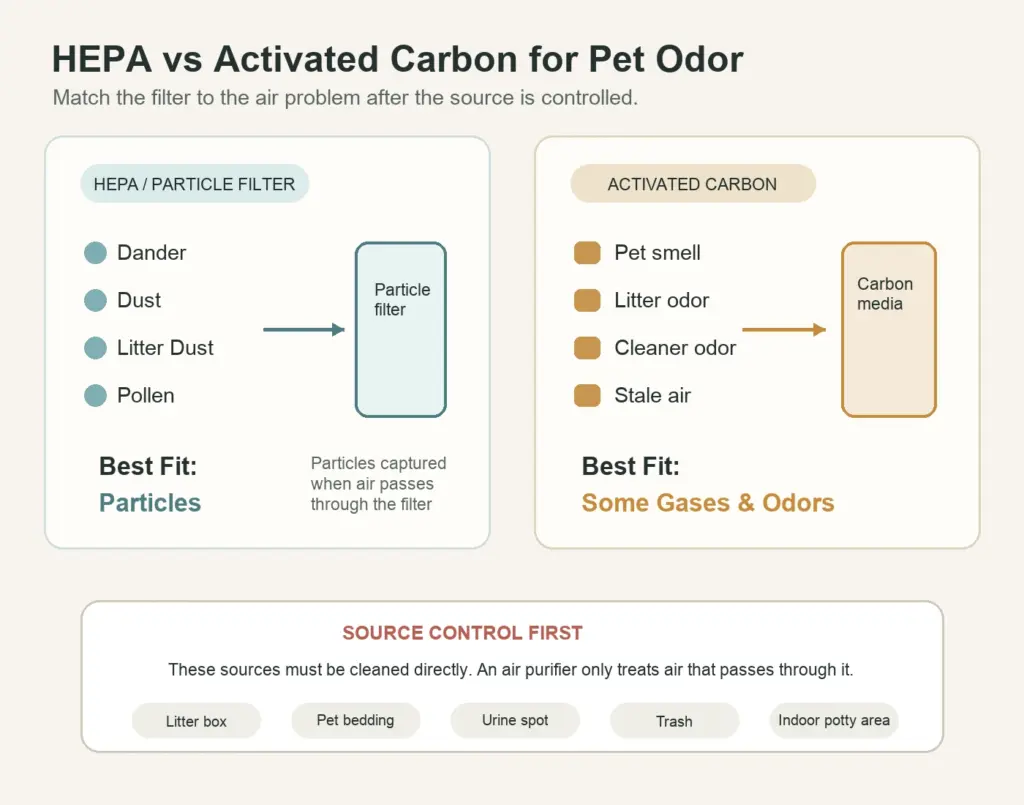
For HEPA vs activated carbon for pet odor, the core split is particles versus gases.
| Air problem in a pet apartment | Usually particle, gas, or surface? | HEPA / particle filter | Activated carbon |
|---|---|---|---|
| Floating pet dander | Particle | Strong fit | Not the main tool |
| Litter dust | Particle | Strong fit | Not the main tool |
| Fine dust from floors and fabrics | Particle | Strong fit | Not the main tool |
| Pet hair floating near intake | Larger particle/fiber | Pre-filter and airflow matter | Not the main tool |
| Wet dog smell in the room | Odor/gas plus source | Limited direct odor help | Better fit after source control |
| Litter box smell | Odor/gas plus source | Limited direct odor help | Better fit after box care |
| Urine odor after cleanup | Odor/gas plus possible surface residue | Limited direct odor help | May help airborne odor after source work |
| Cleaning-product fumes | Gas/VOC category | Not the main tool | Better fit if carbon is sufficient |
| Fur on couch or laundry | Surface problem | Air purifier cannot remove it | Air purifier cannot remove it |
The EPA guide says most filters are designed for either particles or gases, and many air cleaners use one filter for particles and another for gases. That is the whole decision in one sentence.
For pet owners, HEPA and carbon should not compete. They should be assigned different jobs.
What HEPA Does Well in a Pet Apartment
HEPA is about particles. In pet homes, that usually means airborne dander, fine dust, pollen tracked in on fur, some litter dust, and smaller particles that circulate when people walk, pets jump, bedding is shaken, or fabrics are disturbed.
A good particle filter can make the room feel less dusty. It can reduce the amount of fine debris circulating in the air. It can support people who are trying to reduce airborne dander exposure, although it should not be presented as a medical treatment. It can also help with the dusty side of a litter area when the issue is airborne particles rather than smell.
For apartments, airflow is as important as filter efficiency. A very efficient filter does not help much if too little room air passes through it. That is where CADR matters. CADR stands for Clean Air Delivery Rate, and it is used to compare how quickly an air cleaner delivers filtered air for particles. AHAM explains that CADR measures how fast an air cleaner filters common particle types such as dust, pollen, and tobacco smoke, and AHAM’s directory lists certified models by CADR and suggested room size.
In practice, that means you should not choose an air purifier only because it says “99.97%” on the box. That number may describe filter media under a specific test, not how quickly the whole appliance cleans your bedroom or living room. A compact purifier with a strong filter but low airflow may be too slow for an open-plan studio. A larger unit may clean the same room faster, but only if you can tolerate the noise and actually run it.
For pet hair specifically, remember that an air purifier catches only hair that becomes airborne and reaches the intake. It will not pull fur off a sofa, rug, comforter, or pile of laundry. If your bigger issue is visible hair moving across floors, bedding, furniture, and clothing, use our guide to pet hair in apartment homes first. Air filtration is only one support layer.
What Activated Carbon Does Well for Pet Odor
Activated carbon is used for gas and odor control. It is not a magic odor eraser, but it is the filter type that belongs in the conversation when smell is the main issue.
EPA’s technical summary describes adsorbent media as a gas-control technology where gases physically adsorb onto high-surface-area media, often activated carbon. The same EPA summary notes that activated carbon is commonly used in HVAC systems and portable air cleaners to remove gaseous contaminants, while also warning that performance differs by gas, concentration, and the amount of media.
That last part is crucial. “Has carbon” is not the same as “has enough carbon for your odor problem.”
Many small purifiers include a thin carbon-coated sheet or lightweight carbon pre-filter. That may help with light household odors, but it can saturate quickly in a pet apartment. A thicker carbon filter, granular carbon bed, or heavier carbon cartridge may have more capacity, but it may cost more, restrict airflow more, or require more expensive replacements.
Carbon also does not last forever. Once the available adsorption capacity is used up, odor control can decline even if the filter still looks clean. Blueair’s support documentation notes that a used filter in a strong odor environment can become saturated and start to smell, and recommends replacement when that happens. That is a useful real-world reminder: carbon failure may show up as returning odor, not visible dirt.
For pet owners, activated carbon is most relevant after source control for:
- General pet smell in a closed bedroom or studio
- Litter box odor that remains after good box care
- Mild wet-dog smell after bedding and towels are washed
- Lingering odor from cleaned accident areas
- Some cleaning-product odors when ventilation is limited
- Stale air in a pet sleeping room
It is less useful when the odor source is untreated urine, dirty litter, damp bedding, a full trash can, or a surface that needs washing.
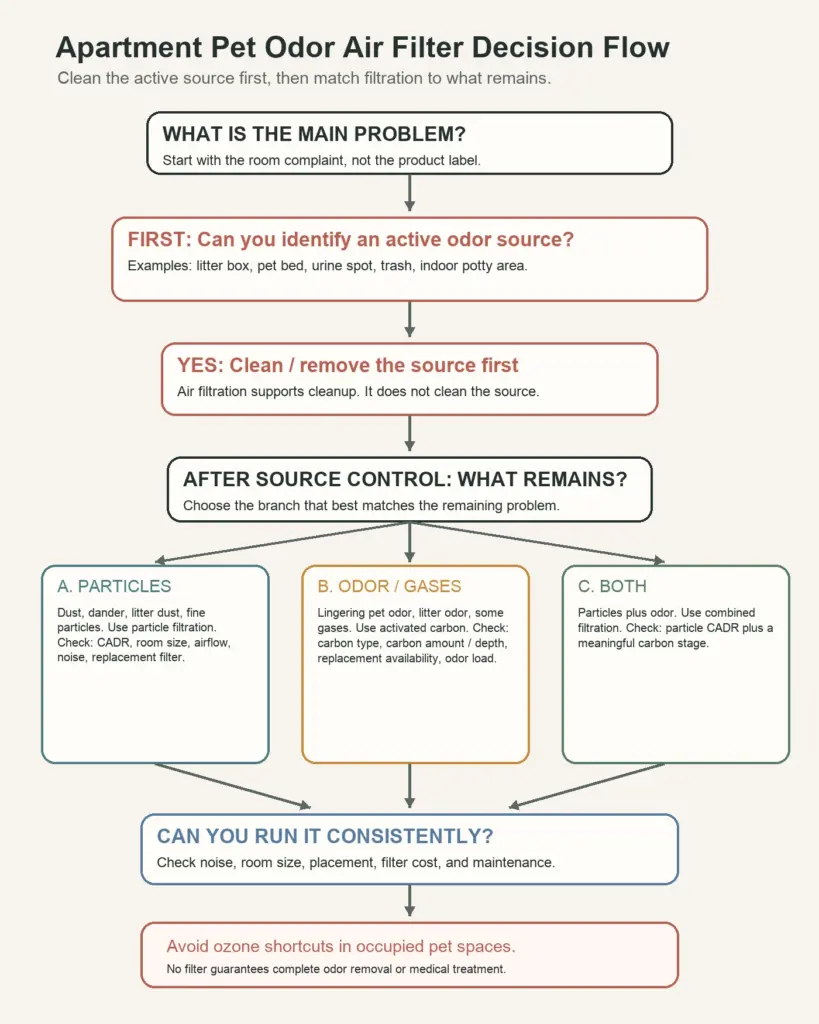
The Apartment Filter Decision System
Use this system before buying or replacing a purifier.
Step 1: Name the main complaint
Do not start with the product. Start with the sentence you would say to a friend.
- “The room smells like dog.”
- “The litter box smell reaches the living room.”
- “I see dust and hair in the sun.”
- “My sofa and blanket smell stale.”
- “The carpet spot smells again.”
- “The room feels stuffy after I clean.”
That sentence tells you whether the next step is cleaning, particle filtration, carbon filtration, ventilation, or a deeper odor investigation.
Step 2: Decide whether the problem is mostly air or surface
If the odor is strongest when you bend near a box, bed, couch, carpet spot, or hamper, the source is probably still on a surface. Clean the source first.
If the source is already managed and the room still smells slightly stale, air treatment becomes more reasonable.
If the problem is floating dust, visible particles, or dander-sensitive comfort, the air purifier may play a more central role.
Step 3: Match filter type to pollutant type
Choose a strong particle filter and adequate CADR for dander, dust, litter dust, and airborne debris.
Choose activated carbon for some gases and odors, but look past the label. Carbon amount, construction, replacement interval, and odor load matter.
Choose both if you have pets and your apartment has both particle and odor concerns.
Step 4: Check room size realistically
Small apartments often have connected rooms, doorways, alcoves, and open kitchens. A purifier rated for a sealed 200-square-foot bedroom may not perform the same way in a 500-square-foot studio with a kitchen, hallway, and litter area.
AHAM’s guidance says room size is one of the most important selection factors and points consumers to CADR. AHAM’s Verifide directory also explains the two-thirds rule for smoke CADR: a room should generally have a smoke CADR at least two-thirds of the room’s area. That rule is for particle removal, not odor removal, but it gives you a more useful comparison than vague “covers up to” claims.
Step 5: Check whether odor claims are supported
For odor control, ask:
- Is the carbon filter a thin sheet, pellet layer, honeycomb, cartridge, or deep bed?
- Does the manufacturer disclose carbon weight or construction?
- Is the filter described as activated carbon, carbon/zeolite, deodorization, or odor control?
- How often does the manufacturer expect replacement?
- Are replacement filters easy to buy?
- Does the manual say anything about strong odors, pets, smoke, or VOCs?
- Is the odor source already cleaned?
If a product says “odor control” but gives no information about carbon, replacement, or filter type, treat the claim cautiously.
Step 6: Avoid ozone shortcuts
Do not use an ozone generator in an occupied pet apartment. EPA warns that ozone generators sold as air cleaners intentionally produce ozone and states that no federal government agency has approved these devices for use in occupied spaces. EPA also notes that ozone can harm health and is generally ineffective at controlling indoor air pollution at concentrations that do not exceed public health standards.
This is especially important in pet homes because odor can make people search for aggressive solutions. A safer approach is source control, ventilation when appropriate, particle filtration, and carbon filtration.
When HEPA Is the Priority
Prioritize HEPA or another well-documented high-efficiency particle filter when the main issue is airborne debris.
This usually applies when you notice:
- Dust collecting quickly on shelves
- Litter dust around the box area
- Pet dander concerns
- Hair floating in sunlight
- Particles disturbed by grooming, vacuuming, or bedding changes
- Outdoor pollen tracked in on pets
In this case, compare CADR, room size, filter replacement cost, noise, and whether the purifier has a serviceable pre-filter. A washable or cleanable pre-filter can be helpful in shedding households because larger fibers and lint can load the first stage quickly. Follow the manual; do not wash a main HEPA filter unless the manufacturer says it is washable.
HEPA may also support a bedroom strategy if pets sleep near you. But do not describe it as a cure for allergies, asthma, or symptoms. If someone has allergy or asthma concerns, air filtration is only one environmental control, and medical advice belongs with a qualified clinician. For cat-specific allergy context, IndoorCatExpert has a separate guide to living with cat allergies in a small apartment.
For this page, the boundary is air-filter decision-making, not diagnosis.
When Activated Carbon Is the Priority
Prioritize activated carbon when smell remains after you have cleaned the obvious source.
That might include:
- A small bedroom that smells like the dog bed even after washing
- A litter room that has good scooping habits but still has mild airborne odor
- A studio where cooking, pets, and laundry share the same air
- A cleaned accident area that leaves a low-level smell in the room
- Cleaning-product odor after safe use and ventilation
For these cases, carbon capacity matters. EPA’s technical summary says activated carbon can have high removal efficiency for many gaseous pollutants when there is enough media for the application, but it also notes that the effectiveness of consumer systems with small amounts of activated carbon is unknown. That is the evidence-based reason to be skeptical of tiny carbon layers marketed as heavy odor solutions.
Some manufacturers make the particle-vs-odor distinction clearly. Levoit’s pet air purifier page, for example, describes pre-filter and main filter roles for fur and dander, while the activated carbon filter is tied to litter box and pet smells. Winix similarly describes True HEPA for airborne pet dander and activated carbon filtration for everyday pet odors. These are manufacturer claims, not independent tests, but they show how brands themselves separate the filter jobs.
Use carbon as a support layer. If odor returns quickly, ask whether the carbon is saturated, the unit is undersized, the odor source is still active, or the room has poor ventilation.
When You Need Both
Most pet apartments need both particle and gas control.
A cat home may have litter dust and litter odor. A dog home may have dander, hair, bedding smell, and outdoor dirt. A multi-pet apartment may have all of those at once. A studio may combine pet air, cooking odors, laundry, and cleaning products in one small volume.
A combined purifier can make sense when:
- You want dander and odor support in the same room
- You have a litter box in a bedroom, bathroom, or open-plan space
- Your pet sleeps in the room
- You need continuous particle control but also want mild odor reduction
- You want one device instead of separate particle and carbon solutions
But “both” still needs quality. Look for adequate CADR for particles and meaningful carbon for odors. A strong HEPA stage with a token carbon sheet may be a particle purifier with light odor support. A heavy carbon machine with weak airflow may be an odor-focused machine that is harder to compare for particles. The right choice depends on your room and your main complaint.
How to Read Air Purifier Specs Without Getting Misled
Air purifier specs can be useful, but only if you know what each one is measuring.
CADR
CADR is about particle removal speed. AHAM’s consumer guidance calls CADR one of the most important comparison metrics for air cleaners because it measures how fast an air cleaner filters dust, pollen, and tobacco smoke particles. Use CADR to compare particle performance and room sizing.
CADR does not tell you how well the purifier removes pet odor gases.
Room coverage
Coverage claims can be confusing because brands may use different air-change assumptions. A purifier that claims a very large room size at one air change per hour may not be a good match for a pet bedroom where you want frequent filtration. Prefer AHAM Verifide room sizing or clear CADR numbers.
HEPA, True HEPA, HEPA-type
The label should be read carefully. “HEPA-type” and “HEPA-like” are not the same as a clearly stated HEPA filter or independently documented particle performance. Also remember that filter-media efficiency and whole-unit performance are not identical. Airflow, leakage, filter fit, fan speed, and room placement all matter.
Activated carbon
For odor, look for more than the word “carbon.” Better clues include granular carbon, carbon weight, carbon/zeolite blend, odor-specific filter, replacement interval, and filter cost. If a brand does not disclose much, you can still use the product, but do not assume it will solve heavy pet odor.
Ozone, ionizers, plasma, UV
Be cautious with technologies that sound like shortcuts. EPA warns against ozone generators in occupied spaces. Some electronic air cleaners may have ozone concerns depending on design. Mechanical filtration plus carbon is easier for most pet owners to understand, maintain, and evaluate.
Filter replacement cost
A purifier is not a one-time purchase. In a pet home, pre-filters can load with fur and dust, particle filters can clog, and carbon can saturate. If replacement filters are expensive or hard to find, the purifier may become less useful because you will delay maintenance.
Apartment Scenarios: Which Filter Matters Most?
Studio with one litter box
The source is the litter box first. Scoop, replace litter as needed, clean the box, check the surrounding floor, and manage trash. After that, a purifier with particle filtration plus activated carbon can help with litter dust and mild airborne odor. Carbon matters for smell; CADR matters for dust and room turnover.
Bedroom with a dog bed
Wash the bed cover, blankets, and nearby soft goods first. If the room still smells closed-in, carbon may help. If dust, dander, or hair are also present, use a combined purifier. Place it where air can circulate around the dog’s sleeping area without blowing directly on the dog or blocking intake.
Open-plan apartment with pets and cooking odors
This is a mixed air problem. Cooking creates particles and gases; pets add particles and odor sources. A purifier may need both high enough particle CADR and a carbon stage. But ventilation and source control matter because one small purifier cannot erase an active kitchen, litter area, and pet bed all at once.
Carpet accident after cleanup
Do not start with an air purifier. Confirm the carpet cleanup was appropriate and fully dry. If odor remains strongest at the spot, the source is likely still local. Carbon can reduce some airborne smell after cleanup, but it cannot treat carpet backing, padding, or nearby materials.
Allergy-sensitive household
Focus on particle control, cleaning routines, and medical guidance as appropriate. HEPA or efficient particle filtration is the more relevant filter type for airborne dander and dust. Carbon may still be useful if odor is also present, but it is not the allergy tool.
Placement Matters More Than People Think
An air purifier can only filter air that reaches it. In small apartments, placement often decides whether the device feels useful.
Good placement usually means:
- In the room where the problem is strongest
- With intake and outlet clear
- Away from curtains, bedding, and furniture that block airflow
- On a stable surface if the manual allows tabletop use
- Away from wet areas, litter scatter, chewing risks, and tipping risks
- Close enough to the odor zone to help, but not so close that it clogs immediately with litter dust or pet hair
EPA’s guide advises placing portable air cleaners in rooms where people spend the most time and keeping airflow unobstructed. For pet homes, that often means the bedroom, living room, or room with the pet’s main rest area.
For room-by-room setup, use our guide to air purifier placement in apartments with pets.
Do not hide the purifier behind a chair because it looks nicer there. A purifier with blocked airflow becomes an expensive white-noise machine.
Run Time, Fan Speed, and Noise
A purifier works only while air moves through it. Short bursts on high may help after a specific event, but continuous lower-speed operation often feels more realistic for bedrooms and living rooms.
The problem is noise. A purifier that is technically powerful but too loud to run will underperform in real life. AHAM notes that noise level is related to room size and that proper sizing can help keep noise acceptable. In an apartment, this matters because you may be using the purifier near a bed, desk, TV, or shared wall.
When comparing units, ask:
- Can I sleep with this on a useful speed?
- Does the unit still move enough air below maximum?
- Is the filter replacement cost acceptable?
- Can I clean the pre-filter easily?
- Will I actually leave it running?
The best purifier is not the one with the biggest marketing claim. It is the one that fits the room, targets the right pollutant, and gets used consistently.
What an Air Purifier Cannot Do
An air purifier is not a substitute for cleaning. It cannot:
- Remove fur already stuck to upholstery
- Clean urine from carpet
- Wash pet bedding
- Scoop or sanitize a litter box
- Empty a trash can
- Fix a damp room or mold source
- Make strong cleaning-product fumes safe
- Replace ventilation when ventilation is needed
- Diagnose health symptoms
- Remove every pollutant from indoor air
EPA states that portable air cleaners and HVAC filters can reduce indoor air pollution but cannot remove all pollutants. That boundary should stay in your buying decision. If a product sounds like it will solve every pet smell in every apartment, the claim is probably doing too much work.
A Practical Buying Boundary Before the Product Guide
This article is not a ranked air purifier list. The buying guide comes later. For now, use these filters to decide what kind of product belongs on your shortlist.
Choose a particle-forward purifier if:
- Dust, dander, and litter dust are the main problem
- You care most about CADR and room turnover
- Odor is mild or already controlled at the source
- You want help with airborne particles in a bedroom or living room
Choose a carbon-forward purifier if:
- Odor remains after cleaning
- The manufacturer discloses meaningful carbon construction
- Replacement carbon is available and affordable
- You understand that source control still comes first
Choose a combined purifier if:
- You have both dander/dust and odor
- The room is where pets spend time daily
- You need a practical single-unit solution
- CADR and carbon both look credible
Skip or pause if:
- The odor source has not been cleaned
- The only odor claim is a vague “fresh air” label
- The unit relies on ozone as the solution
- Replacement filters are unclear
- The room-size claim looks too broad without CADR support
- You are buying because of a “pet” badge but cannot verify the filter stages
Bottom Line
HEPA and activated carbon are not rivals. They solve different parts of the pet-apartment air problem.
HEPA is for particles: dander, dust, litter dust, pollen, and fine debris. Activated carbon is for some gases and odors after the source is controlled. In a small apartment with pets, you often need both, but you still need to clean the source, size the purifier to the room, replace filters on time, and avoid ozone shortcuts.
The smartest purchase is not the purifier with the loudest pet marketing. It is the one matched to the actual problem: source, particle, gas, room size, run time, and maintenance.
When you are ready to compare actual models, see the best air purifiers for pet odor in apartments.
Sources
- EPA: Guide to Air Cleaners in the Home
- EPA: Residential Air Cleaners, A Technical Summary
- EPA: Ozone Generators that are Sold as Air Cleaners
- AHAM: Tips for Choosing the Ideal Portable Room Air Cleaner
- AHAM Verifide: Find a Certified Room Air Cleaner
- Blueair Support: Filter Smell
- Levoit: Air Purifiers for Pets
- Winix America: Air Purifiers for Pet Lovers