Table of Contents
If pet urine smell in carpet padding is your worry, the most important thing is not to assume the worst too early. A returning odor can mean residue is still present somewhere below the visible carpet surface, but odor alone does not prove that the padding, subfloor, or baseboards are contaminated.
The better approach is to slow down and work through the clues: where the smell is strongest, whether the area fully dried, what was already used, whether the same spot has been hit more than once, and whether the flooring belongs to you or the property owner.
The goal is not to keep pouring cleaner into the carpet. The goal is to decide whether this is still a surface-level problem, a deeper-material concern, or a point where professional or property-management help makes more sense.
Quick Answer
Pet urine can sometimes move below carpet fibers into backing, padding, seams, or nearby materials when enough liquid is present or when the same area has been repeatedly saturated. But you cannot confirm carpet-padding contamination by smell alone.
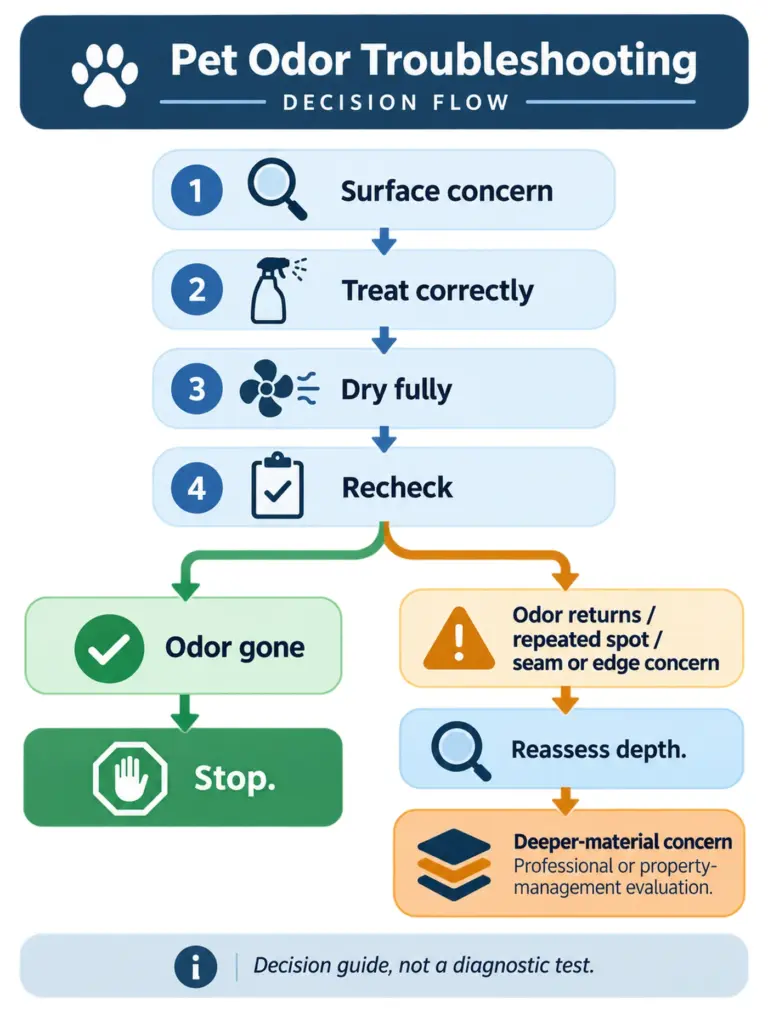
Use this decision path:
- If the accident was recent, localized, and the area has not been treated correctly yet, a surface-level cleanup may still be reasonable.
- If odor returns after full drying, the same spot has been repeatedly affected, or the smell is strongest near seams or edges, deeper material involvement becomes more plausible.
- If several correct treatments have failed, the carpet is landlord-owned, the odor existed before you moved in, or padding/subfloor involvement is suspected, stop repeating surface treatment and consider professional or property-management escalation.
First: What “Carpet Padding” Means
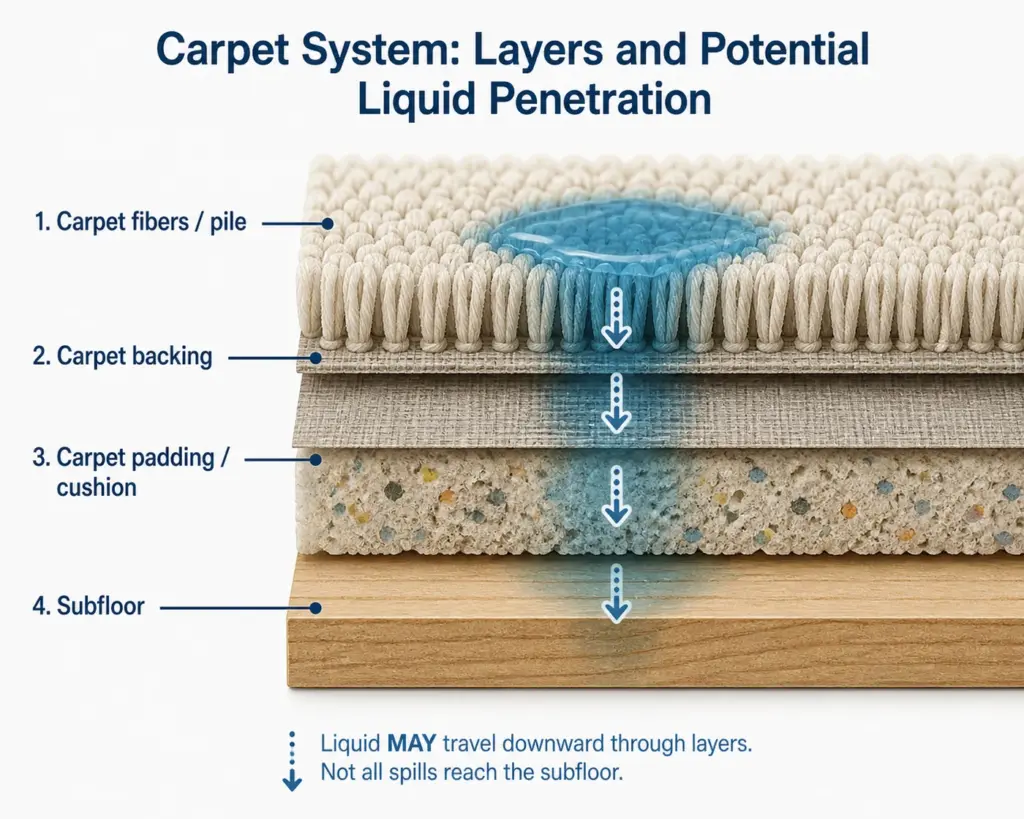
Wall-to-wall carpet is not just one soft layer. A typical installed carpet system may include visible carpet fibers or pile, backing that holds the carpet structure together, carpet padding or cushion beneath it, and a subfloor below that.
The Carpet and Rug Institute’s pet urine technical bulletin explains that pet urine can affect carpet in several ways, including odor, staining, backing separation, and seam vulnerability when urine is left unattended. It also notes that some carpet backings are designed to resist spills and help prevent liquid from reaching cushion or subfloor, which is a useful reminder: carpet construction varies.
That matters because liquid does not always stay where you can see it. A small, quickly blotted accident may remain mostly in the upper carpet fibers. A larger accident, repeated accident, or over-wet cleaning attempt may allow moisture and residue to move lower.
This does not mean every urine accident reaches padding. It means the possibility depends on volume, time, surface type, prior cleaning, drying, and where the odor is now strongest.
The Depth-Concern Decision System
Use these levels as decision signals, not as a diagnosis.
Level A: Surface Problem Still Plausible
A surface-level issue is still plausible when the accident was recent, the spot is small and localized, and the area has not yet been cleaned according to a suitable product label.
This level also fits when the odor does not return after the area dries completely, the smell is strongest only at the original visible spot, and there is no history of repeated accidents in the same location.
In this situation, the next step is usually careful surface treatment, full drying, and rechecking before escalating.
Level B: Deeper Material Concern
A deeper-material concern becomes more reasonable when the odor returns after the carpet seems dry, the same area has been affected multiple times, or the odor seems larger than the visible stain.
Other clues include smell that is strongest around seams, carpet edges, baseboards, or a corner where liquid may have moved outward or downward. Prior surface-only cleaning can also matter if it removed the visible mark but did not reach the actual odor source.
This is the point where repeating the same cleaning step may waste time.
Level C: DIY Limit or Escalation
Escalation becomes more sensible when multiple correct treatments have failed, the odor is room-wide, the carpet is landlord-owned, or the problem may have existed before your current pet.
It also applies when padding is not safely accessible, the carpet has been heavily saturated, nearby baseboards or wall edges may be involved, or you do not know what chemicals were already used.
At this level, the safest next step may be documentation, professional evaluation, or property-management contact rather than more cleaner.
Pet Urine Smell in Carpet Padding: Signs to Check
The phrase “signs” needs a careful boundary. These are clues that deeper involvement may be possible. They are not proof.
The odor returns after full drying
If a carpet smells better while damp but the odor returns after it dries, residue may still be present somewhere in the material. That could be lower fibers, backing, padding, seams, or nearby porous material.
Drying matters because wet carpet can temporarily change how odors move. The Carpet and Rug Institute notes that cat urine odor may reappear in times of high humidity if urine is not completely removed. The cautious takeaway is simple: do not judge the result until the area has fully dried.
The same spot has been affected more than once
Repeated accidents raise the concern level because each event can add more liquid and residue to the same area. Even if each individual accident looked small, the cumulative effect may be different.
This is common in apartment corners, near litter boxes, beside dog pads, near bedroom doors, or around furniture legs where a pet returns to the same location.
The smell is strongest near seams or edges
A smell that concentrates at seams, thresholds, carpet edges, or baseboards deserves extra caution. These areas can behave differently from the center of a carpeted room. Liquid may move along an edge, into a gap, or toward an adjacent material.
The CRI bulletin specifically notes that seam areas can be vulnerable when pet urine is left unattended. Do not pull up carpet in a rental to check this. Just record the pattern and use it in your next decision.
The odor area is larger than the visible stain
Visible staining can understate the affected area. Liquid can spread outward or downward before it dries, especially if the spot was not found immediately.
This does not automatically mean padding is affected. It does mean treating only the visible center may miss the real source.
The carpet has been repeatedly saturated
Heavy wetting can create a new problem: the carpet may take longer to dry, and excess moisture can carry residues deeper. Manufacturer and carpet-cleaning instructions commonly emphasize following label directions, using compatible surfaces, and allowing adequate drying.
If you have already soaked the same area several times, pause before adding more liquid.
The odor existed before your current pet
In a newly rented apartment, a pet urine smell may not come from your current pet at all. Previous-tenant contamination, old cleaning residue, or hidden flooring history can complicate the source.
Document what you notice, where it is strongest, and when you first noticed it. Avoid assuming the current animal caused it.
Why the Smell Can Come Back
Pet urine odor can return when the urine source was not completely removed. In some cases, residue may remain in lower carpet fibers, backing, padding, seams, baseboard-adjacent material, or nearby porous surfaces even after the visible surface looks clean.
Another possibility is incomplete drying. A carpet may feel dry on top while lower materials still hold moisture. That is one reason repeated treatment without enough drying time can make decisions harder.
Cleaning history also matters. If a deodorizer covered the smell, if a cleaner was not compatible with the surface, or if several products were layered, the odor picture can become confusing.
The important point: returning odor tells you to reassess the source. It does not tell you exactly which layer is affected.
What Treatment History Tells You
Treatment history is one of the most useful clues because it tells you whether the prior attempt was a fair test or only a partial attempt.
If the first treatment did not follow the label
If the cleaner was applied too lightly, wiped away too soon, used on the wrong surface, or judged before the instructed drying period, the failed result may not mean the problem is below the carpet. It may mean the treatment was never given a real chance.
Official directions should control the next step. For example, pet-stain products from brands such as Nature’s Miracle and Simple Green give product-specific directions, surface cautions, and safety instructions. The exact product label matters more than generic internet advice.
Decision impact: a careful, label-following re-treatment may still be reasonable if the spot is localized and there are no strong deeper-material clues.
If only the visible center was treated
Urine does not always stay inside the visible stain boundary. Treating only the center can leave residue around the edge of the affected area, especially if the accident sat for a while before discovery.
Decision impact: before escalating, reassess the full odor area. The next step may be treating the full affected zone according to label directions, not just adding more product to the center.
If the carpet was repeatedly saturated
Repeated saturation changes the decision because you are no longer dealing only with the original urine event. You may also be dealing with moisture, residue from prior cleaners, slow drying, or a larger affected area created by over-wetting.
Decision impact: stop and let the area dry fully before deciding anything. If several heavy applications have already failed, more liquid is less likely to be the smartest next move.
If several products were layered
Layered products make the situation harder to read. A fragrance product may mask odor. A detergent may leave residue. A disinfectant or household cleaner may not be appropriate for the carpet. A later pet-urine cleaner may be applied over unknown residue.
This is not a chemistry lesson and it is not a reason to panic. It is a decision signal.
Decision impact: avoid adding another product until you know what was used, whether the area is dry, and whether the next product is compatible. If you are unsure whether cleaners were mixed unsafely, stop and follow basic safety guidance rather than improvising.
If the area was judged before it fully dried
A damp carpet can smell different from a dry carpet. It may smell temporarily better, temporarily worse, or simply different. Judging too early can lead to unnecessary repeat treatment.
Decision impact: wait until the area is fully dry before deciding whether the odor truly returned.
If the same spot is repeatedly affected
A repeated spot suggests the problem may be behavioral, access-related, or source-related, not just cleaning-related. In an apartment, that spot may be a corner, a doorway, a litter-box-adjacent area, or a dog-pad area.
Decision impact: cleaning alone may not solve the recurrence if the pet continues returning to the same location. The odor decision and the prevention decision need to happen together.
How to Map the Odor Area Without Pulling Up Carpet
Mapping is renter-friendly because it helps you make better decisions without damaging the flooring.
Start when the carpet is dry. Walk the room slowly and identify the strongest point. Is it the center of a visible spot, the edge of the spot, a seam, a baseboard, under furniture, or a corner?
Mark the general area on paper, not on the carpet. A simple sketch is enough. Draw the room shape, furniture, doorways, baseboards, and the strongest odor points.
Then separate the pattern:
- One clear spot
- One spot plus a wider edge
- Several separate spots
- Odor strongest near a seam
- Odor strongest near a baseboard
- Odor strongest under furniture
- Room-wide odor with no clear point
This map does not confirm padding contamination. Its purpose is documentation and decision-making.
A single dry spot with a clear center may still be a surface-level problem. A seam or baseboard pattern raises the need for caution. Several locations may mean source mapping should happen before more cleaning. A room-wide odor in a rental may point toward property-history questions rather than one current accident.
If you later contact a professional or property manager, this map is more useful than saying, “The whole room smells.” It gives them a starting point.
Before You Treat Again Checklist
Use this checklist before adding any more liquid or cleaner.
- Is the area fully dry?
- Do I know what was already used?
- Was the prior product labeled for carpet?
- Was the prior product appropriate for pet urine?
- Were the directions followed closely?
- Was only the visible center treated?
- Is the smell strongest at a seam, edge, baseboard, or under furniture?
- Is this the same repeated spot?
- Are there several affected areas?
- Is the carpet landlord-owned?
- Did the odor exist before my current pet?
- Are there signs that broader or deeper material may be involved?
If most answers point to a small, recent, localized, under-treated spot, choose re-treat.
If the answers are unclear, choose recheck: dry fully, map the odor, review products, and avoid layering.
If answers point to repeated failure, landlord-owned flooring, old odor, seam/baseboard concentration, or several affected areas, choose escalate.
Should You Treat the Carpet Again?
Treating again may be reasonable when the source is localized, the first attempt did not follow the product label, the area is fully dry, the surface is compatible, and there are no strong clues of broader or deeper involvement.
For example, if a dog had one accident on a small bedroom carpet area, you blotted quickly, used very little cleaner, and the odor is only at that spot, a careful label-following treatment may still make sense.
Stop repeating surface treatment when multiple correct treatments have already failed, the odor returns after full drying, multiple locations are involved, deeper material involvement is strongly suspected, unknown products were layered, or landlord-owned flooring may require permission before deeper work.
A useful rule is not “try exactly three times.” It is: if each attempt is less likely to reach the suspected source, more of the same is unlikely to become the answer.
Apartment and Renter Scenarios
Studio apartment, one fresh spot
A small studio can make odor feel intense because you are close to the source. If the accident is fresh, localized, and the carpet has not been repeatedly soaked, start with a surface workflow, dry fully, and recheck.
Do not jump straight to “the padding is ruined” from one smell in a small room.
One-bedroom rental, same corner repeatedly affected
If a pet returns to the same corner, deeper concern rises. The repeated location matters more than the size of one visible mark.
Map the area, stop broad spraying, and consider whether behavior management, access control, or a deeper cleaning decision is needed.
Newly rented apartment, odor existed before your pet
If the odor was present before your pet had access to the room, document it. Take notes, photos of visible conditions, and dates.
This is not legal advice, but in a rental, you should avoid destructive inspection or carpet lifting without permission.
Wall-to-wall carpet near a baseboard
Odor near a baseboard can involve edges or adjacent material. Do not pull up landlord-owned carpet or pry trim loose.
This is a good situation for careful documentation and property-management discussion.
Multi-pet apartment with several unknown spots
When there are several cats or dogs, do not treat the entire carpet repeatedly without mapping likely sources. Identify the strongest areas first, separate fresh spots from recurring ones, and avoid creating a wet, over-treated room.
What a Professional Can and Cannot Tell You
A carpet or flooring professional may help evaluate the affected area, the likely cleaning options, whether the carpet construction limits access, and whether replacement is being considered. A professional may also help separate a surface-cleaning problem from a material-condition problem.
A good evaluation may include questions about the carpet type, where the smell is strongest, what has already been used, whether the area was repeatedly saturated, and whether the carpet is installed wall-to-wall or as a removable rug.
But there are limits. A professional cannot always guarantee odor removal. Surface appearance does not always reveal what happened below the pile. Results depend on the carpet, backing, padding, subfloor, age of the accident, prior treatments, access, and whether the source can actually be reached.
That is why escalation should not be framed as “hire someone and it will definitely be fixed.” It is better understood as: get better information before causing more damage or wasting more treatments.
When to Escalate
Professional or property escalation may be reasonable when the affected area is large, the odor returns after multiple correct attempts, the carpet is landlord-owned, or the problem may involve padding, subfloor, baseboards, or previous-tenant history.
The right professional depends on the situation. A carpet cleaner may help evaluate cleaning options and extraction. A flooring professional may help when replacement or material condition is the question. Property management or a landlord may need to be involved for rental carpet, hidden damage, or replacement decisions.
Ask practical questions:
- Can you evaluate whether the odor source may extend below the carpet fibers?
- Is the padding accessible without damaging the installation?
- What carpet, cushion, and subfloor materials are involved?
- What prior products or treatments should be disclosed?
- Is cleaning, partial replacement, or full replacement being considered?
- What needs to dry before the result can be judged?
Do not expect a guarantee. Professional cleaning may help, but it cannot always remove odor if the source is inaccessible, severe, old, or in materials that cannot be cleaned effectively.
What Not to Do
Do not keep layering cleaners just because the odor is frustrating.
Do not mix cleaning products. The CDC and Poison Control warn against unsafe cleaner combinations, especially bleach with other cleaners or disinfectants.
Do not lift rental carpet without permission.
Do not assume stronger chemical means deeper cleaning.
Do not repeatedly saturate the area without understanding drying, surface compatibility, and label directions.
Do not use the smell alone as proof that padding or subfloor must be replaced.
Where Enzyme Cleaners Fit
A surface-compatible pet urine cleaner may still be useful if the affected material can actually be reached according to the label. This is why product directions matter so much.
If the odor source is only in the upper carpet fibers, a suitable label-following product may help. If the source is below what the product can reach, another surface application may not solve the problem.
If the affected material is reachable and another method decision is appropriate, compare enzyme cleaner versus carpet cleaner for pet urine.
This page is not a product ranking. The decision here is whether the problem is still reachable and whether another treatment attempt is sensible.
A Simple Treat-Again vs Escalate Table
| Situation | Surface treatment still reasonable? | Why |
|---|---|---|
| One recent, localized accident | Yes, if label directions were not already followed | Source may still be in reachable fibers |
| Odor returns only after full drying | Maybe | Reassess before adding more liquid |
| Same spot affected repeatedly | Caution | Deeper or wider residue becomes more plausible |
| Odor strongest at seams or baseboards | Caution / escalate | Edges and adjacent material may be involved |
| Multiple correct treatments failed | Usually stop repeating | More of the same may not reach the source |
| Landlord-owned wall-to-wall carpet | Escalate before invasive work | Permission and property handling matter |
| Odor existed before move-in | Document and escalate | Source may predate current pet |
What to Document Before You Escalate
Before you contact a carpet cleaner, flooring professional, landlord, or property manager, write down the information that would help someone understand the problem without guessing from scratch.
Start with location. Note the exact room, the strongest odor point, and whether the smell seems centered in one spot, spread around an edge, concentrated near a seam, strongest at a baseboard, or present in several separate areas. If the carpet was recently wet, note that too. A dry recheck is more useful than judging the area while moisture is still changing the smell.
Next, record history. When did you first notice the odor? Was there a known accident, repeated accidents in the same spot, or an odor that existed before move-in or before your current pet had access to the room? If you know what products were used, list them in order and include the approximate number of treatment attempts. Mention whether the full affected area was treated or only the visible center.
If there is visible staining, loose carpet, seam damage, baseboard swelling, or flooring wear, photos can help document condition. Do not lift carpet, cut padding, pry trim, or damage rental flooring to investigate.
This documentation does not prove carpet padding is contaminated. It gives the next person a clearer treatment history and location map, which can reduce repeated guesswork, unnecessary extra cleaning, and avoidable conflict about what happened when.
The Practical Next Step
If the accident is fresh and localized, use the correct surface workflow, follow the product label, dry fully, and recheck.
If the odor keeps returning, slow down and map the source. Look at treatment history, repeated locations, seams, edges, and drying. Decide whether the evidence still points to a surface problem or whether pet urine smell in carpet padding is plausible enough to stop repeating the same treatment.
If the carpet belongs to a landlord, the odor predates your pet, or deeper material involvement seems likely, documentation and escalation are usually safer than more DIY saturation.
The best outcome is not always “clean harder.” Sometimes the best outcome is knowing when the problem is no longer a simple surface-cleaning job.