If you’re wondering what not to use on pet urine smell, start with one rule: do not mix cleaning products.
Pet urine odor can make people reach for the strongest cleaner nearby. In a small apartment, that can create two problems at once: you may add a real safety risk, and you may make the original urine source harder to understand.
This guide is not a list of “everything you should never use.” Some choices are dangerous when mixed. Some are simply the wrong tool for the surface. Some may only cover odor for a while.
A better question is:
Is this a clear safety risk, a surface or product compatibility issue, or just a weak odor-control shortcut?
Table of Contents
Quick Answer
For pet urine smell, do not mix cleaning products. Be especially careful with bleach, ammonia-based cleaners, acids such as vinegar, disinfectants, and unknown DIY mixtures.
Use this simple system:
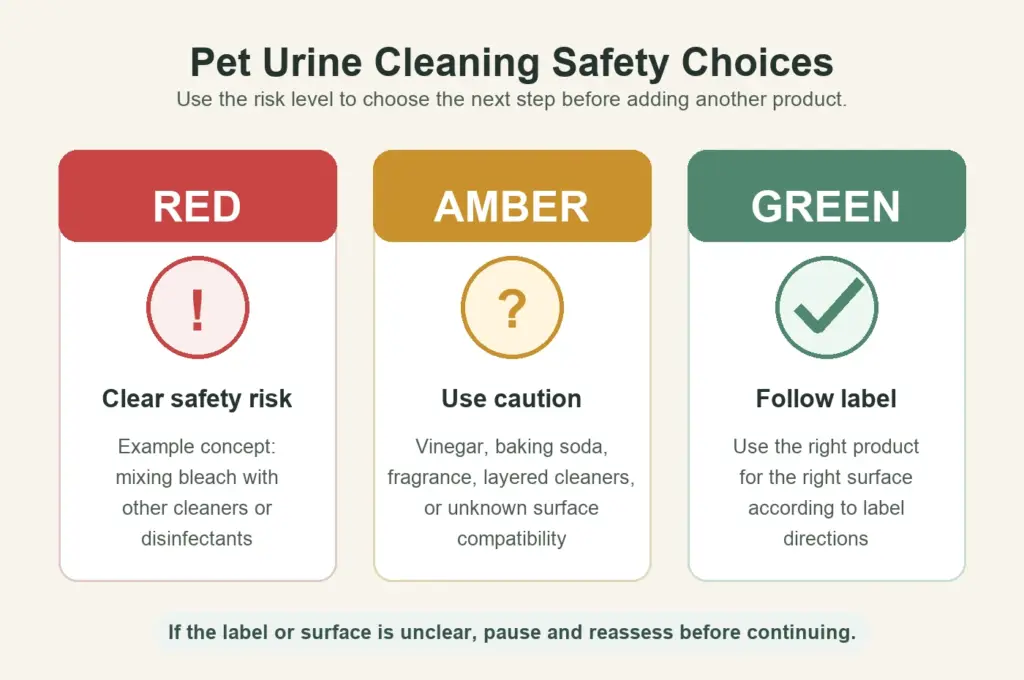
- Red: clear safety risk.
- Amber: may be the wrong product, method, sequence, or surface choice.
- Green: a surface-compatible product used according to its actual label.
If you are unsure what was already applied, stop adding products, ventilate as directed, keep pets away from wet treated areas when the label says to, and reassess the source before trying something stronger.
The Three Risk Levels
Not every bad cleaning choice is bad in the same way.
| Level | What It Means | Example |
|---|---|---|
| Red | Clear, evidence-supported safety risk | Mixing bleach with ammonia, vinegar, or other household cleaners |
| Amber | Not automatically dangerous, but may be the wrong fit | Vinegar on some surfaces, fragrance sprays, baking soda as a source-removal substitute |
| Green | Product and surface match, used by label | A pet urine cleaner used on a compatible surface according to its directions |
The goal is not to panic. The goal is to avoid turning one urine spot into a chemical, surface, or odor-diagnosis problem.
Never Mix Cleaning Products
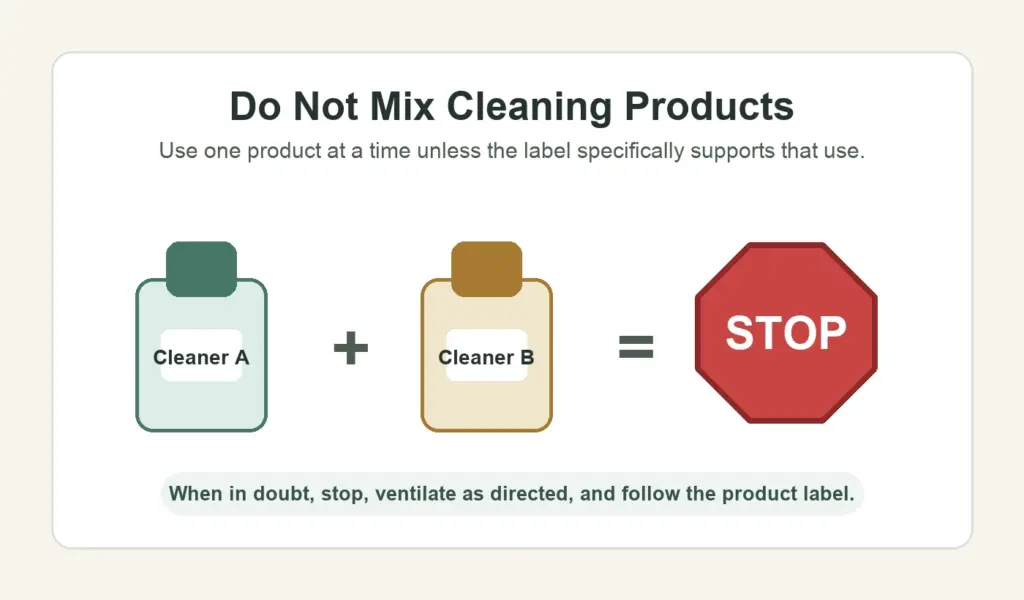
The safest rule for pet urine cleanup is simple: do not layer random cleaners.
The CDC’s bleach guidance says household bleach and disinfectants should not be mixed with other cleaners or disinfectants because dangerous vapors can be released. Poison Control also warns against mixing bleach with chemicals such as ammonia, and its vinegar guidance explains that bleach and vinegar can release irritating chlorine gas.
In an apartment, ventilation options may be limited, so follow ventilation directions carefully and stop cleaning if strong fumes develop.
Better next step: use one product at a time, follow the label, ventilate as directed, and let the area dry before judging whether another step is needed.
Bleach: The Mixing Risk Matters Most
Bleach is not automatically the answer to pet urine smell.
The clearest risk is mixing. Never mix household bleach with other cleaners or disinfectants. That includes ammonia-based cleaners, vinegar or other acids, toilet cleaners, disinfectants, and unknown DIY mixtures.
This does not mean bleach is universally forbidden for every surface or every cleaning task. The point is narrower and stronger:
Bleach mixing = clear safety risk.
Bleach is also a disinfectant, not a universal odor-source remover. A urine odor problem may involve carpet fibers, backing, padding, seams, wood, or upholstery. Stronger disinfection does not automatically mean the odor source has been removed.
Better next step: if a disinfectant is truly needed, follow the label exactly and use it only on surfaces where it is appropriate. For urine odor, source removal usually matters more than adding a stronger chemical.
What About Ammonia?
Ammonia needs careful wording.
There are two different things people often mix together:
- ammonia-based cleaning products
- ammonia-like odor associated with old urine
Do not treat those as the same cleaning decision.
The main safety concern is mixing. The CDC ammonia fact sheet gives general safety context for ammonia exposure, and CDC bleach guidance separately warns not to mix bleach with other cleaners or disinfectants.
An ammonia-based cleaner used alone is not automatically the same level of risk as bleach mixed with ammonia. But it may still be the wrong tool for a pet urine odor problem if the label does not support that use, if bleach or another cleaner may already be present, or if it adds another strong odor that makes the source harder to judge.
Better next step: use ammonia-based products only when the product label and surface guidance clearly support that use. Otherwise, choose a product intended for pet urine on that surface.
Vinegar Is Not a Universal Answer
Vinegar is common in pet urine search results, but it does not belong in the “always safe” or “always useless” bucket.
For some carpet spot-cleaning contexts, the Carpet and Rug Institute pet urine bulletin includes a diluted white vinegar step as part of a specific carpet workflow. That does not mean vinegar is automatically right for every carpet, every old odor, every floor, or every product sequence.
Vinegar is acidic. Some flooring brands advise against it on certain surfaces or finishes. Bona advises against vinegar and water on wood floors because it can affect the finish over time. Shaw Floors also warns laminate owners to avoid strong ammoniated or chlorinated cleaners and excess liquid cleaning methods.
Better next step: treat vinegar as surface-dependent, not universal. Check carpet, flooring, or upholstery care guidance first. If a pet urine product label says to use that product first or avoid other cleaners, follow that label.
Baking Soda: Odor Control Is Not Source Removal
Baking soda is often used for odor absorption. That does not mean it removes the urine source.
If the issue is a light surface odor after wet cleanup is complete, an absorbent powder may make the area smell less noticeable. But if urine reached carpet backing, padding, a seam, or nearby porous material, sprinkling powder on top does not prove the source is gone.
There is also a workflow issue. If you add powder while the area is still wet or before a cleaner has finished working, you may create residue that makes the next step harder.
Better next step: blot liquid first, use a compatible product as directed, allow full drying, then reassess. Do not use baking soda as a substitute for reaching the actual odor source.
Fragrance Can Hide the Problem
Air fresheners, fabric sprays, scented powders, and heavily perfumed cleaners can make a room smell better for a short time. That can be useful for comfort, but it is not the same as urine removal.
The Carpet and Rug Institute notes that some odor products may simply mask the odor. In a small apartment, masking can be especially confusing because the room may smell different while the original urine source still exists.
Better next step: use fragrance only as a comfort layer after the source is addressed, not as the main cleanup method.
Why Layering Cleaners Makes Cleanup Harder
A common pet urine cleanup mistake looks like this:
Cleaner A → vinegar → baking soda → disinfectant → fragrance → enzyme product
That sequence creates two different problems.
First, there is a safety problem. Incompatible chemicals may create a hazard, especially when bleach, ammonia, acids, disinfectants, or unknown residues are involved.
Second, there is a workflow problem. Once several products are layered, you may no longer know:
- what reached the urine source
- what is still wet
- which residue is present
- whether a later treatment is compatible
- whether the surface has been affected
- which label directions still apply
Product directions often assume you are applying the product to the urine source, not to a stack of previous cleaners. Simple Green’s pet stain remover directions tell users to spot test first, avoid saturating wood or laminate, and let the area dry. Nature’s Miracle directions also emphasize testing surfaces, using the product as directed, and keeping people and pets off treated areas until dry.
Better next step: stop, blot or remove what you safely can, ventilate if there are fumes, and restart with one label-directed plan.
Steam, Hot Water, and Machine Cleaning
Do not assume “hotter” or “stronger machine cleaning” is automatically better.
For carpet urine spots, the Carpet and Rug Institute’s carpet maintenance guidance specifically advises against using a steam cleaner on urine spots because heat can set the stain and smell. That is carpet-spot guidance. It should not be stretched into “steam is always bad for every pet urine problem on every surface.”
For laminate, wood, or other flooring, the question is different. Surface guidance matters. Shaw’s laminate care guidance warns against wet mopping and certain strong cleaners. Bona’s wood floor guidance warns against vinegar and excess water on wood finishes.
Resolve Urine Destroyer tells users to test hidden fabric for colorfastness and follow the product’s use directions. Other carpet machine formulas may have different instructions.
Better next step: check the carpet guidance, flooring care instructions, equipment manual, and product label before using heat, hot water, or extraction. This section is a safety and compatibility guardrail, not a product-class comparison.
Surface Compatibility Matters
A cleaner can be acceptable for one surface and wrong for another.
Pet urine may affect:
- wall-to-wall rental carpet
- carpet backing
- padding
- laminate
- wood finish
- upholstery
- dyed fabric
- rugs
- seams and edges
Simple Green says its pet stain remover should be spot tested and should not be applied to silk, velvet, or leather. Nature’s Miracle says to test for colorfastness and avoid surfaces such as untreated hardwood, leather, suede, silk, and specialty fabrics. Resolve tells users to test a hidden section for colorfastness before cleaning.
Better next step: before using any cleaner, ask three questions:
- Is this product meant for pet urine?
- Is this surface listed as compatible?
- Does the label tell me how long to leave it wet, whether to rinse, and when pets can return?
If the answer is unclear, do not guess on a landlord-owned floor or expensive fabric.
A Safer Decision Table
| Method / Product | Risk Level | Why It May Be a Problem | Better Next Step |
|---|---|---|---|
| Bleach mixed with ammonia | Red | Clear chemical-mixing risk | Do not mix; ventilate and follow safety guidance |
| Bleach mixed with vinegar or other acids | Red | Can release irritating chlorine gas | Do not mix household bleach with acids |
| Bleach mixed with other cleaners or disinfectants | Red | CDC warns against mixing disinfectants with other cleaners | Use one product by label directions |
| Bleach where unknown cleaner residue may already be present | Red | Incompatible residue may be present | Stop and identify what has already been used |
| Ammonia-based cleaner used alone | Amber | May be wrong for the surface or sequence; dangerous if bleach is involved | Use only if label and surface guidance support it |
| Vinegar | Amber | Surface-dependent; not a universal urine-source remover | Check surface guidance and product sequence |
| Baking soda | Amber | May absorb odor but does not prove source removal | Use only after wet cleanup if appropriate |
| Fragrance spray or deodorizer | Amber | Can mask odor while the source remains | Treat the source first |
| Multiple cleaners layered together | Amber / Red | Workflow confusion; safety risk if incompatible products are mixed | Stop adding products and reassess |
| Steam or hot-water machine | Amber | Carpet urine spot and flooring compatibility vary | Check CRI guidance, manual, label, and surface instructions |
| Pet urine cleaner used by label | Green | Best fit when surface-compatible and used correctly | Spot test, follow dwell/dry directions, and keep pets away if directed |
When to Stop DIY Experimenting
Stop adding products if:
- you smell strong chemical fumes
- bleach, ammonia, disinfectant, vinegar, or unknown cleaners may have been combined
- the area is still wet from another product
- the carpet feels sticky, powdery, or residue-heavy
- the odor returns after drying
- the surface is landlord-owned or easily damaged
- pets or children cannot be kept away from the treated area as directed
In a small apartment, stopping is not failure. It is often the safest way to avoid making the surface, air, or odor problem worse.
When the Problem Is Bigger Than Cleaning
If a pet repeatedly urinates indoors, cleanup is only one part of the situation.
For dogs, repeated apartment accidents may need a training or potty-area plan. ApartmentDogExpert has guides on how to potty train a dog in an apartment and indoor dog potty solutions.
For any pet, if indoor urination is new, repeated, or paired with health or behavior concerns, contact a veterinarian. This article is about cleanup safety, not diagnosis.
How to Decide What Not to Use on Pet Urine Smell Before You Start
The safest way to decide what not to use on pet urine smell is to pause before adding the second product. Many cleanup problems begin after the first attempt, when the area still smells and the next idea is stronger, wetter, more fragrant, or mixed with whatever is already there.
Use three questions before the next step: What product is already on the surface? What material am I treating? What does the label allow? If you cannot answer those questions, the safest next action is usually to stop, ventilate as directed, keep pets away from wet treated areas according to the label, and reassess after the area dries.
Common Apartment Cleanup Situations
Small bathroom or laundry corner: ventilation may be limited and surfaces may include tile, grout, laminate, painted trim, and washable mats. Do not assume one cleaner is safe for all of them. Use one product at a time and follow the surface directions.
Carpet near a sofa or bed: avoid turning a small spot into a larger wet area. Blot first when fresh, then use a compatible product according to its label. If several products have already been added, stop layering and let the area dry before deciding whether the source remains.
Hard floor with seams: liquid can move into edges, transitions, and gaps. A cleaner that is fine on one sealed surface may not be appropriate for another finish. Check the flooring guidance and avoid excess liquid.
Upholstery or cushion covers: fabric, fill, and removable covers may have different care rules. A strong cleaner that seems reasonable on a hard floor may be wrong for fabric or foam. Follow the furniture label or manufacturer care guidance when available.
Why “Natural” Does Not Automatically Mean Right
Vinegar, baking soda, fragrance, hot water, and DIY mixtures are often described as gentle or natural. That does not make them automatically right for pet urine odor. The important question is fit: fit for the surface, fit for the product sequence, fit for the actual source, and fit for the safety instructions.
Vinegar may appear in some carpet spot-cleaning workflows, but it is not universal. Baking soda may help with odor comfort after cleanup, but it does not prove the urine source is gone. Fragrance may make a room easier to tolerate, but it can hide whether the cleanup worked. Hot water or machine cleaning may be useful in some contexts, but it should not replace label directions or material care guidance.
When a Method Fails, Do Not Escalate Blindly
A failed first attempt does not mean the next step should be stronger. It may mean the treated area was too small, the cleaner did not reach the affected material, the surface was not compatible, the odor source is nearby rather than under the visible spot, or the area was judged before it fully dried.
- If odor is stronger after adding fragrance: stop masking and locate the source.
- If odor returns after drying: reassess the affected area instead of adding a random second cleaner.
- If the surface changes color or texture: stop and check material guidance before continuing.
- If you do not know what was already used: avoid bleach, disinfectant layering, ammonia products, acids, and unknown mixtures.
- If fumes or irritation occur: leave the area, ventilate if safe, and use poison-control or emergency guidance when appropriate.
What a Safer Sequence Looks Like
A safer sequence is boring on purpose. Identify the surface. Remove pets from the wet work area when the label says to. Blot fresh liquid instead of spreading it. Choose one compatible product. Follow the label. Let the area dry fully. Recheck the actual source. Only then decide whether another step is needed.
This page is not saying every household product is always dangerous. It is saying that pet urine odor cleanup gets riskier and less useful when products are mixed, layered, over-applied, or used on the wrong material. In an apartment, the margin for fumes, wet carpet, shared walls, and landlord-owned surfaces is smaller, so a slower decision is often the safer decision.
Where This Guide Stops
This guide covers safety and method guardrails. It does not rank enzyme cleaners, diagnose carpet padding damage, solve potty training, or explain why a pet is urinating outside the usual place. For actual carpet cleanup workflow, start with a cat urine smell in apartment carpet guide. Keeping the boundary clear helps you avoid both unsafe cleaning and the wrong next step.
Label-First Cleanup in a Small Home
A label-first approach is not just legal caution; it is practical apartment odor control. Product labels tell you where the cleaner can be used, how long it should remain wet, whether rinsing is needed, how to ventilate, and when people or pets can re-enter the treated area. If you skip those details, you can accidentally create the very problem you are trying to avoid: lingering odor, surface damage, residue, or unsafe exposure.
Before using a product, read for five things: surface compatibility, mixing warnings, dwell time, drying instructions, and pet or child access instructions. If any of those points are missing or unclear for your situation, do not improvise by adding another product. Choose a cleaner with clearer directions for the surface, or stop and get advice from the manufacturer, landlord, flooring documentation, or a qualified cleaning professional.
This is especially important when the urine spot is near a bed, sofa, crate, litter area, or walkway. In a small apartment, the treated area is rarely isolated. People and pets pass nearby, textiles touch the floor, and ventilation may be limited. The safest cleaning choice is often the one that creates the fewest unknowns: one compatible product, used by label, on one defined area, followed by full drying and a recheck.
Red, Amber, and Green Scenarios in Real Apartments
Red scenario: a urine spot still smells, and you are considering bleach after another cleaner, vinegar, disinfectant, or an unknown product was already applied. The decision is not “which stronger cleaner works?” The decision is to stop mixing, ventilate according to safety guidance, and avoid adding another reactive product. This is a safety-risk problem before it is an odor problem.
Amber scenario: you used vinegar, baking soda, fragrance, or a general-purpose cleaner, and the room smells better only temporarily. The issue may be ineffective source removal, product sequence, or surface compatibility. Do not escalate automatically to bleach or a machine. Reassess what surface is affected, what product is already there, and whether the actual urine source was reached.
Green scenario: you know the surface, the product label supports that surface and use case, no incompatible product has already been applied, and you can follow the dwell, ventilation, drying, and pet-access instructions. Green does not mean the product is magic. It means the next step has fewer unknowns and can be judged after proper drying.
I Already Used Several Cleaners. What Now?
If several cleaners have already touched the urine area, do not try to chemically “neutralize” the mixture yourself. This guide does not provide DIY neutralization instructions. The safer decision path is to stop adding products, keep pets away from the wet area according to product labels, ventilate as directed, and let the area dry if it is safe to do so. If there are strong fumes, irritation, or a suspected hazardous mix, follow Poison Control or emergency guidance instead of continuing cleanup.
After the area is dry and safe to approach, identify what information is still missing. Do you know every product that was used? Do you know the surface material? Did the odor return from the same spot, the edge, or a nearby textile? Is the floor landlord-owned? If the answer is unclear, the next step may be manufacturer guidance, landlord/property guidance, or professional cleaning advice rather than another home remedy.
This distinction matters in apartments because the treated area is close to daily life. A wet carpet spot may be beside a bed, sofa, crate, litter area, or main walkway. Limited ventilation, shared walls, pets, children, and rental surfaces make repeated experimentation a poor tradeoff. The safest useful cleanup is usually controlled, label-based, and easy to reverse if it does not work.
Sources
- CDC: Cleaning and Disinfecting with Bleach
- CDC: Ammonia Chemical Fact Sheet
- Poison Control: Bleach
- Poison Control: Vinegar
- EPA: Selected EPA-Registered Disinfectants
- Carpet and Rug Institute: Pet Urine and Carpet
- Carpet and Rug Institute: Cleaning and Maintenance
- Simple Green: Pet Stain & Odor Eliminator
- Nature’s Miracle: Stain and Odor Remover for Cats
- Bona: Avoid Water and Vinegar on Wood Floors
- Shaw Floors: Laminate Care
- Resolve: Urine Destroyer